Quick Index Pages

▼

10 december 2014

"The Radetzky March" by Joseph Roth (Book review)

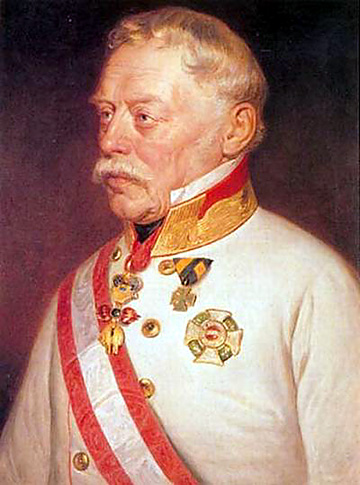
Who doesn't know the Radetzky March by Johann Strauss Sr., played annually as the last piece at the New Year's Concert from Vienna? This famous piece of music is dedicated to a war-horse of the Austro-Hungarian Empire, Bohemian-born Joseph Radetzky von Radetz, who during a 70-year long career first fought against Napoleon and finally ended up trying to suppress the First Italian War of Independence. He was a ruthless disciplinarian, but also idolized by his soldiers as "Vater Radetzky." Joseph Roth used "Radetzkymarsch" as the title for his greatest novel, written in 1932, because the march symbolizes the greatness of the perished Empire, while the protagonists actually also hear it played at important moments.

[Joseph Radetzky von Radetz,
the type of Austro-Hungarian "war horse"
that also figures in the novel - photo Wikipedia]

The novel tells the story of the rise and fall of three generations of the Trotta family, concentrating on the youngest and last member, Carl Joseph, and this is paralleled by the glory and subsequent disintegration of the empire in which they live and serve - in other words, the passing of the Old Europe into the modern world. The Trottas are professional Austro-Hungarian soldiers and career bureaucrats of Slovenian origin. Joseph Trotta, the patriarch, happened to famously save the life of the blundering Emperor, Franz Joseph I, by toppling him from his horse during the Battle of Solferino (1859), and was ennobled for his service, although his parents had been Slovenian farmers. After his promotion and ennoblement, Baron Joseph von Trotta degrades into rural obscurity, except for one anecdote where he demonstrates that he has always remained a naive peasant: he remonstrates (even to the level of the Emperor) against a textbook for use at schools where his deed is made more heroic than it was by changing some facts. As a result, the war hero stubbornly opposes his son Franz' aspirations to a military career, having him become a government official (district administrator in a Moravian town) instead - the second most respected career in the Austro-Hungarian Empire.  Like the first Baron, also the second Baron Trotta is a square and conservative man, a pillar of the nation, but also a rather nondescript government functionary. The grandson, Carl Joseph, has a character that is very different from his forefathers, but at the urging of his father joins the army - with consistently disastrous results. It is his fate to die in WWI, just before the destruction of the empire.

The life of Carl Joseph is not a happy one. He stands for the frivolous generation that lost the empire, addicted to the pleasures of the flesh, to drink and gambling. He has a relation with the wife of the police commander in the town where he has grown up and is shattered when she dies in child birth, especially when the husband openly returns a stack of his love letters. At his next post, he has an affair with the wife of his best friend, the Jewish military doctor; as a result, the doctor dies fighting a senseless duel. It seems as if everything Carl Joseph does falls apart under his hands. He sinks into despondency, becoming old before his time, and seeks forgetfulness in drinking and gambling. For the third time, he takes a married lover, and piles up gambling debts, living in an alcoholic daze in a remote military outpost near the border with Russia (the local drink is a sort of extremely strong vodka called "Ninety Degrees"). Just as he is about to permanently damage the family's honor and good name, the Emperor's son Franz Ferdinand is assassinated in Sarajevo and the Great War breaks out, to devour Carl Joseph's life and those of unnumbered others.

The Austrio-Hungarian Empire was a very authoritarian and hierarchical society. It was a world with a clear order, with clear rules and regulations. People knew who they were and what their place in the greater scheme of things was. This is especially clear in the early chapters where we see that Carl Joseph has been disciplined so by his father, the district administrator, that to any question his father poses he answers obediently "Yes, Pappa." The relation between father and son is so formal that the son doesn't talk when he is not invited to do so. When his father picks up some official documents, the son may read the paper, but he is careful to put this immediately away when his father looks up from his reading. Life has been regulated strictly, everything, such as meals, takes place at fixed times. Somehow, this strict and disciplined society reminded me of the Japan of the Meiji-period (1868-1912). And we also know this world from the descriptions in Stefan Zweig's The World of Yesterday (see my post about this book). It is of course not a very warm society and you can see the gulf that gapes between father and son - especially since for the son the old order ceases to have any meaning. For his father, being the district administrator and a pillar of the empire is his identity - he defines his life in terms of the social order and not in terms of his own being. But the times have changed and Carl Joseph is unable to do that. He is an individualist who simply floats through life, and unfortunately he has chosen the wrong occupation for the army doesn't suit him at all and the boredom even brings out the worst in him. His greatest problem is his lack of reflection, as a more thoughtful life might have brought him to new values.

[Emperor Franz Joseph I - from Wikipedia]

A fourth important character in the novel is the Emperor, Franz Joseph I, who is everywhere present in the form of his official portraits and who with his own unchangeability (he is over eighty years old) symbolizes the state of the realm. But he also meets all three Trottas in person and the fate of the barons seems inextricably linked to that of the Empire, tottering towards its destruction as the Emperor totters towards his grave.

Roth uses historical persons and events in a most imaginative way, that is, they only appear when they are important for the story and not the other way round. He relates the story in a supple style, somewhat understated and matter-of-fact, keeping a fast pace, and his voice is always full of compassion - he treats the death of a small thing like a canary with as much feeling as he does the death-throes of the great Empire.

This superb novel remained long in obscurity. In the Germanic countries, the 1930s were a time that another terrible war was brewing and people didn't have time to read about a previous one. The Nazis next forbade Roth's work because he was of Jewish ancestry. It is only in the last decades that Joseph Roth has been fully rehabilitated - Radetzkymarsch, for example, was in 2003 included in the canon of the most important German-language literary novels by the influential German critic Marcel Reich-Ranicki. The first English translation appeared in 1995 and as a result, the novel was widely acclaimed. The last twenty years have seen a great flow of Roth translations, especially by Michael Hofmann, who also made a second translation of Radetzkymarsch. For more about Joseph Roth, see my post about his last novella, The Legend of the Holy Drinker.  

The German original, Radetzkymarsch, is available from DTV (Deutscher Taschenbuch Verlag). It is also freely available as ebook from various internet sites, as the German Gutenberg site or the Internet Archive. 
The first English translation was made in 1995 by Joachim Neugroschel and is available from The Overlook Press as well as from Everyman's Library. A second translation was made in 2003 by Michael Hofmann (who has translated many works by Roth and is a great Roth advocate) and is available from Granta Books. I have read the novel in German, but a quick comparison of both translations with the original, shows that the translation by Hofmann is closest to Roth's style.


7 december 2014

Kounji Temple and its Garden

Although lying next to the much trodden Philosopher's Path (Tetsugaku no Michi) at the foot of the Higashiyama range in Shishigatani in Kyoto, Kounji is only open a few weeks each year and therefore happily free from tourist throngs. I had previously caught glimpses of its garden and also marveled at its huge tiled roof just below me when walking along the Philosopher's Path.

[Kounji Temple, Kyoto]

The temple in fact belongs to Nanzenji (as a outside subtemple), but originally came from Osaka where it was presumably founded in 1280 by Daimin Kokushi, the founder of Nanzenji. After it fell into disrepair due to various wars, in 1664 it was rebuilt and revived on the present site by the 280th abbot of Nanzenji, Eichu. The present main hall and belfry still date from that period, but most other buildings and land were lost in the mists of modern history.

Kounji was in fact re-established in 1664 as the family temple of Tofukumonin (Tokugawa Masako, 1607-1678), the daughter of the second Tokugawa shogun Hidetada and consort of Emperor Gomizunoo. She was the mother of Empress Meisho (reigned from 1629-1643), the seventh out of only eight women to occupy the Chrysanthemum Throne. Empress Meisho dedicated the above mentioned belfry to the temple. Tofukumonin was an important patron of the arts and used her wealth to help restore many temples and other significant buildings that had been damaged or destroyed during the centuries of internal wars that had ended with the peace of the Tokugawas.

[Garden of Kounji Temple]

The main image of the temple is a serene Shaka statue with two disciples. There is also a very fine Sho Kannon statue that used to be the object of personal devotions of Tofukumonin. The high and spacious main hall also houses a statue of Tofukumonin herself, clad in imperial robes and with a golden crown on her head.

[Stepping stones - Garden of Kounji Temple]

The small but exquisite garden of Kounji already existed in the 18th century, as it is mentioned in travelogues of that period, but it only took its present shape under the hands of the famous modern garden master Ogawa Jihei VII (Ueji; 1860-1933). Ogawa Jihei was also responsible for the gardens of the Heian Shrine, the Murinan Garden and Maruyama Park, where he worked with water as he did in Kounji. He restored the Kounji garden in 1927. It is a pond stroll garden with the Higashiyama hills as borrowed scenery (visitors have to view the garden from the temple, it is not possible to enter it; but as it is quite small, that is in fact a wise arrangement).

Kounji serves as the Nanzenji Zen Center and also offers Zazen sessions (English website of the head priest, Tanaka Kanju). Kounji lies just west of the southern end of the Philosopher's Path, not far from the Eikando Temple. It is only open to general visitors for a few weeks in autumn, at the end of November.

2 december 2014

The Japanese Seasons: December

The twelfth month is traditionally called Shiwasu. This name is often explained as "Buddhist priests (shi) busily running around (hasu, wasu) to hold year-end Buddhist services in people's houses" - something which etymologically doesn't sound very convincing, but there seems to be no better explanation for the poetical name of the twelfth month. It is the season that the trees shed their leaves (ochiba), although - depending on the weather - the momiji can still be beautiful in early December. But winter inexorably deepens and the sunlight becomes weaker - although never as weak as in my native north-western Europe where it can remain almost dark the whole day. There are more winter showers and a cold north wind starts blowing. Temperatures are around 12ºC in the afternoon and drop to about 5ºC in the morning and at night.

One of the seasonal points is called Daisetsu, Great Snow, around the 7th or 8th of December, when winter is deemed to be starting in earnest. Fifteen days later, on the 22nd or 23rd of December falls Toji, the winter solstice, with the shortest day time and longest night time of the year. There is an old belief that taking a bath with yuzu citrus floating in it (yuzu-yu) will help one stay healthy through the cold winter. Another winter solstice custom is to eat kabocha squash.

[Yuzu]

After November with its enjoyment of nature by way of viewing the gorgeous autumn colors, December is a rather colorless and above all busy month. The 13th of December is called Kotohajime, the Start of Preparations for the New Year, a custom originating in Edo Castle in the Edo period. The first thing to do is housecleaning (soji), not only in order to start the new year with a spic-and-span dwelling, but also as a sort of ritual cleansing of the evil that may have accumulated in the house during the year. At Nishi Honganji Temple in Kyoto Buddhist priests clean the dust away in the huge temple on December 20 in a ritual called Susuharai.

People may also be busy buying and sending out Seibo or Year-End Gifts. Oseibo are given to persons who have supported one personally or professionally during the past year and are generally of a higher value than the summer gifts (Ochugen). Usually expensive food items are bought, of course nicely packaged - many companies devise special gift sets for Oseibo. The busiest time of Oseibo shopping is from early through mid-December when the winter bonus is paid to workers of companies and government agencies.

In December, people are also kept busy with Bonenkai or Year-End Parties. These are held with colleagues or friends to forget the hardships of the past year, to thank each other and ask for continued support in the new year. Depending on the size of one's social network, some people have to attend many of these parties and as the drinking is usually quite heavy, there are a lot of people suffering from head-aches during the daytime.

[Kadomatsu]

At the end of December, but before the 28th, the New Year Decorations such as Kadomatsu have to be put up by the entrance to welcome the God of the New Year (Toshigami). This has to be done early so that the deity can be welcomed in a relaxed way. Kadomatsu are placed in pairs on both sides of entrances to homes, shops, offices, etc. These consist of three diagonally cut bamboo poles of varying length, symbolizing strength and growth, and pine branches which symbolize long life, bound with a newly woven straw rope and sitting on a straw mat at the bottom. As these are very expensive, ordinary homes instead may only put up Shimekazari: a small rope made from rice straw (shimenawa), with zigzag-shaped paper strips called shide, small pine branches and a citrus fruit as the daidai to add color - these are hung above doorways, both inside and outside the house, and serve to keep bad spirits away.

Also around the 28th of December (the exact date can become earlier when it happens to be in a weekend) falls Goyo Osame, "Concluding the Year's Work," by the employees of public organizations and government agencies. In companies, this is called shigoto osame. The work of the year is formally completed, so that one can make a fresh start in the new year. 

[Kera-mairi - lighting the rope with the sacred fire]

Then comes December 31 or New Year's Eve, in Japan called Omisoka. People stay up late and many visit a shrine or temple at midnight to make an auspicious start of the new year. One way to spend the long evening is to watch Kohaku Utagassen, the Red vs. White Song Competition, which is broadcast live by NHK since 1951.  In the four hour long show a red (female) and white (male) team each consisting of about 25 of the most popular artists of the year compete in acts that are often the highlights of a singer's career. New Year's Eve is also the time to eat Toshikoshi Soba, buckwheat noodles, something which originally started as a simple and quick dish for merchants who were still busy settling their books on this day, but which now continues because of the expression "to live long like a soba noodle." Finally, at midnight on New Year's Eve, temple bells are rung 108 times to eliminate the 108 delusions and false attachments to which human beings are subject. This is called Joya no kane. There are many temples where visitors can join in ringing the bell. A nice custom exists in the Yasaka Shrine in Kyoto, where on New Year's Eve watch fires and toro lanterns are lit using the roots of a medicinal herb called Okera, which is believed to help cast away evil influences from the past year. This festival is called Okera-Mairi. In the past, visitors used to take back embers from this fire to prepare the ozoni for New Year. Nowadays, visitors can buy a bamboo rope and kindle this symbolically with the herbal root fire. You have to keep swinging the rope to keep the fuse burning, and it is a nice sight to see people walking in the darkness with those small red flames - although it is now impractical to take these ropes home.

There are several other festivals in December. One, also in Kyoto, is the Kyoto Minamiza Kichirei Kaomise, or the annual Appearance of the All-Star Cast of Kabuki at the Minamiza Theater. It is a stage for actors from east and west Japan to meet each other and also a greeting by the cast to the audience, asking for their continued patronage.

December is also the month of Chushingura or the story of the Forty-seven Ronin (see my post about Chushingura elsewhere at this blog). This tale of feudal loyalty, based on a historical incident, has inspired countless media, from kabuki and bunraku to film, theater, novels and manga. The Forty-seven Ronin refers to the 47 loyal retainers of Lord Asano of the Ako clan, led by Oishi Kuranosuke. As their revenge on Asano's rival, Kira Yoshinao, took place on a snowy night on December 14, this has become the day of the Gishisai or Festival of the Loyal Retainers at Sengakuji Temple in Tokyo - Sengakuji is the temple where they and (some years earlier) Lord Asano himself were buried after committing seppuku. On December 14, many people visit their graves and also come to watch a parade of persons dressed up as these 47 loyal retainers. (In Ako in Hyogo Prefecture, the location of the castle of Lord Asano, a similar parade is held on the same date).

[Hagoita Market, Sensoji, Tokyo]

A more bright event are the Hagoita Markets (Hagoita Ichi) held throughout Japan from mid-December. A hagoita is a paddle used in the game called hanetsuki, a sort of badminton which in the past was a popular pastime at New Year. However, the hagoita sold at these markets today are purely ornamental - they are beautifully decorated with pasted pictures of Kabuki heroes, geisha, film/TV stars and anime characters. By far the largest and most famous Hagoita Market is held in the Sensoji Temple in Tokyo from Dec. 17 through 19.

The flower of December is the tsubaki (sancha) or camellia, an evergreen shrub with flowers that range from white via pink to deep red. Depending on the sort, tsubaki can bloom either in winter or in spring. The winter type starts blooming in October, keeps blooming during winter, and looses it flowers in spring. The flower is indigenous in China and Japan and was brought to Europe by the German botanist Engelbert Kaempfer, who called them "Japan Roses." In the 19th century it was a popular luxury flower in Europe, as appears from Dumas' La Dame aux camélias.

[Tsubaki]

A popular fruit of December is the yuzu, which was already mentioned above. Winter is also the time that enormous amounts of mikan, Japanese mandarins, are consumed. Typical vegetables of December are shungiku (kikuna), edible chrysanthemum leaves, which add a bitter note to stews and one-pot dishes, and of course the versatile daikon or giant white radish that is eaten boiled in various dishes. Several temples and shrines in Kyoto have days that they serve daikon-daki, boiled slices of daikon, often with abura-age, for example Daihoonji (also called Senbon Shakado, Dec. 7 & 8) or Ryotokuji (Dec. 9 & 10).

A popular fish of December, finally, is buri or yellowtail, This is an auspicious fish that has its name changed as it grows from infant to adult as though it were given a "promotion." It is also a must for the New year dinner in West Japan, and often used as a year-end gift.

30 november 2014

Rue des Boutiques Obscures (Missing Person, 1978) by Patrick Modiano

The Nobel Committee in Sweden doesn't always get it right - and they have their own agenda which is narrower than the total range of literature - but their choices are usually well worth checking out. It were Nobel Prizes that initially attracted my attention to José Saramago and J. M. Coetzee, who are now among my favorite authors. And this year's choice, Patrick Modiano, is a highly interesting author as well. Here I discuss one of his best novels, Prix de Goncourt winner Rue des Boutiques Obscures from 1978.


[Via delle Botteghe Oscure (« Rue des Boutiques obscures »), Roma]


The novel tells the story of a man suffering from amnesia who searches for his identity, a tale of memory and repression. Guy Roland has lost his memory ten years ago; since then, he has worked in a detective agency. Now, in the mid-1960s, on the retirement of his boss and closure of the office, he finds the time has come to use his sleuthing technique to recover what he can of his tenuous past.

The pieces do not fit easily together. Guy Roland goes around talking to various persons, but is himself  a so-called "empty narrator," a first-person narrator devoid of self or identity, who only listens to others but never talks about himself. He tries to reconstruct his old self using unreliable, fragmentary evidence he receives from those he interrogates, such as old photographs, letters, a magazine, a book. These bring back flashes of memory, but it is not certain whether these recollections are authentic, or just dreams, the result of his imagination. Perhaps he is just creating his past with the memories and the past of others.

First Guy thinks he might have lived in a milieu of Russian émigrés; then he imagines he lived once in Hollywood, serving as the companion of the actor John Gilbert. Next it seems he worked as a diplomat for a Latin-American embassy under the assumed name Pedro McEvoy - a false identity to evade arrest - but in reality he may have been a Greek Jew, a broker who lived in Rome and Paris, called Jimmy Stern, who consorted with the idle rich, including exiled Russian aristocrats. Jimmy Stern was married to a French model called Denise, and was friends with Freddie Howard de Luz of Mauritius (a youth friend whom he met at an exclusive private school) and his wife Gay Orlov, an American dancer of Russian origin. To avoid the Nazi occupation (dangerous if Guy/Jimmy was indeed a Jew) the four friends, together with an English jockey, seem to have moved to the winter sports village of Megève in the French Alps. From there, Guy and Denise tried to flee to Switzerland but they were cheated by their guides and became separated. Guy was abandoned in the snow and Denise disappeared forever. This was in 1943.


[Following traces...]

Here the memories break off again, and it seemingly follows that Guy lost his memory in 1943. But elsewhere it is stated unambiguously that this happened in 1955 - so what has occurred in the twelve years between those dates? Was this twelve year gap a case of conscious forgetting, just like the French after the war tried to forget their history of cooperation with the Nazis and the Holocaust? This is one of the many questions that is never answered in the book.

The novel has a playful relation to the conventions of detective fiction, by raising the reader's expectations according to the rules of the genre, but always failing to fulfill them. Guy Roland's quest is a never-ending search for identity in a world where "the sand holds the traces of our footsteps but a few moments."

By the way, in English this book has been renamed "Missing Person," which is not only wrong (it is not what the book is about), but which also destroys the rich references of the original title "Street of Dark Shops." This is the name of an actual street in Rome (which also appears in Modiano's previous novel, Livret de famille), and it also points at small clothes shops owned by Jews and therefore hints at the (implied) Jewish identity of the protagonist, Guy Roland, while the "shops" suggest his "shopping around" for an identity, and that he never seems satisfied with what he finds. Guy Roland remains an empty self, trying to fill the void in him with various narratives. The title also embodies "obscurity," connected to the fact that Guy Roland never finds clear proof of his past self, which remains shrouded in darkness. And, finally, a reference to the actual street Rue des Boutiques Obscures in Rome stands at the end of the book suggesting "lack of closure" - the search for identity goes on and will never end. So you see how much is lost when a too commercially-minded publisher changes a title the author has given deep thought to, into a simplistic phrase suggesting a cheap genre novel!


[Patrick Modiano (2014)]


Patrick Modiano was born in Paris in 1945 as the son of an Italian Jewish father and a Belgian mother. His father hid his Jewish identity and evaded arrest, but spent the war doing questionable business on the black market. Modiano always had a difficult relation with his father, who was often absent. Instead, he was emotionally close to his brother Rudy, who died from an illness when only ten years old. After high school, Modiano did not continue to university, but started writing. The famous author Raymond Queneau, a friend of his mother, acted as his mentor and played a decisive role in Modiano's development. His first novel, La Place de l'étoile, was published in 1968 and attracted much attention.

Since then, Modiano has published a new novel every year or every other year. He has also written children's books and film scripts - the most important of these is Lacombe Lucien, a film set under the German occupation, filmed by Louis Malle in 1974. Modiano's books center on themes as memory, oblivion, identity and guilt - there is a decided similarity to the work of German author W.G. Sebald here. Paris also plays an important role in his work, it is evoked by using real addresses and Modiano follows the evolution of its streets. Modiano uses many autobiographical elements in his work. He is also obsessed with what happened during the Nazi occupation. Some of his novels have a documentary character, being built on newspaper articles. Modiano's many novels not only share the same topics, but also hang together because the same persons may return in different novels, and earlier, concise episodes may be extended in later books. Modiano writes in a bare and unemotional - indeed documentary - style.

Some important novels, also translated into English, are: Villa Triste (1975); Voyage des noces (1990, translated as Honeymoon) and especially Dora Bruder (1997, again a title severely mistranslated as "The Search Warrant"). This last novel documents the true history of a fifteen-year old girl (called Dora Bruder) in Paris who ran away from the convent that had sheltered her during the Nazi Occupation and who subsequently became victim of the Holocaust. It shows, again, how little remains of a human life.
Photos:
Via delle Botteghe Oscure:  Lalupa, CC BY-SA 3.0, via Wikimedia Commons
Traces in the snow: Richard Dorrell / Further up the track, via Wikimedia Commons (Share Alike 2.0 Generic license).
Modiano:  Frankie Fouganthin, CC BY-SA 4.0, via Wikimedia Commons

Two Shishigatani Temples: Reikanji and Anrakuji

Shishigatani is the area between the small Shirakawa River and the thickly wooded slopes of Higashiyama, just south of Ginkakuji. For centuries this shallow valley was farmer's land, interrupted only occasionally by a small temple or a country villa. But then, after WWII, the city started expanding and a wave of stucco houses swept also over Shishigatani. But with the Philosopher's path and the little, almost hidden temples - and despite the unpleasant rise in numbers of tourists - Shishigatani is still one of my favorite Kyoto haunts.

[Reikanji temple halls on the hill slope]

Reikanji and Anrakuji both form part of this string of secluded, little temples that cling to the hillside where the slope of Higashiyama begins to get steep. They are usually closed and only open to visitors for a few weeks in spring and autumn.

***

Reikanji or "Sacred Mirror Temple" is a nunnery of the Rinzai school of Zen. It was established in 1654 for the 10th daughter of the retired Emperor Gomuzinoo, Johosshinin no Miya Socho. The new temple took over as main image the Nyoirin Kannon statue (as well as sacred mirror) of a temple in the area that had been closed.

Until the Meiji Restoration, Reikanji served as a monzeki monastery that always had an imperial princess for its abbess. The Shoin, the first building one passes, possesses screens by Kano Motonobu. Opposite is a small moss-covered rock garden with old stone lanterns and a pond which used to contain water, but now stands dry. On a somewhat higher level and connected via a corridor, stands the main hall housing the small Kannon statue.

[Maple leaves at Reikanji]

The garden spreads out over the hill and the one-way path leads first steeply up, and later again down, through flowering bushes and trees. The flowering trees in the northern part of the garden include red and white camellias, plums and cherries. It is a fine, though small, garden. One exits via a path that leads under the corridor between the two temple buildings and finally can enter the Shoin, where usually some treasures of the temple are exhibited. These include fine makie lacquer work, and infallibly one also finds some of the marvelous dolls the princesses owned (like the Imperial nuns of Hokyoji). The temple is only open to visitors for a few weeks in spring (early April), when the cherry trees are in full bloom, and autumn (late November) when the maple trees are on fire.

***

Anrakuji is a Jodo (Pure Land) temple that legend has firmly linked to Honen (1133-1212), the founder of that school, and two of his disciples, Anraku and Juren. It was probably founded around 1211-1212, to the memory of both these priests, although it was only named after one of them. It stands about one kilometer from the spot where Anraku and Juren had set up their cottage called "Shishigatani Soan." Both priests were experts in shomyo, Buddhist chanting, and their beautiful singsong had attracted many followers. Among them were also two court ladies of Emperor Gotoba, Matsumushi-hime (Pine Beetle) and Suzumushi-hime (Bell Cricket). They were so entranced by the teachings of the musical priests that they fled the palace and became nuns. Legend adds as spicy elements that the Emperor was especially fond of them and that the other palace ladies had become extremely jealous.

[Main Hall of Anrakuji]

So the rumor machine worked at full speed, suggesting that the intentions of Anraku and Juren were not honorable. The handsome priests were accused of having a love affair with the beautiful palace ladies. As a result, Emperor Gotoba - who had already for a long time been pronged by the traditional schools to put a stop to the teachings of Honen - became furious and exiled the aged Honen. Anraku and Juren were hit by a harder fate, for they were executed on the bank of the Kamo River on a charge of immorality. The grounds of Anrakuji contain the small graves of Anraku and Juren, and - chastely in a different spot - those of the palace ladies, who became nuns and died at a later time.

The grounds of Anrakuji are well-planted and have fine camellia trees. The graves are to the right (Anraku/Juren) and far right (at the back) of the entrance path; the path leading to the main hall, standing to the left, crosses this at a right angle. Both sets of graves are surrounded by low fences.

[Anrakuji - The graves of the two court ladies]

The present main hall dates from the late 16th century. The central trinity in this hall of Amida, Kannon and Seishi, has been ascribed to Eshin (942-1017). The altar also contains an ancient Jizo statue. To the left of the main altar stands a smaller altar with a statue of Honen and his most important follower, Shinran. Here one also finds a walking stick and hat said to have belonged to Shinran, but both look suspiciously newer. A right-hand altar contains the images of Anraku, Juren, Matsumushi-hime and Suzumushi-hime. The court ladies are depicted as nuns.

Connected to the main hall is a shoin type building, which has a nice garden with azalea bushes on its east side, against the green background of the Higashiyama hills. One can sit down here and relax. Anrakuji is filled with peace.

[Anrakuji - the Shoin garden with clipped azalea bushes]


27 november 2014

"The Emigrants" ("Die Ausgewanderten") by W.G. Sebald

The Emigrants, a work of fiction written in 1992 by W.G. Sebald, consists of four short biographical narratives. The original German title, Die Ausgewanderten, has a nuance that is impossible to convey in the same way in English: it means people who have already emigrated, and who are now living away from their original homeland, not "emigrants" still on the move, which would be "Auswanderer." "Displaced persons" or "exiles" would be a better description for the four persons described in these tales, as they have not only emigrated in a spacial sense, but also in a social and above all psychological sense. The Emigrants is the record of the narrator's research into the memories, traumas and feelings of foreignness of four such displaced persons, and it is at the same time a post-modern fictional investigation into the relationship between memory and history. Unavoidably, that history is the impact of WWII and the Holocaust on Germans, especially those of Jewish heritage. It is a sign of Sebalds' mastery that the word "Holocaust" is never mentioned in the book, but that we feel its ominous present on almost every page.

They four "displaced persons" are:
Dr. Henry Selwyn, the estranged and unworldly husband of the English landlady of the narrator. The narrator and his wife first meet him when they come to look at a house for rent in Norwich and in fact find him face down on the lawn, talking to the grass. When Dr. Selwyn was only seven, in 1899, his family emigrated from a village in Lithuania to England. It was their intention to go to New York, but the boat dumped all emigrants in London, where they unknowingly for a long time kept searching for the Statue of Liberty. In this way, the originally Jewish Dr Selwyn, who had a distinguished career as a medical doctor, could remain untouched by the horrors of Nazism. However, it is clear that psychologically he increasingly suffers under the shadow of the (never mentioned) Holocaust - that is the reason he gradually dissolves most relations with other humans and only feels close to plants and animals. At the same time, Dr Selwyn doesn't like to speak about the past and it is only via chance meetings that the narrator hears part of his life story. Dr Selwyn finally commits suicide by shooting himself.
Paul Bereyter, the primary school teacher of the narrator in a town called "S" in southern Germany. The story is triggered when the narrator reads a small notice of the death by suicide of his old teacher. Although partly Jewish, and therefore having trouble finding work in Germany in the 1930s, Paul Bereyter has served in the Wehrmacht because at that time he felt his identity was "German." After the war he leads a quiet life as an inspirational school teacher, who takes his pupils often out of the classroom. But after his pension he moves to France, not feeling at home in Germany anymore - as his grandfather was Jewish, he gradually realizes he belongs to the "exiles." He finally commits suicide by lying down on the railroad.
Ambros Adelwarth, a long-dead great uncle of the narrator. During a visit to relatives living in New Jersey, the narrator hears the story of this great uncle. In his youth, in the early 20th century, Uncle Adelwarth has emigrated from Germany to the U.S. where he became the traveling companion (both valet and lover) of a young man from a wealthy Jewish family who wandered around the world (the narrator paraphrases his diaries to tell about this period). They visit casinos and famous hotels were the pre-WWI jetset used to seek its enjoyment. When his companion has become mentally ill, Uncle Adelwarth continues serving the same family as a butler on their estate on Long Island. After his pension, he suffers from depression and undergoes an electroshock treatment whereby his memories seem to be dissolved. He finally dies in a mental institution.
Max Aurach (in the English version: Feber), an expatriate German-Jewish painter. He scratches his paintings as much as 40 times away, until they become veritable "images of the lost." The young narrator (who has come to the U.K. to study) meets him in the dilapidated city of Manchester. Years later, the painter gives the narrator the diary of his mother, which describes her idyllic life as a girl in a Bavarian village in the early 20th c. It was written as she and her husband awaited deportation to the Nazi death camps. In this way, the narrator gradually discovers the effects of the Holocaust on Aurach/Ferber and his family.

In the above, I have on purpose spoken about "the narrator" and not "Sebald." I wanted to make clear that we should distinguish between the two - although the narrator shares many autobiographical elements with Sebald, The Emigrants is a work of fiction. That same fictionality is true for the four narratives: these "biographies" ring very true, but we know that Sebald included fictional elements, making them rather "mock biographies." For example, the painter in the fourth story is a composite, fictional figure, partly based on the real Frank Auerbach, a German-born painter with a Jewish background working in London, who indeed paints in the style described by Sebald. But Sebald has said in an interview that he has never met Auerbach and in order to protect Auerbach's privacy, he changed the name of the painter in the English translation from "Aurach" into "Feber." This of course means that the diary of the mother of the painter is also fictional, or that Sebald used another diary here. And so there are more instances revealing the ultimate fictionality of the biographies - which does not alter the fact that the book as a whole points at a higher truth.

There is one more fictional element that all four stories have in common: In all of them suddenly a man (in the last story, a boy) with a net catching butterflies appears - this obviously is the famous author Vladimir Nabokov, who was a great butterfly fan and spent all his holidays hunting butterflies, either in the U.S. or Europe. The inclusion of Nabokov is more than just a post-modern joke - after all, also Nabokov was an "emigrant," exiled from Russia by the Revolution, and his autobiography is significantly called "Speak, Memory."

Sebald illustrates his mix of fact and fiction with small blurry black-and-white photographs which are another form of "memories," but here, too, we can never be sure we have to do with real documents - teasingly, they may, or may not, be photographs of the places and people in the narrative.

What Sebald shows in a masterly fashion is how our lives are constituted by chance, how they rather randomly consist of both realized and unrealized possibilities. On top of that, for Sebald the major elements of life are not the great themes of love, truth or friendship - but rather unremitting loneliness and permanent disquiet.

No life develops as originally scripted, "life stories" only exist in Hollywood films. In fact, life can be stranger than fiction, as in the story about Dr Selwyn, who tells the narrator about his friendship with a Swiss mountain guide - until that guide suddenly disappeared. Long after the death of Dr Selwyn, the narrator reads in a paper that the body of exactly this guide has been found in a retreating glacier, many decades after his death. "And so they are ever returning to us, the dead," he concludes.

A very profound work of fiction, that gains from repeated readings.

P.S. Sebald, who since 1970 lived permanently in England where he taught at the University of East Anglia in Norwich, was himself an emigrant as well.

English translation by Michael Hulse, published by New Directions.
See my review of The Rings of Saturn by W.G. Sebald for more information about the author.

26 november 2014

Autumn in Arashiyama (2): Okochi Sanso

Okichi Sanso is a mountain villa, laid out on the sides and top of a steep hill next to Kameyama Park in Arashiyama. It affords grand views over both the city of Kyoto (towards the Higashiyama range) and over the gorge of the Hozu River. There are evergreen pine trees, but also maple trees and cherry trees which dress the garden in the color of the season. There are also several buildings, such as a shrine, a tea house and a private residence in traditional style, but these are not open to the public.

[Okochi Sanso - the lawn in front of the main house with a gorgeous Ginkgo tree]

Okochi Sanso is named after the man who constructed house and garden: Okochi Denjiro (real name Obe Masuo; 1898-1962), one of Japan's most famous film actors. Okochi's career started in 1926 with silent films, and he mostly - though not exclusively - acted in period films (jidaigeki). He worked with directors as Kurosawa Akira, Ito Daisuke, Yamanaka Sadao, Kinugasa Teinosuke, Inagaki Hiroshi and Makino Masahiro, and played next to famous stars as Bando Tsumasaburo, Kataoka Chiezo, Shimura Takashi and Hara Setsuko.

[Okochi Sanso - the main house called Daijokaku]

Among Okochi's famous films are The Million Ryo Pot (Tange Sazen Yowa: Hyakuman Ryo no Tsubo), a jidaigeki comedy made in 1935 by Yamanaka Sadao; and Sugata Sanshiro (1943), The Men Who Tread on the Tiger's Tail (Tora no O wo Fumu Otokotachi, 1945) and No Regrets for Our Youth (Waga seishun ni kuinashi, 1946), all by Kurosawa Akira. His most famous genre roles in period film were that of the wandering gambler Kunisada Chuji and the nihilistic ronin Tange Sazen, who has lost his right eye and right arm due to betrayal. In non-period films (made during the Occupation after WWII, when jidaigeki were forbidden), he usually depicts a traditional, overbearing father.

[Okochi Sanso - Mossy garden next to the Tekisuian tea house]

The 20 thousand square meter garden was constructed over a period of 30 years. The main structures, such as the Daijokaku main house and Tekisuian tea house were built in the 1930s and 1940s; only the Jibutsudo Buddhist shrine dates from the Meiji period and was brought here from elsewhere. This unique garden has only few flat spaces - the largest one is in front of the main house, where visitors can sit down on benches and enjoy the view over Kyoto. Another one is close to the entrance, where there is a restaurant serving the cup of green tea and a sweet included in the (somewhat higher than usual) entrance fee. There is also a mossy garden next to the exquisite Tekisuian tea house. But for the rest this garden consists of narrow paths running steeply up or down the hill, all with one-way traffic - to see the garden, one has to do quite a lot of climbing. At the top of the hill is a viewpoint affording a view of the Hozu River gorge and Daihikaku Temple on the opposite hillside - but the view over the same river gorge from nearby Kameyama Park is better, as that allows a broader and more open view of the valley.

[Okochi Sanso - the view towards Kyoto]

As a bonus there is a small outdoor museum with pictures of Okochi Denjiro in various film roles; but unfortunately for foreign visitors, no effort at translation has been made here. The garden is open around the year and although one has to do some effort to see it, the reward for that is a rich seasonal feeling.

24 november 2014

Autumn in Arashiyama (1): Hogonin

A few weeks ago, when the leafs on the trees were just starting to show some color, I visited two beautiful gardens in Kyoto's Arashiyama: the garden of Hogonin temple and the garden of the Okochi Sanso (Mountain Villa). Here follows first Hogonin.

Hogonin is one of the subtemples of Tenryuji, the Rinzai Zen temple that sits in a central position in Arashiyama, Kyoto. Hogonin was originally founded in the 15th century in central Kyoto, suffered several times destruction, then was restored in the grounds of Kogenji, another subtemple of Tenryuji, before being set up in the present independent location - a spot where originally another subtemple of Tenryuji had stood which was closed down. After that, during a spat of fighting with rebellious Satsuma forces in 1877, Hogonin's buildings were again destroyed, together with those of Tenryuji. In other words, the present buildings of the temple were all reconstructed in the 20th century, and you come here not for the architecture, but for the garden.

[Hogonin garden with large rock shaped like a Shishi lion]

That garden, which predates Hogonin, is ascribed to a disciple of Muso Soseki, the famous priest credited with the creation of the great Tenryuji garden. But as far as I can see, there is no proof for that ascription. We only know for certain that the garden did exist in the Edo-period, as it is mentioned in travelogues of the 18th century (such as the Miyako Rinsen Meisho Zukan or Guidebook to the Gardens of Miyako dating from 1799). The name of the garden is "Shishiku," which means "Lion's Roar" - an image of the preaching of the historical Buddha, Sakyamuni (in modern Japanese it also means "making an impassioned speech").

The garden is usually described as a "shakkei kaiyushiki teien," a "circuit stroll garden (often centered on a pond, but not here) that incorporates the surrounding scenery into its design." This is also called "borrowed scenery" (shakkei), but gardens with borrowed scenery usually have a framing device through which the borrowed scenery is viewed - as Mt Hiei seen through a frame of strategically placed trees in the case of the Entsuji garden. That is not the case here and as the Arashiyama hill serves more as a diffuse background and continuation of the tall trees in the Hogonin garden itself, I doubt whether it formally could be called a "borrowed scenery garden."

[Arashiyama seen through the trees of Hogonin]

That does not make the garden less interesting, on the contrary: this is an enclosed "forest garden" (my term, not a traditional one!) with tall Japanese maple trees (iroha momiji), various varieties of moss, and several colossal rocks. In one place, a pine tree grows from a rock, having split the stone in two. The garden almost seems to be natural, but of course is carefully tended. The moss is so beautiful that Hogonin is a good alternative to the so-called Moss Garden Temple (Kokedera) elsewhere in Arashiyama, which restricts visitors by a super-high entrance fee and compulsory sutra copying. The rocks in Hogonin must have been eroded in the past by the nearby Oi River - thanks to the human "Rorschach fallacy," one of them looks indeed like the Shishi lion that gives the garden its name.

What makes this garden interesting is the natural atmosphere - the murmuring of a small stream that flows through it, the bird calls, the rustling of the leaves, these are all like "wordless preaching." There are some benches where visitors can sit down to enjoy the peaceful atmosphere. Adding to the rustic character are several interesting bamboo fences, one made with bamboo branches (not poles) packed tightly together (takeho-gaki); there is also an unusual hanging bamboo gate as used in tea ceremony gardens, made from strips of bamboo woven into a diamond pattern (shiorido). Although these elements are newly made by the gardeners, they wonderfully fit the garden. The only element that I could do without is the small "themed garden" that has been laid out near the entrance and that shows the Buddhist River Styx (made with large, round stones), with a boat-stone to pass to the "other side (higan) where three large upright stones symbolizing the Amida trinity wait - this is just too artificial.

[Maple leaf on the moss]

For an extra fee, one can have matcha in the tea house in the garden; and for another extra fee it is also possible to enter the main hall and see the screens by contemporary painter Tamura Noriko - but for me, the garden with its beginning autumn colors was more than sufficient. As an added bonus there is a cute set of arhats (rakan) called the "Arashiyama Rakan" sitting outside, opposite the gate of Hogonji. It is good this fine temple is nowadays open (something which only started recently), if only for a few weeks in spring and in autumn.


18 november 2014

"The Following Story" by Cees Nooteboom (Best Novellas)

The novella The Following Story by the Dutch author Cees Nooteboom is - at less than 100 pages - a little gem. It is also a strange and uncanny story, although told with the necessary humor. A man who as usual went to bed in his apartment in Amsterdam, to his surprise wakes up in a hotel room in a different country. What has happened to him? What kind of metaphysical mystery has him in its grip? Is he still alive?

The man called Hermann Mussert (a surname with a notorious connotation as this is also the name of the leader of the National Socialist Movement in Holland before and during WWII, who was executed for high treason) is in his fifties; he used to be a teacher of Greek and Latin, until he lost his job, after which he became a writer of popular travel guides. He is not an attractive man - not for nothing was his nickname as a teacher "Socrates" (the Greek philosopher was reputedly one of the ugliest men in history) - and a typical intellectual who only lives for his books and study - of course he is unmarried and lives alone. He is obsessed by Greek and Roman literature, and especially by the mythology as described in the Metamorphoses of Ovid.

But twenty years ago he was harshly pulled into ordinary life (the life of other mortals) when a rather forceful and outspoken female colleague started an affair with him - to take revenge on her husband who was having his own affair with one of his pupils. The affair with the female colleague, a biology teacher called Maria Zeinstra, started in the same hotel room in Lisbon where he now finds himself, and the next day he spends his time walking through Lisbon, bringing back memories of his life and especially of what happened twenty years ago. The pangs and pleasures of memory bring him to the fundamental question of his identity, and what he has done with his life. They are also filled with an inexpressible melancholy.

And then, in the second half of the novella, the scene suddenly changes, as the man takes passage on a mysterious ship that sails west, and finally will reach South-America where it enters the mouth of the Amazon. There is only a handful of other passengers, who seem to be in the same circumstances, plus a woman, a sort of guide. They are from different walks of life and only thrown together by accident, as travelers usually are. Gradually we understand that they are all dead, shades as in classical mythology, on their way to Hades. When the ship enters the mouth of the Amazon, the passengers one by one are invited to tell their life story, after which they have to follow the guide and disappear. They all tell how they died. The teacher is the last one to tell his story and he starts with the words that he will tell "the following story" - at which point the novella ends, for this is the story we have just been reading.

As the author has indicated, the two parts of the story represent the first few moments during and after dying: at first, one sees the most important scenes of one's life flashing before one's eyes; next, one leaves the earth. Nooteboom is not religious in the traditional sense, so he doesn't conjure up a heaven or paradise - he uses images from classical Greek and Roman mythology, as that is the specialty of the teacher - and mixes these with the contemporary insight that death is the end: in life we are a collection of a particular set of atoms, after death these atoms will be scattered and their function will change so that even they will have no memory of the body they once formed.

The scenes that appear before his eyes the moment the teacher in the story dies, have been the crucial ones in his life, because this was a time that he was untrue to himself. This truth is buried deep in the story and never stated in so many words. For the relation with the biology teacher was not a tale of love: Maria was an overbearing, assertive and - as Dutch can be - aggressively outspoken person and just swept the shy classical language teacher, who had no experience in love or life, from his feet. She didn't love him, and the way she spoke to him shows that she in fact looked down on him. She only used him for taking revenge on her philandering husband. That husband is a teacher at the same school and has an affair with a beautiful pupil, Lisa d'India. She is the best pupil also in Latin and Greek, and much admired by our protagonist. He is even secretly in love with her, perhaps without being wholly aware of that.

As events develop, Lisa sends him a letter, and he receives it while the biology teacher is standing next to him. Maria Zeinstra demands that he throws the letter away, unseen, or else she will stop loving him. The meek classical teacher obeys, and so throws away his own chance of happiness - this was the crucial moment in which he failed Lisa d'India and himself, something which he only now realizes as it had been buried deeply in his consciousness. That same day, he gets involved in a fist fight with Maria's husband, after which both teachers are sacked; and Lisa d'India dies in a car accident.

Finally Hermann Mussert discovers who he is, and the answer is not a pleasant one.
First published in Dutch with the title Het volgende verhaal in 1991. The English translation was made by Ina Rilke and published in 1994. A Vintage paperback edition has followed in 2014 (with a foreword by David Mitchell). The German edition was translated by Helga van Beuningen and published by Suhrkamp in 1991; this led to a breakthrough for Nooteboom in Germany, where Die folgende Geschichte was not only highly praised by critics (as Marcel Reich-Ranicki of Das Literarische Quartett) but also led to highly successful sales (seven printings in only the first three months). 

19 oktober 2014

Bach Cantatas (51): Trinity XX (BWV 162, 180 & 49)

The twentieth Sunday after Trinity. The cantatas for this day are based on the parable of the king's son's wedding, to which invitations are sent but largely ignored because people are too busy; when the guests finally arrive, one lacks a wedding garment and is severely punished. This parable can be mixed with the more practical message of Ephesians to avoid bad company and bad habits.

There are three cantatas for this Sunday.

Readings:
Ephesians 5:15–21, Avoid bad company: "walk circumspectly, ... filled with the Spirit"
Matthew 22:1–14, parable of the great banquet (marriage of the king's son)

Cantata Studies:
Bach Cantatas Website | Simon Crouch | Emmanuel Music | Julian Mincham | Wikipedia | Eduard van Hengel (in Dutch) | Bach Companion (Oxford U.P.) | Bach: The Learned Musician (Wolff) | Music in the Castle of Heaven (Gardiner)


[Parable of the Great Banquet by Brunswick Monogrammist (circa 1525)]


Cantatas:
  • Ach! ich sehe, itzt, da ich zur Hochzeit gehe, BWV 162, 3 November 1715 or 25 October 1716

    Aria (bass): Ach! ich sehe, itzt, da ich zur Hochzeit gehe
    Recitative (tenor): O großes Hochzeitfest

    Aria (soprano): Jesu, Brunnquell aller Gnaden
    Recitative (alto): Mein Jesu, laß mich nicht
    Duet aria (alto, tenor): In meinem Gott bin ich erfreut
    Chorale: Ach, ich habe schon erblicket

    "Ah! I see, now, when I go to the wedding"
    Text & translation

    Scored for a small ensemble, four soloists, corno da tirarsi (likely added in Leipzig), two violins, viola, and basso continuo, including bassoon in movement 1. Only the chorale is set for four voices.

    Bach wrote the cantata for the 20th Sunday after Trinity when he was concertmaster at the court of Johann Ernst von Saxe-Weimar in Weimar, where it was first performed in the castle church on November 3, 1715 (according to Alfred Dürr) or October 25, 1716 (according to Christoph Wolff and others). The text of the cantata is by the court poet Salomon Franck and was published in 1715 in Evangelisches Andachts-Oper. It emphasizes the importance of responding to God's loving invitation. The final chorale is the seventh verse of "Alle Menschen müssen sterben" by Johann Rosenmüller (1652). Bach performed the cantata again in Leipzig on October 10, 1723, in a revised version, this time with a corno da tirarsi, a rare Baroque wind instrument thought to be similar to the slide trumpet (tromba da tirarsi).

    Although the narrative of this cantata is based on the notion of a wedding, it is not joyful at all, but focuses on the concerns of the invitees that they may be unworthy (lacking proper clothes to attend a wedding). The cantata begins with a sturdy bass aria accompanied by three instruments in polyphony, two violins and a viola, later joined in Leipzig by the slide trumpet, which adds a haunting note to the contemplative music. The bass expresses the existential doubt of the believer who, on his way to the banquet, wonders whether his life's path will pass the host's test. The characteristic motif of the opening words runs through the entire movement.

    In his secco recitative, the tenor is astonished that God should send his Son to earth and that this Son should choose unworthy humanity as his bride. Not all parts for the embellished soprano aria have come down to us, so in some performances parts for flauto traverso and oboe d'amore have been reconstructed. As a faithful soul, the soprano confesses her weakness and humbly asks Jesus for help in a pastoral 12/8 time.

    After a long recitative for the alto about the proper bridal gown, the consoling duet for the alto and tenor joins in a little dance music, happy in the certainty of being welcomed by Christ. This duet is accompanied only by the continuo, but seems complete. The cantata concludes with a short chorale based on a beautiful melody by Johann Rosenmüller from 1652.

    Video: J.S. Bach-Foundation (St. Gallen) - Workshop (in German) - Contemplation (in German)


  • Schmücke dich, o liebe Seele, BWV 180, 22 October 1724

    Chorus: Schmücke dich, o liebe Seele
    Aria (tenor): Ermuntre dich, dein Heiland klopft
    Recitative and chorale (soprano): Wie teuer sind des heilgen Mahles Gaben! – Ach, wie hungert mein Gemüte
    Recitative (alto): Mein Herz fühlt in sich Furcht und Freude
    Aria (soprano): Lebens Sonne, Licht der Sinnen
    Recitative (bass): Herr, laß an mir dein treues Lieben
    Chorale: Jesu, wahres Brot des Lebens


    "Adorn yourself, o dear soul"
    Text & translation

    Scored for four vocal soloists (soprano, alto, tenor, bass), a four-part choir, two recorders, flauto traverso, two oboes, two violins, viola, violoncello piccolo and basso continuo.

    Based on the popular chorale melody "Schmücke dich, o liebe Seele" by Johann Franck and its associated melody by Johann Crüger, a hymn for the Eucharist. It matches the Sunday's prescribed reading, the Parable of the Great Banquet from the Gospel of Matthew. A joyful cantata with a swinging rhythm - all movements are set in the major mode, in keeping with the festive text, and several movements resemble dances.

    The opening chorus, "Schmücke dich, du liebe Seele" (Adorn yourself, beloved soul) is an orchestral concerto with the vocal parts embedded, the soprano singing the cantus firmus of the tune by Johann Crüger. Two recorders plus oboe and cor anglais dance lightly over a gigue-like figure in the strings.

    The ensuing tenor aria is accompanied by a virtuoso transverse flute, while the knocking of the line "Arouse yourself: your Savior knocks" is humorously depicted in the bass line.

    In the soprano recitative and arioso, a violoncello piccolo (now often played on viola) plays a lively figuration under an ornamented version of the chorale.

    The two recorders reappear in the alto recitative, followed by a beautiful dancing soprano aria with the full instrumental ensemble, celebrating the joy of communion with Christ.

    The bass then calls for a rekindling of the fire of faith before a final chorale, one of Bach's greatest chorale harmonizations, brings this wonderful cantata to a satisfying close.

    Bach composed the cantata subsequent to his chorale prelude of the same name, BWV 654, part of his Great Eighteen Chorale Preludes.

    Video: J.S. Bach Foundation (St. Gallen) - Workshop (in German) - Contemplation (in German)


  • Ich geh und suche mit Verlangen, BWV 49, 3 November 1726

    Sinfonia
    Aria (bass): Ich geh und suche mit Verlangen
    Recitative (soprano, bass): Mein Mahl ist zubereit
    Aria (soprano): Ich bin herrlich, ich bin schön
    Recitative (soprano, bass): Mein Glaube hat mich selbst so angezogen
    Aria (bass) + Chorale (soprano): Dich hab ich je und je geliebet – Wie bin ich doch so herzlich froh


    "I go and seek with longing"
    Text & translation

    Scored for soprano and bass soloists, oboe d'amore, two violins, viola, violoncello piccolo, organ and basso continuo.

    A solo cantata for soprano and bass, an intimate dialogue between the Soul and Jesus, her Bridegroom, based on the parable of the wedding feast. It uses the love lyrics of the Old Testament Song of Songs to articulate the union of soul and Savior.

    Bach composed this cantata during his fourth year in Leipzig, for the 20th Sunday after Trinity, as part of his third cantata cycle. The poet Christoph Birkmann was inspired by the wedding feast in the Gospel to portray the soul as the bride invited by Jesus to her wedding, while other characters from the pericope are not mentioned. The poet makes several biblical allusions, comparing the bride to a dove (Song of Songs 5:2; Song of Songs 6:9), referring to the Lord's Supper (Isaiah 25:6), the bond between the Lord and Israel (Hosea 2:21), faithfulness until death (Revelation 3:20), and concluding with "Yea, I have loved thee with an everlasting love; therefore with loving kindness have I drawn thee" (Jeremiah 31:3). Instead of a concluding chorale, Bach combines this idea, sung by the bass, with the seventh verse of Philipp Nicolai's mystical wedding hymn, "Wie schön leuchtet der Morgenstern," given to the soprano.

    The opening Sinfonia for concertante organ and orchestra, which Bach later included as the final movement of the Concerto for Harpsichord and Orchestra in E major BWV 1053, complements the cantata beautifully.

    The bass, as vox Christi, then sings the words of Jesus, based on a passage from the Song of Songs, in an opening aria full of longing, accompanied by an organ obbligato.

    This is followed by a duet recitative and a soprano aria, the latter accompanied by oboe d'amore, viola and continuo. In this aria, the bride reflects on her beauty with the words "I am glorious, I am beautiful," making it one of Bach's most impressive arias.

    After more dialog in a recitative, the cantata ends with a duet. While the bass expresses happiness at the consummation of the marriage, the soprano intones a verse of the chorale "Wie schön leuchtet der Morgenstern". The mood of this cantata has been described as "religious-erotic".

    Video: J.S. Bach Foundation (St. Gallen) - Workshop (in German) - Contemplation (in German) / Netherlands Bach Society

Bach Cantata Index

7 september 2014

The World of Yesterday by Stefan Zweig

This year it is 100 years ago that the Great War which would devastate Europe and European culture started. We have seen many new publications which look back at this disaster - one I have read is The Sleepwalkers by Christopher Clark, which borrows its title from the great novel by Hermann Broch - but the best book about this watershed in history and culture is in my view an older one: The World of Yesterday (Die Welt von Gestern), the autobiography of the Austrian writer Stefan Zweig (1881-1942). Different from most other autobiographies, Zweig did not write about his private or family life, but he wrote a memoir of a country, Austria, and a time irrevocably lost. He wrote the book in desperate times, by the rise of the Nazis chased out of Austria to England, and then having to leave England where at the start of WWII he was no longer welcome as a former Austrian (although he had lost his passport because of his flight), to end up - via the U.S. - in Brazil. Uprooted from his culture and having lost most things he valued, in February 1942 he and his second wife Lotte Altmann committed suicide, dying in each other's arms, just after he had send off the manuscript of The World of Yesterday to a Swedish publisher - making the book a sort of suicide note. The Zweigs, who already had lived through one terrible war and in the interbellum had seen their hopes for a better and peaceful world shattered, were too exhausted to wait for better days.

[Stefan Zweig in 1912 - Wikipedia - Public Domain]

Indeed, Stefan Zweig was so to speak everything that Hitler and his brutish henchmen hated. He was born into a wealthy Jewish family in Vienna, was well-educated, spoke many languages and was an ardent pan-European. He believed in the need for an international community of artists that would oppose the short-sightedness of politics (Zweig did not see himself as an Austrian Jew, but as a European - his book carries not for nothing the subtitle "Memories of a European"). His novels, stories, plays and carefully researched biographies (Zweig in fact wrote more non-fiction than fiction) had been translated in countless languages and he was one of the most popular authors in the German language. Starting in 1933, these books were forbidden in all European continental countries where Nazis, Fascists or other barbarous rightists had come to power, and they were burned by the thousands. Unfortunately, Zweig was much less known in the Anglophone world (a condition which still persists), so with the persecution by the Nazis, he also lost his authority as an author, all that he had built up during a lifetime.

The autobiography is a lament for the past, written from the perspective of a man who grew up in the waning days of the Austro-Hungarian Empire, who like others of his generation lost his innocence in the Great European War, worked hard for peace and understanding between the citizens of different nations in the interbellum, but finally had to concede defeat to the dark forces of barbarity that made him a stateless fugitive. In fact, Zweig was a pacifist who usually took an a-political stance - until events did not allow such luxury anymore.

Here are some points that struck me when reading The World of Yesterday:
  • In the last decades of the 19th century, up until WWI, people in the Austro-Hungarian Empire and other countries of Europe, firmly believed in a stable and peaceful world. They lived in well-ordered societies in which everything and everyone had its place. Their material lives were getting increasingly better, thanks to scientific progress and a flourishing economy. They believed in the stability of banks, of governments, of institutions. There was still - in the main - tolerance for religious and ethnic minorities, especially in the multi-ethnic state that was the Austro-Hungarian Empire. The outburst of the Great War, into which the politicians of the time entered while sleepwalking, meant the end of this belief. (I was born after WWII, when a similar belief in perpetuity existed under the protection of the Pax Americana - although there was the threat of the Cold War, we in Western-Europe believed that our stable societies, with their great social security systems would last forever - and how wrong we were).
  • Turn-of-the-century Vienna was a vibrant city, where culture was valued above all else. The school system was old-fashioned and fossilized (read Musil's Die Verwirrungen des Zöglings Törleß (The Confusions of Young Torless, 1906) or Hermann Hesse's Unterm Rad (Beneath the Wheel, 1906) for novels about the strict discipline and senseless root-learning in Austrian and German schools of the same period), but Zweig and his friends stealthily read poetry, plays, philosophy and literature in their class. It was a world full of books, theater performances, music, ideas, and debates about art. The culture of this period in Vienna in the first place rested on the shoulders of cosmopolitan Jews (Schnitzler, Hofmannsthal, Kraus, Klimt, Mahler, Schoenberg, Korngold, Kreisler, to name a few).
  • Nineteenth century society was a hothouse of sexuality, exactly because sex was negated and hidden (think only of the impossible dresses of the women that left no skin bare, the fact that young women could not go out without a chaperon, the segregated school system, etc). For this reason, the number of prostitutes in Vienna was huge and sexual diseases were rampant. This situation changed after WWI, when there came more equality between the genders, women dressed in modern clothes, could freely meet with friends of both sexes, joined sports clubs, etc. As a result, the hothouse atmosphere was replaced by a more healthy climate and the number of prostitutes dwindled. 
  • Before WWI Zweig traveled to the United States and to India - interestingly, in the period before the war passports, visa etc. were not yet necessary. Borders of countries were invisible lines, which were easy to cross. After WWI, that changed into the ever stricter system that still plagues us today. What a great time when as a world citizen you could travel without papers!
  • During a visit to a provincial movie theater in France in the years just before WWI, Zweig realized the hatred these locals felt towards the German Emperor - the public burst out in spontaneous booing and shouting of imprecations when the German head of state appeared on a newsreel. This deep hatred of neighbors in the same Europe had been caused by indoctrination at school and by an inimical populist press. Zweig now for the first time realized that a war in Europe was possible. 
  • In his book, Zweig describes friendships with many writers and artists, often of other countries - these friendships survived the war, as most of his friends were also pan-Europeanists: Romain-Rolland, Rilke, Hofmannsthal, Verhaeren, Freud, Rodin, James Joyce, Shaw, Gorki, H.G. Wells, Richard Strauss and the German politician Rathenau. 
  • After defeat in the Great War, the Empire which had had a population of more than 50 million, fell apart and only the rump state of Austria remained, with 7 million inhabitants and with Vienna as its "water head" capital of 2 million. But Austria was not allowed to join Germany, and new countries like Hungary didn't want it, so the small country had to survive on its own (something which was difficult in the interbellum - see the later fate of Austria, or of other small states. It was only after WWII, when the European Union was established, that small states could join into a stable and well-ordered system with larger states). 
  • Zweig had been in Switzerland for the last year of the war, and when returning, at the border he watched the train with the last emperor leave Austria. With little food, a housing shortage and run-away inflation, this was a period of privations (caused by the war, when all the men were fighting at the front and normal industrial and agricultural production was halted). That same inflation would soon afterwards also destroy savings accounts in Germany - something which for ordinary citizens was even a worse experience than losing the war. 
  • Between the wars Zweig lived in a small castle on the outskirts of Salzburg, where he found the quiet atmosphere to write his best works. Ironically, from his residence he could almost see the house where Hitler lived in Berchtesgaden, on the other side of the German border. He describes the rise of the Nazis, who utilized the feelings of humiliation left by the loss of WWI among the general population. They operated in gangs that were well-funded, riding in brand-new cars, wearing spotless uniforms and carrying shining weapons. In this form they would execute lightning fast attacks on people they considered as their enemies (often Socialists or Communists), severely beating them up with their cudgels. Thus democracy was intimidated and terrorized away by the violence by these political bullies. Gradually, the ominous signs of Nazi influence were growing.
  • In the interbellum, Zweig had become one of the most celebrated authors of the world. On his fiftieth birthday, his German publisher gave him a voluminous catalog listing all of his publications in various editions and translations. But in 1933 when Hitler had finally come to power, after just two performances, Strauss' opera Die Schweigsame Frau was banned because of the Jewish background of Zweig who wrote the libretto. Not long afterwards, all Zweig's works were banned and burned on huge bonfires with the books of other Jewish authors. From being one of the most widely read authors of both fiction and nonfiction, in only a few months time Zweig went to a stateless nobody.
In this way, the world that Zweig had once lost, but recovered by hard work, was lost for a second time. Despite the often dramatic contents, and the fact that Zweig committed suicide soon after finishing this book, it is written in a lucid, calm and factual style. Although some readers may regret this, it is not a private account of Zweig's life - it is a "biography" of the times he lived through and only includes personal information where relevant to that purpose. It is a most beautiful book, one of the best accounts of the years before, after and during the Great War, which almost seamlessly fused into that second, even more horrible war. It is book full of the feeling of loss - a loss caused by the stupidity and bestiality of human beings, even in what was then the most civilized part of the world.

The World of Yesterday was translated by Anthea Bell and is available from Univ. of Nebraska Press. The German original is available from Fischer Taschenbuch Verlag, as well as from Insel Verlag. The text is also freely available at the German Gutenberg site. English translations of several of Zweig's literary works have been published by New York Review Books.
Non-Fiction Index

4 september 2014

"A Dog's Heart" by Bulgakov

A Dog's Heart by Mikhail Bulgakov is the fiercest literary criticism of Soviet society imaginable, written in 1925 when that regime was in power, although going through a small crisis - Lenin had just died, Stalin still was to appear, and there seems to have been a tiny possibility that the political experiment would be abandoned. It was a time of both hope and despair. The hope was soon squashed and A Dog's Heart  could only be published in 1987, many decades after the death of its author. Although a sharp satire, the story is nowhere strident or overtly political - it is always good fun and above all, extremely well written, on a par with Bulgakov's large novel The Master and Margerita.


Bulgakov certainly knew his Modernism and one of the nifty things is how he starts the story from the consciousness of the dog, roaming a bleak, snowbound Moscow, until the hungry mongrel is picked up by a passing medical doctor and taken to his comfortable apartment. The dog, who is called Sharik by the Professor (a common name for dogs in Russian), can't believe his good fortune: lots of meaty food, a warm home, a friendly master... but of course things are not what they seem. A funny motive here is, by the way, the recurring animosity the dog feels towards a stuffed owl that sits in the professor's study and that he seeks to destroy.

Professor Preobrazhensky has enticed the dog to his house to use it for a medical experiment, that he undertakes together with his assistant, Dr Bormenthal: they plan to implant human testicles and a pituitary gland into the dog and make it "human" - a parody by Bulgakov of the Communist experiment, where the proletarian masses were forcibly "uplifted" by the State in its social laboratory.

Professor Preobrazhensky is an old-time bourgeois who still holds on to his large and comfortable, multi-room apartment, because as a doctor he is granted many privileges by the State for his rare skills (the members of the Politburo are after all not immune from illness). But all around him the apartments from his wealthy neighbors are seized and divided into tiny flats into which disparate households are crammed by a crude and offensive "housing committee." The professor is basically depicted with sympathy by Bulgakov, as an old-fashioned gentleman-intellectual who stands up against the encroaching communists, and whose home is a rare spot of warmth and comfort in the cold new society.

The operation is described in great and gory detail - Bulgakov had not for nothing been an army surgeon during WWI. And, although difficult, it is successful - too much so, we might say, for the dog who gradually develops human traits - he starts walking on his hind legs and learns speaking - proves to be a real "proletarian:" brutish, vulgarian, aggressive, using "class revenge" as a pretext to get everything he wants. He teams up with the housing committee so that he can demand his own rooms in the professor's apartment, he is often drunk, noisy and uses vulgar language - and he can't keep his greedy hands off women... Of course he refuses to learn etiquette, because that smacks of Czarism.

He drives the professor almost insane... what to do with him? Should the doctor just kill him, as he is after all a dog? But that is difficult, as the former canine now has papers and is officially registered under the preposterous name "Poligraf Poligrafovich Sharikov."

Is there a more sophisticated way to make him disappear?

A hilarious satire and scathing indictment of the "New Soviet Man." The novella moves at high pace, mixing surrealist scenes with lucid realism, and perfectly captures the mad atmosphere of those strange times.

A Dog's Heart has been translated by Andrew Bromfield and is available from Penguin Books.