A pleasant surprise: Kazuo Ishiguro, a writer I have been following since his first novel, A Pale View of Hills, in the early 1980s, has been awarded the Nobel Prize in Literature 2017. I bought his first novel in the Maruzen bookstore in Kyoto when I was living there as a researcher at Kyoto University. Ishiguro has Japanese roots, as his name tells us, but he is not a Japanese author. Born in Nagasaki in 1954, his parents moved to England when he was five because of his father's job. As they expected to return to Japan at some time, in the home they gave their son a Japanese education, while outside the home he learned to be a perfect Englishman (his speech and mannerisms are absolutely English). As it turned out, the return to Japan never came about and Ishiguro obtained English nationality. But like in my own case (having lived for about half my life and almost all of my working life in Japan), his is a hybrid culture, a mix of Japaneseness and Englishness, and that is what makes his novels so interesting. The butler in The Remains of the Day, for example, with his samurai-like loyalty to a worthless master and total neglect of his private feelings, is only conceivable as a fatal combination of English stiff upper-lip and Japanese self-discipline.
Kazuo Ishiguro writes a spare English style, which is both precise and concise. In this respect he can be compared to South-African Nobel Prize winner J.M. Coetzee (another of my favorite writers whom I appreciate for his conciseness). Another connect is that they both have written dystopian novels and fable-like stories. Ishiguro is a great perfectionist in his craft who to date has written only seven novels and one collection of short stories. Despite the austere style, Ishiguro's novels have a great emotional force and, as the Nobel Committee said, "they uncover the abyss beneath our illusory sense of connection with the world." His novels often end on a note of melancholic resignation. He engages with memory and forgetting, identity, mortality, and the influence on us of the major 20th/21st c. conflicts - including the comfortable lies people tell themselves to feel like decent persons although they are in fact morally corrupt.
So Kazuo Ishiguro is a major writer with a clear moral stance. His books are serious literature, despite his popularity thanks to the Booker Prize for The Remains of the Day, and the filming of that novel by James Ivory with Anthony Hopkins and Emma Thompson. In fact, his books are not very easy to read. The style is clear enough, but there are always many layers hidden below the narrative which the reader has to uncover in order to be able to appreciate the novel.
The news in Japan was enthusiastic about Kazuo Ishiguro's winning, as he after all was born in Japan and seemed a sort of consolation for the fact that Haruki Murakami again didn't get the prize. The Japanese indeed can celebrate, because Ishiguro is the better writer of the two. This year's Nobel in Literature is an excellent choice (and an intelligent one, as Ishiguro fully deserved it without figuring on any of the outside "bookmaker's" lists) and Kazuo Ishiguro ranks with other recent "deserving" winners as José Saramago, J.M. Coetzee, Orhan Pamuk and Patrick Modiano - to name a few.
6 oktober 2017
2 juli 2017
Best Symphonies from the Twentieth Century, Part One (1900-1933)
The 19th century witnessed a symphonic tradition under the leadership of the German-speaking countries. Seen from an intercultural viewpoint, the symphony with its intricate structure based on sonata form is a typical product of German "engineering." Composers from other countries, from as far away as Russia and America, therefore all traveled for study to Germany. It is only in the last decades of the century that symphonic activity spread evenly to other countries, thanks to the technical revolution which brought greater wealth. At the same time, nationalism was on the rise, and the symphony was a suitable vehicle for the expression of the various "national styles." Even in opera-crazy countries as Italy and France, composers started writing symphonies, and the same was true for countries as England and The Netherlands, which had been in a deep musical winter sleep until about 1880.

In the early 20th century, German-lead symphonism found its highest expression in the mega-symphonies of Gustav Mahler, but ended abruptly with the defeat in the Great War of both Germany and the Double Monarchy - that last state fell apart, leaving Austria with Vienna as a small rump-state. Typically, the two symphonies Schoenberg wrote were for chamber ensemble, as was the miniature Symphony by Webern.
The symphonic tradition was however continued elsewhere, in the Soviet Union (where Shostakovich, the 20th century's greatest symphonist after Mahler, lived; he wrote 15 symphonies; other Russian symphonists are Myaskovsky (27), Weinberg (22) and Prokofiev (7)), in the United States (Harris, Schuman, Copland, Hanson, Bernstein, Piston, Thomson and others), in Scandinavia (Sibelius, Madetoja, Nielsen, Langgaard, Pettersson, Holmboe, Wiren, Nørgård, Rautavaara etc), in England (Elgar, Bax, Brian, Walton, Vaughan Williams, Malcolm Arnold), in The Netherlands (Vermeulen, Andriessen, Pijper, Gilse, Badings), in France (Roussel and Milhaud), in Italy (Casella, Malipiero), in South America (Chavez, Villa-Lobos), in Japan (Yamada, Akutagawa, Mayuzumi, Bekku, Ohki, Ifukube), and elsewhere.
The symphony kept flourishing and even survived the 20th century's next disaster, that of the Second World War, which in Europe led to a strong disillusionment with traditional culture (as this had been implicated in Nazism). Music went down the path of increasingly sterile atonality, finally winding down into non-musical "sonological" experiments. Thankfully, we have survived even the destruction by the postwar generation, and... the symphony is still doing great! Now, as in the past, writing a symphony is considered as the highest proof of musical mastery.
In the 20th century, symphonies were written in all countries of the world that were influenced by Western culture, and they show the greatest variety imaginable. We also find many eccentric composers, who stubbornly went their own "enfant terrible" way. The symphony in the 20th c. provides a colorful and multi-faceted spectacle, ranging from the mystical struggles of Scriabin and Langgaard, the Gothic choral edifices of Brian, the multiphonies of Ives, the ironies of Nielsen and Sibelius in their last symphonies, a symphony honoring silent film Hollywood stars by Koechlin, to the extreme essays in aleatoric music with a great diversity of quotations by Schnittke, the meditations by Hovhaness which include not only Armenian and Indian elements, but also Chinese and Japanese, a symphony including a full performance of a traditional Japanese Nagauta by Yamada and a symphony bringing Buddhist shomu chant on stage by Mayuzumi, or Philip Glass' symphony "Heroes" which is based on music by David Bowie and Brian Eno...
Here are my favorite 20th century symphonies (Part One, from the first three decades of the century):
1. Alexander Scriabin, Symphony No 3 in C minor Op 43 "Le Divin Poème" [1904]
Alexander Scriabin (1872-1916) was an eccentric who lived in his own fantasy world. He also was a typical fin-de-siecle artist, a voluptuary who translated some of the period's Art Nouveau atmosphere into lush and often orgiastic sound. Scriabin wrote five "philosophical" symphonies: the Mahlerian Symphony No 1 (1899-1900), in six movements and with solists and chorus in the exalted hymn to art of the final movement; the Symphony No 2 (1901), a gloomily introspective work which however doesn't lack in vitality and grandeur; the Symphony No 3 (1902-4) subtitled "The Divine Poem," in three movements: "Luttes," "Voluptés" and "Jeu Divin;" the Poem of Ecstacy (1905) which Scriabin called his Symphony No 4 even though that rather stretches the definition of the form - it is again a combination of sensuality with spirituality crashing over the listener in undulant waves of sound; and finally the similar Prometheus "Le Poème du feu" (1910) with a rhapsodic and hieratic character. The last two works are shorter than the first three (roughly 20 minutes in playing time rather than 50) and are of course more like symphonic poems. My favorite is the Third Symphony, about which I have already written in my post about eccentric symphonies by cult composers. Here are the main points. Scriabin's Third Symphony is a sort of fin-de-siecle "soul drama," written for vast orchestral forces. The subject matter of the symphony is the development of the human spirit towards the divine. Man's Ego consists of a "divine part" and "slavish part" and these continually struggle with each other, until they finally attain unity and bliss and so true freedom. The symphony consists of three parts, linked without pause: (1) Luttes ("Struggles"), a mysterious and tragic Allegro in c minor; (2) Voluptés ("Delights"), a sublime Lento in E major; and (3) Jeu divin ("Divine Play"), a radiantly joyful Allegro in C major. The work starts with a short prologue (Lento) which introduces the three leading motives of the symphony: "Divine Grandeur" (an unforgettable motif in the low brass), "The Summons to Man" (an ascending trumpet call) and the "Fear to approach, suggestive of Flight" (literally "flighty" strings). And of course, if you prefer to regard all these metaphysics as so much hot air, you can also enjoy Scriabin's music on a purely abstract level!
2. Josef Suk, Asrael Symphony for large orchestra in C minor Op 27 (1905-1906)
Another mega-symphony in an intensely personal vein, although here a more singular utterance as Josef Suk only wrote one more symphony, an earlier one which is a somewhat bland affair borrowing heavily from Brahms and Dvořák. Suk was more a salonesque miniaturist (he wrote many small piano pieces, although these were usually linked in series) than a symphonist. Except in this huge and shattering funeral symphony, dedicated to the memory of the composer Dvořák, Suk's mentor and father-in-law, and Suk's wife Otylka, who also happened to be Dvořák's daughter. Suk started work on the symphony about eight months after Dvořák's sudden death; when he was in the middle of the composition, in July 1905, also his wife Otylka died at age 27, so he recast the work in two parts to commemorate both persons nearest to him: the first three movements dedicated to Dvořák, and the last two to Otylka. The resulting ambitious work was a novelty for Suk in its grand scale and solemn style. The solemn opening of the first movement starts with a fate theme that is heard throughout the symphony. Asrael, by the way, is the Angel of Death. The fourth movement is a gentle portrait of Suk's wife, warm in tone. The finale culminates in an all-passion-spent version of the fate theme as a musical sign that Suk had come to terms with his grief. The final chord is in C major. Asrael is hyper-emotional music, a larger-than-life creation.
3. Alfredo Casella, Symphony No 1 in B minor Op 5 (1906)
A first symphony, written by a 22-year young composer, but with a truly distinctive identity. Alfredo Casella (1883-1947) came from an old Torino family and studied at the Conservatoire in Paris with Gabriel Fauré. Although Ravel was a good friend, Casella was not influenced by French Impressionism, but rather by the great Austrians as Mahler and Strauss, as well as Russian composers as Rimsky-Korsakov. Thanks to his Italian lyricism and keen sense of drama, his music is all his own, as is demonstrated in this symphony, the first of three (the second was written in 1909, the third in 1940). The orchestration, for one thing, is very imaginative, making frequent use of dark, crepuscular sonorities. The symphony is in three movements (which may be the only French aspect) and starts with gloomy cello/bass led music answered by rocking woodwind and harp. The slow movement is a melancholy meditation, the 20-minute long third movement employs the second theme of the opening movement as a chorale. There are several big climaxes, but the music ends softly, with an enigmatic return of the opening melody on solo cello. A symphony brimming with energetic youthfulness.
[Performance listened to: Orchestra Sinfonica di Roma conducted by Francesco La Vecchia on Naxos]
4. Arnold Schoenberg, Chamber Symphony No. 1, Op. 9 (1906)
Schoenberg represents the reaction against the huge (in length and number of performers) symphonies of Bruckner and Mahler. Anyway, ten years after Schoenberg's Chamber Symphony, when the war had been lost by Austria and the empire fallen apart, there was no interest anymore in exaggerated utterances and small chamber-like symphonies became the norm in the German-speaking world (and not only there: in the 1920s, also elsewhere in Europe Neo-Classicism with its smaller forms took hold, while the contents changed from deep confessions to light entertainments). We also find a further step in the dissolution of tonality in this symphony from 1906. The symphony is remarkable for its whole-tone and quartal harmony, and its initiation of dynamic and unusual ensemble relationships, involving dramatic interruption and unpredictable instrumental allegiances. The form is a Lisztian model, that is to say, in the broad outlines of a single-movement sonata, the scherzo and andante are interpolated between the sonata's formal sections. There is an unparalleled beauty and wealth of ideas in this work, which belies its short duration of only 20 minutes. The 15 solo instruments have all individualized parts (like in chamber music), which has been combined with a symphonic approach.
5. Gustav Mahler, Symphony No 10 in F sharp (1910)
Mahler is the most typical late 19th-early 20th century symphonic composer, the man of the mega-symphony, of symphonies in which he expressed a whole world view. Mahler wrote ten symphonies: 1 (1888), 2 (1894), 3 (1896), 4 (1901), 5 (1902), 6 (1904), 7 (1905), 8 (1907), 9 (1910), 10 (1910), as well as Das Lied von der Erde (1908-1909), which was in fact his Ninth Symphony but not counted as such for superstitious reasons. Mahler's first four symphonies are often classed as his "Wunderhorn" group owing to thematic links with settings of songs from the anthology of German folk poems "Des Knaben Wunderhorn" ("Youth's Magic Horn"). Symphonies 5 to 8 are then "middle period," and 9 and 10 "late works." As Mahler said: "My symphonies represent the content of my entire life." Mahler used his symphonies to explore psychological states and philosophical questions that still mesh powerfully with audiences 100 years after his death. When 40 years ago I started listening to Mahler (I had a series of records with Rafael Kubelik as conductor, which I played until they were gray), he was by far not as popular as today, although his ascent had already begun thanks to among others the efforts of the Concertgebouw Orchestra and, separately, Leonard Bernstein. When I was a student, Mahler's music was my daily companion. I got to know his symphonies very well, except one: No 10, Mahler's last, uncompleted symphony, and that is therefore the one I want to discuss here. No 10 is often left out of recordings of the full symphonies, and I developed the mistaken idea that it was just a series of sketches. Nothing could be farther from the truth. Not only is there a complete draft score, Mahler also already scored movements 1 and 3. A draft score is not a final score - Mahler used to change many details while scoring - but close enough to say that what we have of the 10th symphony is true Mahler, and not Deryk Cooke (the musicologist who with several collaborators made the performing version which is usually played today). Moreover, the 10th symphony also is more positive than the "dark night of the soul" of the 9th Symphony. Instead of plunging farther into a preoccupation with death, Mahler was clearly moving again towards a more vitally creative attitude. The 10th Symphony has an extraordinary structural balance: two Adagios frame two scherzos, which themselves frame a sort of intermezzo called "Purgatorio." The symphony starts in death-haunted nostalgia, moves to forced happiness and unease, until finally achieving serenity in the finale. It is interesting to ponder what Mahler's 11th Symphony would have been like, and how his career would have proceeded had he lived longer...
[Article in The Atlantic about the 10th Symphony]
6. Edward Elgar, Symphony No 2 in E Flat, Op 63 (1909–1911)
7. Franz Schmidt, Symphony No 2 in E flat major (1911-13)
Franz Schmidt (1874-1939) is an Austrian composer who is combined a reverence for the great Austro-German lineage of composers with very personal innovations in harmony and orchestration. Unfortunately, as so many composer of his generation, he seems to have fallen between two stools: his works are too complex for the conservatively minded, yet too obviously traditional for the avant-garde. Since the last decades of the previous century his music has enjoyed a modest revival like that of his contemporaries. The Second Symphony is a glorious symphony, a real tour de force: three large movements, of which the second is an extremely inventive set of variations. Where Mahler had given way to modernity by breaking up classical forms, Schmidt (two years after the death of Mahler) takes stock by bringing the most important architectural schemes since the Baroque together: fugue technique and variation and sonata form, at the highest level of craftsmanship, realized by a giant orchestra in late-romantic, post-Wagnerian ecstatic sound - while that was still possible. Note that in this 3-movement symphony in fact the Scherzo, the fourth part of the classical symphony, is not lacking: Variation 9 is the scherzo of the Symphony, Variation 10 its Trio, after which the Scherzo is repeated. The Finale, a Rondo, starts with a fugue as introduction, and here the theme of Variation 11 is used. And this again thematically close to the theme of the first movement. The symphony ends with a large apotheosis, a chorale that in its turn is based on variation 8... This is gloriously lyrical writing for the lush Viennese strings and brass (containing eight French horns). A sunny symphony.
[Performance listened to: Neeme Jarvi with the Chicago Symphony Orchestra on Chandos]
8. Charles Ives, Symphony No 4 [1910-1916]
Charles Ives (1874-1954) was a modernist who has been called the greatest American composer. Perhaps the most remarkable piece of orchestral music Ives completed was his Fourth Symphony (1910–16). The list of forces required to perform the work is extraordinary and eccentric in the sense that although six trumpets are called for, one of them only plays one note in the whole piece; and a whole choir has to join and sit on stage during the length of the symphony, while it only sees 30 seconds of action at the beginning and again at the end. For a certain part of the work, a second conductor is necessary. No wonder this symphony, although considered as the culmination of Ives' musical achievement, is seldom performed. The first complete performance was given in 1965, more than a decade after Ives' death. The symphony starts with a prelude that asks questions to which the succeeding movements try to provide answers - in the style of Ives' The Unanswered Question. It also contains a hymn, "Watchman, tell us the night." The second movement is a riotous multiphony quoting dozens of well-known American tunes, an Allegretto inspired by a story of Hawthorne. Ives himself described the third movement, a fugue, as "an expression of the reaction of life into formalism and ritualism." The final movement, Largo maestoso, is a sort of struggle between dissonance and traditional tonal music, taking up earlier motifs and building to a tremendous climax (with the choir) after which the piece ends quietly with just the percussion playing as if from a distance. Ives said this "had something to do with the reality of existence and its religious experience."
[Youtube] [Performance listened to: Boston Symphony Orchestra and Tanglewood Festival Chorus conducted by Seiji Ozawa on Deutsche Grammophon]
9. Karol Szymanowski, Symphony No. 2 in B flat major Op 19 (1911)
Karol Szymanowski (1882-1937) was the most celebrated Polish composer of the early 20th century. Written at age 27, the Second Symphony is one of the first works by Szymanowski in his mature style. As we also see in his string quartets, there are several unconventional elements, such as the fact that the symphony is in two movements and that it begins with a violin solo. The opening movement has a passionate and grandiose character and provides contrasts in its use of solo instruments in a varied orchestral texture. The second movement is almost self-contained and consists of a theme and five variations. It is playful, festive and dance-like. Also in this movement, the solo violin makes an emotionally effective appearance. The movement ends with a sixth variation followed by a fugue, its chromatic subject dramatically introduced and developed with continuing contrasts of orchestral texture. After an interruption by a gently lyrical section, there is a massive conclusion to the symphony.
[Performance listened to: Karol Stryja with the Polish State Philharmonic Orchestra Katowice on Naxos]
10. Rued Langgaard, Symphony No. 6 "Det Himmelrivende" [1919-20]
Rued Langaard (1893-1952) was a Danish "cult composer" whose musical style was at odds with his Danish contemporaries. Only in recent decades becoming recognized, he has more than 400 works to his name, including 16 symphonies, the Music of the Spheres, 150 songs, works for piano, organ, and an opera entitled The Antichrist. Langaard saw music as a fight between good and evil and the 6th symphony, with the title "The Heaven Storming" is the embodiment of such a cosmic conflict. Langgaard's music is visionary, extreme and bizarre. The Sixth Symphony of 1919-1920 is one of Langaard's strongest works. Here Langgaard releases the forces of good and evil, light and dark, and God and Satan against each other. This Christian-based contrasting of "good and evil" is not my worldview, I rather think in shades of grey, but it makes for good drama. The apocalyptic symphony is in one continuous movement that takes the form of variations on a theme. That theme permeates the whole symphony and has two different shapes, a pure, light one, and a dark, chromatic one. Langaard displays absolute technical mastery of the orchestra and invokes the enormous power of the brass to drive "the storming armies of evil under the canopy of heaven." One of the most astonishing symphonies I know.
[Performance listened to: The Danish National Radio Symphony Orchestra conducted by Neeme Järvi on Chandos]
11. Carl Nielsen, Symphony No 5, Op 50, FS 97 (1920-22)
Carl Nielsen (1865-1931) is widely recognized as Denmark's most prominent composer. His Fifth is a very unconventional and original symphony, a one-of-a-kind work. It confounds all expectations of what a symphony is supposed to be. At the premiere, the audience was stunned by the weird battle between the snare drum and the orchestra in the first of the two movements; a near riot ensued, like the premiere of Stravinsky's Rite of Spring. The symphony has been cast in two movements. The first section of the opening movement is a sort of prelude, with bizarre color combinations and amorphous themes. The second section starts with a broadly flowing theme, treated contrapuntally, while the music grows to a cacophonous climax. The above mentioned snare drummer is given the task of interrupting the orchestra, playing ad libitum and out of time, as if to destroy the music. The second movement begins with a scherzo-like section. The work's final section starts with an elegiac and harmonically intricate fugue, after which a bustling coda is based on both the section's opening music and the first movement's wailing figure. A sort of battle between the forces of order and chaos.
[Youtube] [Performance listened to: Esa Pekka Salonen with the Swedish radio Symphony Orchestra on Sony]
12. Jean Sibelius, Symphony 7 in C (1924)
The Seventh Symphony was Sibelius' last published symphony, and it is as unconventional as the above symphony by Nielsen. It is notable for having only one movement. Development is continuous from the outset, making a discussion of first and second subjects irrelevant. The form is open to various interpretations - for example the slow opening section has been labeled both as an introduction and as an exposition. The strings dominate in this symphony, but there is also a distinctive trombone theme - in fact, the trombone solo, which occurs three times, punctuates the symphony like three great pillars. The Seventh Symphony must be counted among the most individual examples of organic growth in all music. Its formal aspect is unique and arises as the inevitable result of the content.
[Youtube][Performance listened to: Sir Alexander Gibson conducting the Scottish National orchestra on Chandos (with First Symphony)]
13. Sergei Prokofiev, Symphony No. 2 in D minor Op. 40 (1924-5)
When Prokofiev wrote his Second Symphony, he was settled in Paris and intent on writing a piece in the vanguard of musical modernism. Although the two-movement form is modeled on Beethoven’s final (Op. 111) piano sonata, this is music “of iron and steel,” an onslaught comparable to Stravinsky’s Sacre. The first movement, full of nervous energy, starts with strident trumpet fanfares and charging strings – it is fact an 11 min assault full of anger, bitterness and violence. The second movement, a set of six highly brilliant variations, starts more gentle, with a glorious oboe theme. Each variation is clearly delineated and the range of emotions is remarkable: fast, mercurial music; beautiful slow passages; vigorous percussive writing; patches of aggression and violence; and it all ends with a glowingly orchestrated march.
[Youtube][Performance listened to: Mstislav Rostropovitch conducting the Orchestre National de France on Erato (with Third Symphony)]
14. Willem Pijper, Symphony No 3 (1926)
Willem Pijper (1894-1947) has been called the most important and influential Dutch composer of his generation. He was mostly self-taught. In the early 1920s, he grew into one of the most advanced composers in Europe, working with "cell technique," polytonality and bitonality. As long-time teacher at the Conservatories of Amsterdam and Rotterdam he exerted a large influence over several new generations of Dutch composers. Pijper's large and varied output includes operas, three symphonies, concertos for piano, violin and cello, and five string quartets as well as a number of chamber works. His impressive Third Symphony was written for Pierre Monteux, who performed it frequently. It is in one movement, but as usual the sections allegro, adagio, scherzo and allegro can be discerned.
[Youtube][Performance listened to: Radio Philharmonic Orchestra conducted by Jac van Steen]
15. Havergal Brian, Symphony No 1 in D minor "Gothic" [1919-27]
Although rarely performed, cult composer Havergal Brian (1876-1972) was extremely prolific until a very advanced age - he wrote a total of 32 symphonies, of which the First one calls for the largest orchestral forces demanded by any conventionally structured concert work. "Gothic" as Brian uses the term here, points to the Gothic style in architecture, to the age in which the great cathedrals of Northern Europe were built. Brian saw these huge stone edifices as symbols of Western culture, as monuments to the struggle of the human spirit against immense odds. Such a struggle had just taken place: the Great War, which had shaken Western values by its cruel violence and unbelievable death toll. Brian, however, reaffirms the idealistic Western tradition in the vast choral movements of the symphony - the Te Deum is meant in a secular rather than religious way. On the other hand, in the orchestral movements Brian reflects on the horrors of the war. Take for example the start of the first movement which its violent tympani attack propelling the music forward, or the brutal, raw march in the second movement. But war and peace go together, there are also moments of great beauty such as the passage for solo violin near the end of the first movement. Brian uses traditional (late-Romantic) idioms in a wholly nontraditional way, thereby severely undercutting the expectations of the listener. He places harmonic opulence at the side of lean polyphony, he combines types of music that are mutually inimical, he elides transitions, suddenly switching from one mood to the next. His music is often extremely violent, but that is paired with sudden patches of peaceful and soft music. In other words, he continually pulls the rug away under the feet of the listener.
[Performance listened to: Martyn Brabbins with the BBC National Orchestra of Wales and the BBC Concert Orchestra on Hyperion]
16. Virgil Thomson, Symphony on a Hymn Tune (1926-28)
Not the cacophony Ives made of his hymn tunes, but also not a straightforward "populist" peroration, in his First Symphony Virgil Thomson (1896-1989) wrote sensitive and affectionate music in which he often falls back on small groups of solo instruments so that the symphony has a strong chamber music character. The main theme (which returns in every movement) is based on an old Scottish melody called "How Firm a Foundation." When the theme appears in the first movement, the harmonization is on purpose half out of focus. This is followed by various dance-like passages derived from the theme. The first movement ends with a humorous "farmyard" cadenza for trombone, piccolo, solo cello and solo violin. The contemplative andante in its turn ends with a suggestion of a distant railway train. The next movement is a strongly rhythmic passacaglia on the hymn-tune bass. The concluding Alla breve reintroduces all the chief material of the symphony, including the hymn in full. This movement was used by Virgil Thomson as the finale of the film The River, for which he later composed the musical score. A rural America that has long since disappeared, but that was dignified and sweet.
[James Sedares conducting the New Zealand Symphony Orchestra on Naxos]
17. Anton Webern, Symphony Op 21 (1928)
A miniature symphony for small orchestra that lasts only 10 minutes, but packs more punch than many much larger works. This is pure twelve-tone serial music, deliciously atonal. Webern's tone rows have been arranged to take advantage of internal symmetries, which gives his work motivic unity. Webern also uses a technique called "Klangfarbenmelodie," splitting a musical line or melody rapidly between several instruments, rather than assigning it to just one instrument, thereby adding color and texture to the melodic line. The Symphony consists of two movements: the first movement is based on a complex canon; both halves of the movement are repeated. The second movement is a very concentrated set of variations. An enigmatic work of immense restraint and luminous clarity.
[Performance listened to: Pierre Boulez with the Wiener Philharmoniker on Deutsche Grammophon]
18. Albert Roussel, Symphony No 3 in G minor Op 42 (1930)
Albert Roussel (1869-1937) has been called the greatest French symphonist of the first half of the 20th century, but that reputation rests mainly on his two last symphonies (of four), and especially on his Third Symphony. This is a vigorous masterpiece, concise and classical in form. It was one of the many works commissioned by Serge Koussevitzky for the 50th anniversary of the Boston Symphony Orchestra, where it had a triumphant premiere. A simple five-note motive serves as the cyclic bond between the four highly succinct movements. The music brims with energy, the harmony is harsh and often polytonal. There is a strong motoric drive in the fast movements, like in Prokofiev's music of the 1920s. The initial, hammering Allegro Vivo has an unforgettable impact. The Adagio ascends to a majestic double-fugue. The Scherzo takes the form of a witty fast waltz, and the symphony ends with a vigorous Allegro con Spirito.
[Performance listened to: Charles Dutoit with the Orchestre National de France on Erato (with First Symphony)]
19. William Grant Still, Symphony No. 1 in A-flat, "Afro-American" (1930)
The first symphony written by an African American to be performed by a leading American orchestra. The work combines a fairly traditional symphonic form with blues progressions and rhythms characteristic of popular African-American music at the time. In this way, William Grant Still (1895-1978) integrated black culture into the classical form. The Afro-American Symphony is centered on a single blues-like theme which runs through the entire symphony, and is treated differently in each of the four movements. In the third movement, a banjo is used for atmosphere. Still gave the four movements the subtitles "Longings," "Sorrows," "Humor" and "Aspirations." Still was born in Mississippi as the son of two school teachers. He earned his living writing background music for radio and television. In addition to symphonies, Still's classical compositions include chamber music, operas, and ballets.
[Performance listened to: Detroit Symphony Orchestra conducted by Neeme Jarvi]
20. Aaron Copland, Short Symphony (Symphony No 2) (1933)
What is designated as Copland’s "Second Symphony" is better known as his "Short Symphony." Strangely enough, this attractive, concise rhythmical work is almost never played and there are only few recordings. It shows us Copland before his populist, sometimes rather bombastic (Third Symphony) Americana phase, letting us glimpse him in neo-classical guise, the Copland of The Symphonic Ode, the Piano Variations and the piano trio Vitebsk which were written around the same time. The Short Symphony is preoccupied with complex rhythms, and although the Mexican composer Carlos Chavez premiered the work in Mexico City in 1934, no Northern-American orchestra dared attempt a performance of this intricate work. In 1937, Copland therefore reworked the symphony into the Sextet for Clarinet, Piano and String Quartet, with hardly any changes to the music itself. It was only in the late sixties that the Symphony received a limited circulation in performance in the U.S. The work is in three movements played without pause. The first movement is scherzo-like in character. The second movement features a song-like middle part, but also has several dissonant climaxes. The finale is once again bright in color and rhythmically intricate. In fact, this is one of Copland most successful compositions, full of marvelous colorations and (poly)rhythms.
[Performance listened to: Bournemouth Symphony Orchestra conducted by Marin Also on Naxos]
Best Symphonies from the Twentieth Century, Part One
Best Symphonies from the Twentieth Century, Part Two
Best Symphonies from the Twentieth Century, Part Three

The symphonic tradition was however continued elsewhere, in the Soviet Union (where Shostakovich, the 20th century's greatest symphonist after Mahler, lived; he wrote 15 symphonies; other Russian symphonists are Myaskovsky (27), Weinberg (22) and Prokofiev (7)), in the United States (Harris, Schuman, Copland, Hanson, Bernstein, Piston, Thomson and others), in Scandinavia (Sibelius, Madetoja, Nielsen, Langgaard, Pettersson, Holmboe, Wiren, Nørgård, Rautavaara etc), in England (Elgar, Bax, Brian, Walton, Vaughan Williams, Malcolm Arnold), in The Netherlands (Vermeulen, Andriessen, Pijper, Gilse, Badings), in France (Roussel and Milhaud), in Italy (Casella, Malipiero), in South America (Chavez, Villa-Lobos), in Japan (Yamada, Akutagawa, Mayuzumi, Bekku, Ohki, Ifukube), and elsewhere.
The symphony kept flourishing and even survived the 20th century's next disaster, that of the Second World War, which in Europe led to a strong disillusionment with traditional culture (as this had been implicated in Nazism). Music went down the path of increasingly sterile atonality, finally winding down into non-musical "sonological" experiments. Thankfully, we have survived even the destruction by the postwar generation, and... the symphony is still doing great! Now, as in the past, writing a symphony is considered as the highest proof of musical mastery.
In the 20th century, symphonies were written in all countries of the world that were influenced by Western culture, and they show the greatest variety imaginable. We also find many eccentric composers, who stubbornly went their own "enfant terrible" way. The symphony in the 20th c. provides a colorful and multi-faceted spectacle, ranging from the mystical struggles of Scriabin and Langgaard, the Gothic choral edifices of Brian, the multiphonies of Ives, the ironies of Nielsen and Sibelius in their last symphonies, a symphony honoring silent film Hollywood stars by Koechlin, to the extreme essays in aleatoric music with a great diversity of quotations by Schnittke, the meditations by Hovhaness which include not only Armenian and Indian elements, but also Chinese and Japanese, a symphony including a full performance of a traditional Japanese Nagauta by Yamada and a symphony bringing Buddhist shomu chant on stage by Mayuzumi, or Philip Glass' symphony "Heroes" which is based on music by David Bowie and Brian Eno...
Here are my favorite 20th century symphonies (Part One, from the first three decades of the century):
1. Alexander Scriabin, Symphony No 3 in C minor Op 43 "Le Divin Poème" [1904]
Alexander Scriabin (1872-1916) was an eccentric who lived in his own fantasy world. He also was a typical fin-de-siecle artist, a voluptuary who translated some of the period's Art Nouveau atmosphere into lush and often orgiastic sound. Scriabin wrote five "philosophical" symphonies: the Mahlerian Symphony No 1 (1899-1900), in six movements and with solists and chorus in the exalted hymn to art of the final movement; the Symphony No 2 (1901), a gloomily introspective work which however doesn't lack in vitality and grandeur; the Symphony No 3 (1902-4) subtitled "The Divine Poem," in three movements: "Luttes," "Voluptés" and "Jeu Divin;" the Poem of Ecstacy (1905) which Scriabin called his Symphony No 4 even though that rather stretches the definition of the form - it is again a combination of sensuality with spirituality crashing over the listener in undulant waves of sound; and finally the similar Prometheus "Le Poème du feu" (1910) with a rhapsodic and hieratic character. The last two works are shorter than the first three (roughly 20 minutes in playing time rather than 50) and are of course more like symphonic poems. My favorite is the Third Symphony, about which I have already written in my post about eccentric symphonies by cult composers. Here are the main points. Scriabin's Third Symphony is a sort of fin-de-siecle "soul drama," written for vast orchestral forces. The subject matter of the symphony is the development of the human spirit towards the divine. Man's Ego consists of a "divine part" and "slavish part" and these continually struggle with each other, until they finally attain unity and bliss and so true freedom. The symphony consists of three parts, linked without pause: (1) Luttes ("Struggles"), a mysterious and tragic Allegro in c minor; (2) Voluptés ("Delights"), a sublime Lento in E major; and (3) Jeu divin ("Divine Play"), a radiantly joyful Allegro in C major. The work starts with a short prologue (Lento) which introduces the three leading motives of the symphony: "Divine Grandeur" (an unforgettable motif in the low brass), "The Summons to Man" (an ascending trumpet call) and the "Fear to approach, suggestive of Flight" (literally "flighty" strings). And of course, if you prefer to regard all these metaphysics as so much hot air, you can also enjoy Scriabin's music on a purely abstract level!
2. Josef Suk, Asrael Symphony for large orchestra in C minor Op 27 (1905-1906)
Another mega-symphony in an intensely personal vein, although here a more singular utterance as Josef Suk only wrote one more symphony, an earlier one which is a somewhat bland affair borrowing heavily from Brahms and Dvořák. Suk was more a salonesque miniaturist (he wrote many small piano pieces, although these were usually linked in series) than a symphonist. Except in this huge and shattering funeral symphony, dedicated to the memory of the composer Dvořák, Suk's mentor and father-in-law, and Suk's wife Otylka, who also happened to be Dvořák's daughter. Suk started work on the symphony about eight months after Dvořák's sudden death; when he was in the middle of the composition, in July 1905, also his wife Otylka died at age 27, so he recast the work in two parts to commemorate both persons nearest to him: the first three movements dedicated to Dvořák, and the last two to Otylka. The resulting ambitious work was a novelty for Suk in its grand scale and solemn style. The solemn opening of the first movement starts with a fate theme that is heard throughout the symphony. Asrael, by the way, is the Angel of Death. The fourth movement is a gentle portrait of Suk's wife, warm in tone. The finale culminates in an all-passion-spent version of the fate theme as a musical sign that Suk had come to terms with his grief. The final chord is in C major. Asrael is hyper-emotional music, a larger-than-life creation.
3. Alfredo Casella, Symphony No 1 in B minor Op 5 (1906)
A first symphony, written by a 22-year young composer, but with a truly distinctive identity. Alfredo Casella (1883-1947) came from an old Torino family and studied at the Conservatoire in Paris with Gabriel Fauré. Although Ravel was a good friend, Casella was not influenced by French Impressionism, but rather by the great Austrians as Mahler and Strauss, as well as Russian composers as Rimsky-Korsakov. Thanks to his Italian lyricism and keen sense of drama, his music is all his own, as is demonstrated in this symphony, the first of three (the second was written in 1909, the third in 1940). The orchestration, for one thing, is very imaginative, making frequent use of dark, crepuscular sonorities. The symphony is in three movements (which may be the only French aspect) and starts with gloomy cello/bass led music answered by rocking woodwind and harp. The slow movement is a melancholy meditation, the 20-minute long third movement employs the second theme of the opening movement as a chorale. There are several big climaxes, but the music ends softly, with an enigmatic return of the opening melody on solo cello. A symphony brimming with energetic youthfulness.
[Performance listened to: Orchestra Sinfonica di Roma conducted by Francesco La Vecchia on Naxos]
4. Arnold Schoenberg, Chamber Symphony No. 1, Op. 9 (1906)
Schoenberg represents the reaction against the huge (in length and number of performers) symphonies of Bruckner and Mahler. Anyway, ten years after Schoenberg's Chamber Symphony, when the war had been lost by Austria and the empire fallen apart, there was no interest anymore in exaggerated utterances and small chamber-like symphonies became the norm in the German-speaking world (and not only there: in the 1920s, also elsewhere in Europe Neo-Classicism with its smaller forms took hold, while the contents changed from deep confessions to light entertainments). We also find a further step in the dissolution of tonality in this symphony from 1906. The symphony is remarkable for its whole-tone and quartal harmony, and its initiation of dynamic and unusual ensemble relationships, involving dramatic interruption and unpredictable instrumental allegiances. The form is a Lisztian model, that is to say, in the broad outlines of a single-movement sonata, the scherzo and andante are interpolated between the sonata's formal sections. There is an unparalleled beauty and wealth of ideas in this work, which belies its short duration of only 20 minutes. The 15 solo instruments have all individualized parts (like in chamber music), which has been combined with a symphonic approach.
5. Gustav Mahler, Symphony No 10 in F sharp (1910)
Mahler is the most typical late 19th-early 20th century symphonic composer, the man of the mega-symphony, of symphonies in which he expressed a whole world view. Mahler wrote ten symphonies: 1 (1888), 2 (1894), 3 (1896), 4 (1901), 5 (1902), 6 (1904), 7 (1905), 8 (1907), 9 (1910), 10 (1910), as well as Das Lied von der Erde (1908-1909), which was in fact his Ninth Symphony but not counted as such for superstitious reasons. Mahler's first four symphonies are often classed as his "Wunderhorn" group owing to thematic links with settings of songs from the anthology of German folk poems "Des Knaben Wunderhorn" ("Youth's Magic Horn"). Symphonies 5 to 8 are then "middle period," and 9 and 10 "late works." As Mahler said: "My symphonies represent the content of my entire life." Mahler used his symphonies to explore psychological states and philosophical questions that still mesh powerfully with audiences 100 years after his death. When 40 years ago I started listening to Mahler (I had a series of records with Rafael Kubelik as conductor, which I played until they were gray), he was by far not as popular as today, although his ascent had already begun thanks to among others the efforts of the Concertgebouw Orchestra and, separately, Leonard Bernstein. When I was a student, Mahler's music was my daily companion. I got to know his symphonies very well, except one: No 10, Mahler's last, uncompleted symphony, and that is therefore the one I want to discuss here. No 10 is often left out of recordings of the full symphonies, and I developed the mistaken idea that it was just a series of sketches. Nothing could be farther from the truth. Not only is there a complete draft score, Mahler also already scored movements 1 and 3. A draft score is not a final score - Mahler used to change many details while scoring - but close enough to say that what we have of the 10th symphony is true Mahler, and not Deryk Cooke (the musicologist who with several collaborators made the performing version which is usually played today). Moreover, the 10th symphony also is more positive than the "dark night of the soul" of the 9th Symphony. Instead of plunging farther into a preoccupation with death, Mahler was clearly moving again towards a more vitally creative attitude. The 10th Symphony has an extraordinary structural balance: two Adagios frame two scherzos, which themselves frame a sort of intermezzo called "Purgatorio." The symphony starts in death-haunted nostalgia, moves to forced happiness and unease, until finally achieving serenity in the finale. It is interesting to ponder what Mahler's 11th Symphony would have been like, and how his career would have proceeded had he lived longer...
[Article in The Atlantic about the 10th Symphony]
6. Edward Elgar, Symphony No 2 in E Flat, Op 63 (1909–1911)
That Edward Elgar was not only the patriotic composer of imperial Pomp and Circumstance cliches, is demonstrated by his sensitive Second Symphony (and by his excellent chamber music). Elgar wrote his First Symphony in 1908 when he was 50, a confident, triumphant, but also rather imperialistic work, an expression of the jingoist ideals of Edwardian England. The Second Symphony followed three years later and was very different: a work full of nagging doubt and with a sense of struggle below the surface, an elusive attempt to capture the "spirit of delight" (as in the Shelley quotation on the score that reads: "Rarely, rarely comest thou, Spirit of Delight!"). This can be heard right at the beginning where the opening note has to wrench itself into being before blossoming forth into the first theme. The second movement is a massive funeral march, with something of a veiled radiance, publicly dedicated to the memory of Edward VII, and privately to several friends of Elgar. It has been called an expressive combination of tenderness and melancholy, typical of Elgar. The scherzo contains a violent crescendo, like a nightmare, and the Finale is deceptively serene, closing the symphony with a radiant quietness (very different from the boisterous First Symphony). An ambiguous and multi-layered work.
[Youtube] [Performance listened to: Bernard Haitink with the Philharmonia Orchestra on EMI]
[Youtube] [Performance listened to: Bernard Haitink with the Philharmonia Orchestra on EMI]
Franz Schmidt (1874-1939) is an Austrian composer who is combined a reverence for the great Austro-German lineage of composers with very personal innovations in harmony and orchestration. Unfortunately, as so many composer of his generation, he seems to have fallen between two stools: his works are too complex for the conservatively minded, yet too obviously traditional for the avant-garde. Since the last decades of the previous century his music has enjoyed a modest revival like that of his contemporaries. The Second Symphony is a glorious symphony, a real tour de force: three large movements, of which the second is an extremely inventive set of variations. Where Mahler had given way to modernity by breaking up classical forms, Schmidt (two years after the death of Mahler) takes stock by bringing the most important architectural schemes since the Baroque together: fugue technique and variation and sonata form, at the highest level of craftsmanship, realized by a giant orchestra in late-romantic, post-Wagnerian ecstatic sound - while that was still possible. Note that in this 3-movement symphony in fact the Scherzo, the fourth part of the classical symphony, is not lacking: Variation 9 is the scherzo of the Symphony, Variation 10 its Trio, after which the Scherzo is repeated. The Finale, a Rondo, starts with a fugue as introduction, and here the theme of Variation 11 is used. And this again thematically close to the theme of the first movement. The symphony ends with a large apotheosis, a chorale that in its turn is based on variation 8... This is gloriously lyrical writing for the lush Viennese strings and brass (containing eight French horns). A sunny symphony.
[Performance listened to: Neeme Jarvi with the Chicago Symphony Orchestra on Chandos]
8. Charles Ives, Symphony No 4 [1910-1916]
Charles Ives (1874-1954) was a modernist who has been called the greatest American composer. Perhaps the most remarkable piece of orchestral music Ives completed was his Fourth Symphony (1910–16). The list of forces required to perform the work is extraordinary and eccentric in the sense that although six trumpets are called for, one of them only plays one note in the whole piece; and a whole choir has to join and sit on stage during the length of the symphony, while it only sees 30 seconds of action at the beginning and again at the end. For a certain part of the work, a second conductor is necessary. No wonder this symphony, although considered as the culmination of Ives' musical achievement, is seldom performed. The first complete performance was given in 1965, more than a decade after Ives' death. The symphony starts with a prelude that asks questions to which the succeeding movements try to provide answers - in the style of Ives' The Unanswered Question. It also contains a hymn, "Watchman, tell us the night." The second movement is a riotous multiphony quoting dozens of well-known American tunes, an Allegretto inspired by a story of Hawthorne. Ives himself described the third movement, a fugue, as "an expression of the reaction of life into formalism and ritualism." The final movement, Largo maestoso, is a sort of struggle between dissonance and traditional tonal music, taking up earlier motifs and building to a tremendous climax (with the choir) after which the piece ends quietly with just the percussion playing as if from a distance. Ives said this "had something to do with the reality of existence and its religious experience."
[Youtube] [Performance listened to: Boston Symphony Orchestra and Tanglewood Festival Chorus conducted by Seiji Ozawa on Deutsche Grammophon]
9. Karol Szymanowski, Symphony No. 2 in B flat major Op 19 (1911)
Karol Szymanowski (1882-1937) was the most celebrated Polish composer of the early 20th century. Written at age 27, the Second Symphony is one of the first works by Szymanowski in his mature style. As we also see in his string quartets, there are several unconventional elements, such as the fact that the symphony is in two movements and that it begins with a violin solo. The opening movement has a passionate and grandiose character and provides contrasts in its use of solo instruments in a varied orchestral texture. The second movement is almost self-contained and consists of a theme and five variations. It is playful, festive and dance-like. Also in this movement, the solo violin makes an emotionally effective appearance. The movement ends with a sixth variation followed by a fugue, its chromatic subject dramatically introduced and developed with continuing contrasts of orchestral texture. After an interruption by a gently lyrical section, there is a massive conclusion to the symphony.
[Performance listened to: Karol Stryja with the Polish State Philharmonic Orchestra Katowice on Naxos]
10. Rued Langgaard, Symphony No. 6 "Det Himmelrivende" [1919-20]
Rued Langaard (1893-1952) was a Danish "cult composer" whose musical style was at odds with his Danish contemporaries. Only in recent decades becoming recognized, he has more than 400 works to his name, including 16 symphonies, the Music of the Spheres, 150 songs, works for piano, organ, and an opera entitled The Antichrist. Langaard saw music as a fight between good and evil and the 6th symphony, with the title "The Heaven Storming" is the embodiment of such a cosmic conflict. Langgaard's music is visionary, extreme and bizarre. The Sixth Symphony of 1919-1920 is one of Langaard's strongest works. Here Langgaard releases the forces of good and evil, light and dark, and God and Satan against each other. This Christian-based contrasting of "good and evil" is not my worldview, I rather think in shades of grey, but it makes for good drama. The apocalyptic symphony is in one continuous movement that takes the form of variations on a theme. That theme permeates the whole symphony and has two different shapes, a pure, light one, and a dark, chromatic one. Langaard displays absolute technical mastery of the orchestra and invokes the enormous power of the brass to drive "the storming armies of evil under the canopy of heaven." One of the most astonishing symphonies I know.
[Performance listened to: The Danish National Radio Symphony Orchestra conducted by Neeme Järvi on Chandos]
11. Carl Nielsen, Symphony No 5, Op 50, FS 97 (1920-22)
Carl Nielsen (1865-1931) is widely recognized as Denmark's most prominent composer. His Fifth is a very unconventional and original symphony, a one-of-a-kind work. It confounds all expectations of what a symphony is supposed to be. At the premiere, the audience was stunned by the weird battle between the snare drum and the orchestra in the first of the two movements; a near riot ensued, like the premiere of Stravinsky's Rite of Spring. The symphony has been cast in two movements. The first section of the opening movement is a sort of prelude, with bizarre color combinations and amorphous themes. The second section starts with a broadly flowing theme, treated contrapuntally, while the music grows to a cacophonous climax. The above mentioned snare drummer is given the task of interrupting the orchestra, playing ad libitum and out of time, as if to destroy the music. The second movement begins with a scherzo-like section. The work's final section starts with an elegiac and harmonically intricate fugue, after which a bustling coda is based on both the section's opening music and the first movement's wailing figure. A sort of battle between the forces of order and chaos.
[Youtube] [Performance listened to: Esa Pekka Salonen with the Swedish radio Symphony Orchestra on Sony]
12. Jean Sibelius, Symphony 7 in C (1924)
The Seventh Symphony was Sibelius' last published symphony, and it is as unconventional as the above symphony by Nielsen. It is notable for having only one movement. Development is continuous from the outset, making a discussion of first and second subjects irrelevant. The form is open to various interpretations - for example the slow opening section has been labeled both as an introduction and as an exposition. The strings dominate in this symphony, but there is also a distinctive trombone theme - in fact, the trombone solo, which occurs three times, punctuates the symphony like three great pillars. The Seventh Symphony must be counted among the most individual examples of organic growth in all music. Its formal aspect is unique and arises as the inevitable result of the content.
[Youtube][Performance listened to: Sir Alexander Gibson conducting the Scottish National orchestra on Chandos (with First Symphony)]
13. Sergei Prokofiev, Symphony No. 2 in D minor Op. 40 (1924-5)
When Prokofiev wrote his Second Symphony, he was settled in Paris and intent on writing a piece in the vanguard of musical modernism. Although the two-movement form is modeled on Beethoven’s final (Op. 111) piano sonata, this is music “of iron and steel,” an onslaught comparable to Stravinsky’s Sacre. The first movement, full of nervous energy, starts with strident trumpet fanfares and charging strings – it is fact an 11 min assault full of anger, bitterness and violence. The second movement, a set of six highly brilliant variations, starts more gentle, with a glorious oboe theme. Each variation is clearly delineated and the range of emotions is remarkable: fast, mercurial music; beautiful slow passages; vigorous percussive writing; patches of aggression and violence; and it all ends with a glowingly orchestrated march.
[Youtube][Performance listened to: Mstislav Rostropovitch conducting the Orchestre National de France on Erato (with Third Symphony)]
14. Willem Pijper, Symphony No 3 (1926)
Willem Pijper (1894-1947) has been called the most important and influential Dutch composer of his generation. He was mostly self-taught. In the early 1920s, he grew into one of the most advanced composers in Europe, working with "cell technique," polytonality and bitonality. As long-time teacher at the Conservatories of Amsterdam and Rotterdam he exerted a large influence over several new generations of Dutch composers. Pijper's large and varied output includes operas, three symphonies, concertos for piano, violin and cello, and five string quartets as well as a number of chamber works. His impressive Third Symphony was written for Pierre Monteux, who performed it frequently. It is in one movement, but as usual the sections allegro, adagio, scherzo and allegro can be discerned.
[Youtube][Performance listened to: Radio Philharmonic Orchestra conducted by Jac van Steen]
15. Havergal Brian, Symphony No 1 in D minor "Gothic" [1919-27]
Although rarely performed, cult composer Havergal Brian (1876-1972) was extremely prolific until a very advanced age - he wrote a total of 32 symphonies, of which the First one calls for the largest orchestral forces demanded by any conventionally structured concert work. "Gothic" as Brian uses the term here, points to the Gothic style in architecture, to the age in which the great cathedrals of Northern Europe were built. Brian saw these huge stone edifices as symbols of Western culture, as monuments to the struggle of the human spirit against immense odds. Such a struggle had just taken place: the Great War, which had shaken Western values by its cruel violence and unbelievable death toll. Brian, however, reaffirms the idealistic Western tradition in the vast choral movements of the symphony - the Te Deum is meant in a secular rather than religious way. On the other hand, in the orchestral movements Brian reflects on the horrors of the war. Take for example the start of the first movement which its violent tympani attack propelling the music forward, or the brutal, raw march in the second movement. But war and peace go together, there are also moments of great beauty such as the passage for solo violin near the end of the first movement. Brian uses traditional (late-Romantic) idioms in a wholly nontraditional way, thereby severely undercutting the expectations of the listener. He places harmonic opulence at the side of lean polyphony, he combines types of music that are mutually inimical, he elides transitions, suddenly switching from one mood to the next. His music is often extremely violent, but that is paired with sudden patches of peaceful and soft music. In other words, he continually pulls the rug away under the feet of the listener.
[Performance listened to: Martyn Brabbins with the BBC National Orchestra of Wales and the BBC Concert Orchestra on Hyperion]
16. Virgil Thomson, Symphony on a Hymn Tune (1926-28)
Not the cacophony Ives made of his hymn tunes, but also not a straightforward "populist" peroration, in his First Symphony Virgil Thomson (1896-1989) wrote sensitive and affectionate music in which he often falls back on small groups of solo instruments so that the symphony has a strong chamber music character. The main theme (which returns in every movement) is based on an old Scottish melody called "How Firm a Foundation." When the theme appears in the first movement, the harmonization is on purpose half out of focus. This is followed by various dance-like passages derived from the theme. The first movement ends with a humorous "farmyard" cadenza for trombone, piccolo, solo cello and solo violin. The contemplative andante in its turn ends with a suggestion of a distant railway train. The next movement is a strongly rhythmic passacaglia on the hymn-tune bass. The concluding Alla breve reintroduces all the chief material of the symphony, including the hymn in full. This movement was used by Virgil Thomson as the finale of the film The River, for which he later composed the musical score. A rural America that has long since disappeared, but that was dignified and sweet.
[James Sedares conducting the New Zealand Symphony Orchestra on Naxos]
17. Anton Webern, Symphony Op 21 (1928)
A miniature symphony for small orchestra that lasts only 10 minutes, but packs more punch than many much larger works. This is pure twelve-tone serial music, deliciously atonal. Webern's tone rows have been arranged to take advantage of internal symmetries, which gives his work motivic unity. Webern also uses a technique called "Klangfarbenmelodie," splitting a musical line or melody rapidly between several instruments, rather than assigning it to just one instrument, thereby adding color and texture to the melodic line. The Symphony consists of two movements: the first movement is based on a complex canon; both halves of the movement are repeated. The second movement is a very concentrated set of variations. An enigmatic work of immense restraint and luminous clarity.
[Performance listened to: Pierre Boulez with the Wiener Philharmoniker on Deutsche Grammophon]
18. Albert Roussel, Symphony No 3 in G minor Op 42 (1930)
Albert Roussel (1869-1937) has been called the greatest French symphonist of the first half of the 20th century, but that reputation rests mainly on his two last symphonies (of four), and especially on his Third Symphony. This is a vigorous masterpiece, concise and classical in form. It was one of the many works commissioned by Serge Koussevitzky for the 50th anniversary of the Boston Symphony Orchestra, where it had a triumphant premiere. A simple five-note motive serves as the cyclic bond between the four highly succinct movements. The music brims with energy, the harmony is harsh and often polytonal. There is a strong motoric drive in the fast movements, like in Prokofiev's music of the 1920s. The initial, hammering Allegro Vivo has an unforgettable impact. The Adagio ascends to a majestic double-fugue. The Scherzo takes the form of a witty fast waltz, and the symphony ends with a vigorous Allegro con Spirito.
[Performance listened to: Charles Dutoit with the Orchestre National de France on Erato (with First Symphony)]
19. William Grant Still, Symphony No. 1 in A-flat, "Afro-American" (1930)
The first symphony written by an African American to be performed by a leading American orchestra. The work combines a fairly traditional symphonic form with blues progressions and rhythms characteristic of popular African-American music at the time. In this way, William Grant Still (1895-1978) integrated black culture into the classical form. The Afro-American Symphony is centered on a single blues-like theme which runs through the entire symphony, and is treated differently in each of the four movements. In the third movement, a banjo is used for atmosphere. Still gave the four movements the subtitles "Longings," "Sorrows," "Humor" and "Aspirations." Still was born in Mississippi as the son of two school teachers. He earned his living writing background music for radio and television. In addition to symphonies, Still's classical compositions include chamber music, operas, and ballets.
[Performance listened to: Detroit Symphony Orchestra conducted by Neeme Jarvi]
20. Aaron Copland, Short Symphony (Symphony No 2) (1933)
What is designated as Copland’s "Second Symphony" is better known as his "Short Symphony." Strangely enough, this attractive, concise rhythmical work is almost never played and there are only few recordings. It shows us Copland before his populist, sometimes rather bombastic (Third Symphony) Americana phase, letting us glimpse him in neo-classical guise, the Copland of The Symphonic Ode, the Piano Variations and the piano trio Vitebsk which were written around the same time. The Short Symphony is preoccupied with complex rhythms, and although the Mexican composer Carlos Chavez premiered the work in Mexico City in 1934, no Northern-American orchestra dared attempt a performance of this intricate work. In 1937, Copland therefore reworked the symphony into the Sextet for Clarinet, Piano and String Quartet, with hardly any changes to the music itself. It was only in the late sixties that the Symphony received a limited circulation in performance in the U.S. The work is in three movements played without pause. The first movement is scherzo-like in character. The second movement features a song-like middle part, but also has several dissonant climaxes. The finale is once again bright in color and rhythmically intricate. In fact, this is one of Copland most successful compositions, full of marvelous colorations and (poly)rhythms.
[Performance listened to: Bournemouth Symphony Orchestra conducted by Marin Also on Naxos]
Best Symphonies from the Twentieth Century, Part One
Best Symphonies from the Twentieth Century, Part Two
Best Symphonies from the Twentieth Century, Part Three
Classical Music Index
28 juni 2017
Hyakunin Isshu (One Hundred Poets, One Poem Each): Poem 26 (Fujiwara no Tadahira)
Hyakunin Isshu, Poem 26
Translation and comments by Ad Blankestijn
Translation and comments by Ad Blankestijn
you maple leaves
on Mt Ogura's peak,
if you have a heart
then wait for one more
Imperial Excursion
on Mt Ogura's peak,
if you have a heart
then wait for one more
Imperial Excursion
Ogura-yama
mine no momoji-ha
kokoro araba
ima hitotabi no
miyuki matanamu
小倉山
峰のもみじ葉
心あらば
今ひとたびの
みゆきまたなむ
峰のもみじ葉
心あらば
今ひとたびの
みゆきまたなむ
Fujiwara no Tadahira 藤原忠平 (880–949)

Kyoto's Arashiyama/Sagano area) is famous as the place where Fujiwara no Teika had his villa and where he is supposed to have compiled the Hyakunin Isshu anthology. Verdant Sagano was a kind of resort area (like Uji in Poem 8), with fresh air and clear rapids, a world away from the noisy and dusty city. Many Heian aristocrats had villas here.
The present poem starts the association of Sagano with autumn and momiji, maple leaves, turning away from Tatsuta in Nara which until then had been the classical poetic association for autumn colors.
As the emperor still has not made his outing to see the maple leaves, the poet playfully asks the leaves to keep their colors for a while. A headnote accompanying the poem in the Shuishu, puts the sentiment of the poem in the mouth of the Cloistered Emperor Uda, who was so impressed by the maple leaves on and near Mt Ogura, that he wanted his son, Emperor Daigo, to see them as well. Tadahira then composed the poem to convey the Cloistered Emperor's will. The occasion was quite famous as it also figures in the Tales of Yamato (episode 99) and in the Great Mirror (Okagami).
Note that the basic situation of Tadahira's poem is similar to that of Poem 24 by Michizane. "Miyuki," "An Imperial Excursion," is also a chapter title in the Genji Monogatari, although there the emperor visits the Oharano Shrine further west of Kyoto rather than Arashiyama. .
By the way, with this poem we enter the mid-Heian period, called "the Period of the Fujiwara Regency (Sekkan-ki)," which lasted from the early 10th c. until the mid-11th c., and it is fitting that it was written by one of the most powerful Fujiwara regents of all time.


[Arashiyama, Kyoto]
Kyoto's Arashiyama/Sagano area) is famous as the place where Fujiwara no Teika had his villa and where he is supposed to have compiled the Hyakunin Isshu anthology. Verdant Sagano was a kind of resort area (like Uji in Poem 8), with fresh air and clear rapids, a world away from the noisy and dusty city. Many Heian aristocrats had villas here.
The present poem starts the association of Sagano with autumn and momiji, maple leaves, turning away from Tatsuta in Nara which until then had been the classical poetic association for autumn colors.
As the emperor still has not made his outing to see the maple leaves, the poet playfully asks the leaves to keep their colors for a while. A headnote accompanying the poem in the Shuishu, puts the sentiment of the poem in the mouth of the Cloistered Emperor Uda, who was so impressed by the maple leaves on and near Mt Ogura, that he wanted his son, Emperor Daigo, to see them as well. Tadahira then composed the poem to convey the Cloistered Emperor's will. The occasion was quite famous as it also figures in the Tales of Yamato (episode 99) and in the Great Mirror (Okagami).
Note that the basic situation of Tadahira's poem is similar to that of Poem 24 by Michizane. "Miyuki," "An Imperial Excursion," is also a chapter title in the Genji Monogatari, although there the emperor visits the Oharano Shrine further west of Kyoto rather than Arashiyama. .
By the way, with this poem we enter the mid-Heian period, called "the Period of the Fujiwara Regency (Sekkan-ki)," which lasted from the early 10th c. until the mid-11th c., and it is fitting that it was written by one of the most powerful Fujiwara regents of all time.
Notes
- Ogura-yama: Mt Ogura is located in Kyoto's Sagano. It lies opposite Arashiyama, from which it is separated by the Oi River. It is in fact a small, round hill rather than a soaring mountain peak. This is the only poem in the collection associated with Mt Ogura. The compiler of the Hyakunin Isshu, Fujiwara no Teika, lived here in the Ogura Sanso (Villa), of which however the exact location in this area is not known.
- mine no momiji: the red maple leaves are here personified and directly addressed by the poet.
- ima hitotabi: one more
- miyuki: the imperial excursion of Emperor Daigo.
- -namu: indicates a wish: "I want you to wait for the imperial excursion."

[Kyoto seen from Arashiyama (Okochi Sanso)]
The poet
The powerful statesman and politician Fujiwara no Tadahiro was also known as Teishinko, "Lord Teishin," or "the Ko-Ichijo Chancellor." Tadahira is credited with writing the Engishiki and was one of the principle editors responsible for the development of the Japanese legal code known as Sandai-kyaku-shiki ("Rules and Regulations of the Three Generations"). Tadahira served as regent under Emperor Suzaku who ruled from 930 to 946.Tadahira was the son of Mototsune; his brothers were Fujiwara no Tokihira and Fujiwara no Nakahira. Tadahira took over as head of the Hokke (Northern) branch of the Fujiwara clan in 909 when his elder brother Tokihira died. He was the father of Morosuke, who in turn was the grandfather of the famous Michinaga. Tadahira's diary is extant, as are 13 of his poems in various imperial anthologies.

[The river gorge at Arashiyama seen from Kameyama Park]
Visiting
(1) Kameyama Park. Arashiyama has been a popular scenic spot since the Heian period, famous for its cherry blossoms in spring and maple trees in autumn. The harmony of the green mountains, the river flowing through a gorge, and the graceful Togetsu Bridge, makes this a wonderful place to visit.
The Katsura River, which weaves its way through the Atago Mountains to the northwest of Kyoto, is named "Hozu River" from Kameoka, and "Oi River" in the Arashiyama area (before becoming Katsura River again). Kameyama Park is a hilly area occupying the southeastern part of Mt. Ogura, with Tenryuji Temple and its beautiful subtemple Hogon-in to the east and Okochi Sanso Villa to the north, and is impressive for its gorgeous nature, with red pines as the main trees, cherry trees and maple trees, and azaleas and other plants growing in clusters underneath. On the west side, there is an observatory, at an elevation of 40 meters above the river, which affords an excellent panoramic view of the Hozu River in the gorge between Arashiyama and Mt Ogura. On the other side of the Hozu River, Senkoji Temple's Daihikaku Pavilion, associated with Suminokura Ryoi (see below), can be seen on a rocky outcrop.
In Kameyama Park are located 49 kahi, stones with inscriptions of waka from the Hyakunin Isshu. When you can read some Japanese, it is nice to make a leisurely walk around this "Garden of Literature."
In the park you'll als find a statue of Suminokura Ryoi (1554 - 1614), a wealthy merchant from Kyoto. In the 1590s Hideyoshi granted him a license for overseas trade with what is now Vietnam. This endeavor brought in huge profits for Suminokura - until the Tokugawas closed the country in 1635. Suminokura Ryoi used his fortune to open various rivers around Kyoto for commercial navigation (and new profits), the most important ones being the present Hozu River (people taking the popular Hozugawa-kudari course from Kameoka to Arashiyama still profit from his efforts!) and the Takasegawa Canal he had dug along the Kamo River (which was too erratic in its water levels to use for regular transport services) from central Kyoto south to the Yodo River.

(2) Nison-in. The exact location in Sagano of Teika's villa is not known from independent sources - the idea that it was Nisonin comes from poetry fans in the Edo-period and has no scientific basis. There are also competitors, such as nearby Jojakko-in temple or the quiet nunnery Enrian. Both Nisonin and Jojakko-in seem in fact doubtful as they are located on hills and Heian aristocrats usually built their villas on more easily accessible, level ground - probably Teika had his country house somewhere in the vicinity of where now Rakushisha with its memories of another poet, Basho, stands.
Nison-in
is supposed to have been founded in 841 by the Emperor Saga (who is
also intimately connected with Daikakuji). Belonging to the Tendai
faith, it derives its name "Temple of the Two Images" from the fact that
it has two main images: Shaka, who enlightens humans in this world, and
Amida who takes care of our souls after death.
Because of its purported association with the Hyakunin Isshu, every year in May, the temple hosts a re-enactment of a Heian-era karuta game played by women in period costume. At all times it is an elegant and serene place. A kahi stone with the present poem stands on the hill behind the main hall.
Because of its purported association with the Hyakunin Isshu, every year in May, the temple hosts a re-enactment of a Heian-era karuta game played by women in period costume. At all times it is an elegant and serene place. A kahi stone with the present poem stands on the hill behind the main hall.
References: Pictures of the Heart, The Hyakunin Isshu in Word and Image by Joshua S. Mostow (University of Hawai'i Press, 1996); Traditional Japanese Poetry, An Anthology, by Steven D. Carter (Stanford University Press, 1991); Hyakunin Isshu by Inoue Muneo, etc. (Shinchosha, 1990); Genshoku Hyakunin Isshu by Suzuki Hideo, etc. (Buneido, 1997); Ogura Hyakunin Isshu at Japanese Text Initiative (University of Virginia Library Etext Center); Hyakunin Isshu wo aruku by Shimaoka Shin (Kofusha Shuppan); Hyakunin Isshu, Ocho waka kara chusei waka e by Inoue Muneo (Chikuma Shoin, 2004); Basho's Haiku (2 vols) by Toshiharu Oseko (Maruzen, 1990); The Ise Stories by Joshua S. Mostow and Royall Tyler (University of Hawai'i Press, 2010); Kokin Wakashu, The First Imperial Anthology of Japanese Poetry by Helen Craig McCullough (Stanford University Press, 1985); Kokinshu, A Collection of Poems Ancient and Modern by Laurel Rasplica Rodd and Mary Catherine Henkenius (University of Tokyo Press, 1984); Kokin Wakashu (Shogakkan, 1994); Shinkokin Wakashu (Shogakkan, 1995); Taketori Monogatari-Ise Monogatari-Yamato Monogatari-Heichu Monogatari (Shogakkan, 1994).
The photos in this post are my own work.
27 juni 2017
The Omiwa Shrine and Sake
Mt Miwa, a beautiful conical mountain (467m / 1532ft) north of the city of Sakurai, at the eastern edge of the Yamato basin in Nara Prefecture, is an important sacred mountain, home to one of Japan's earliest Shinto shrines, called Omiwa or "Great Deity." The whole mountain is sacrosanct and entry is in principle forbidden even today.

An alternative name for Mt Miwa is Mimoro (Mimuro), which means "August Hall." Mt Miwa serves as the shintai (object of veneration, or "kami-body") of that shrine. On the western slope is Japan's most ancient road, known as the Yamanobe no Michi, which is already mentioned in the Manyoshu poetry collection of about 759. Several large burial mounds from the early Kofun period (2nd half 3rd c. - 4th c. CE) can be found around the mountain.

The deity enshrined here is Omononushi (or Onamuchi), also identified with the Izumo kami Okuninushi, the leader of the earthly deities. In Kojiki (712) and Nihon shoki (720), the kami of Miwa emerges as the prototypical earthly deity, or as John Breen and Mark Teeuwen write in A New History of Shinto (p. 71): a violent force that the early Yamato kings struggled to control. In one story the Miwa kami transforms himself into a red arrow and impregnates a beautiful maiden while she is defecating in a ditch (before the advent of water closets riversides and ditches often served the purpose of natural toilets). The offspring resulting from this union with the arrow deity of Miwa became the wife of Jinmu, the mythical first emperor and fictional ancestor of the Yamato dynasty.

In another tale, the land of Yamato was harassed by a dangerous epidemic and the kami of Miwa appeared in a dream to the then Emperor, the legendary Sujin. The deity declared that he was responsible for the disease and demanded that his spirit from then on be worshiped by a certain Otataneko. When this man was found and started venerating the Miwa kami, the disease was quelled. In fact, Otataneko was a mythical descendant of the Miwa kami, who - in another snake story - had entered the sleeping quarters of Otataneko's mother (Ikutamayori-hime) by way of the keyhole in the guise of snake.
And in one final story, Emperor Yuryaku dispatched one of his vassals of Korean background to seize the Miwa kami. The deity turned out to be a large snake, which cracked thunder at the emperor, forcing him to flee. So the kami of Miwa was a thunder (and rain) deity, who could appear in both human form and in the guise of a snake or arrow. Even today, the offerings at Miwa include not only sake but also raw eggs, because snakes are in Japanese folklore believed to love eggs.

Otataneko was the ancestor of the priestly lineages of both Miwa, Kamo (the two Kamo shrines in Kyoto) and Hie (at the foot of Mt Hiei in Shiga). "In other words, they were part of an extensive network of intermarrying priestly lineages who controlled a category of earthly deities that threatened the heavenly rule of the Yamato kings with techniques that were at least in part of continental origin," is the conclusion of Breen/Teeuwen.
There existed already an important cult place at Mt Miwa in the Yayoi period (300 BCE - 250 CE); archaeological surveys have shown that offerings continued here until well into the 7th c. The 7th or 8th c. was probably the time that for the first time physical shrine buildings were set up, as happened around that time at many kami cult places in Japan inspired by Buddhist example. The Omiwa Shrine only has a Haiden (prayer hall) and no Shinden (main hall where the deity dwells), because Mt Miwa, right behind the shrine is regarded as the shintai of Omononushi. Behind the Haiden is a triple torii, this time (in contrast to torii in general) with gates (and a fence) which normally remain closed as the mountain is a so-called kinsokuchi or forbidden place. (There is one entrance at the nearby Sai Shrine where pilgrims identified as such and under strict conditions are allowed to follow a path to a rock formation at the summit of Mt Miwa). The present Haiden at Omiwa dates from 1664.

The above mentioned large keyhole-shaped burial mounds in the neighborhood of the mountain probably belong to the first "great kings" (okimi, the term tenno or emperor was only devised in the late 7th c.) of the Yamato lineage. They probably ruled in the second half of the third and in the fourth centuries CE and Sujin, as we saw credited with initiating the worship of Omononushi at Miwa, may have been the first of the line (his real name was Mimaki-iri-biko-inie no mikoto, "Sujin" is a Sinified name devised - as for all emperors - in the 8th c.; also note that the Nihon shoki adds a fabricated calendar pushing the reign back to the impossible dates of 97-30 BCE).

Like the Matsuo Shrine in Kyoto, Omiwa has deep connections with sake brewing: the brew was handed down to mankind by Omononushi, the deity of the shrine, and continues to be offered to him as a way of thanksgiving. In the Manyoshu, "umazake," "delicious sake," is employed as an epithet for the Omiwa Shrine, and the term "miwa" itself was used to designate sake in the past. The Omiwa Shrine holds an annual Sake Matsuri on November 14, when brewers come to pray for a successful brewing season. In contrast to Matsuo Taisha and the Umemiya Shrine in Kyoto, the link of Omiwa with sake is documented in written sources and it was also deeper than that of just a patron deity for the craft of brewing. Deity and sacred drink form a unity, the one is a manifestation of the other. One of the sub-shrines of Omiwa, Ikuhi Jinja, is dedicated to the mythical Takahashi Ikuhi, the first ever Master Brewer (Toji) of Japan. Several songs preserved in the Kojiki and Nihon shoki deny human agency but affirm divine responsibility (through the power of Omononushi, or alternatively, Sukunabikona) for successful sake brewing. The process of alcoholic fermentation must have been considered miraculous and sacred in antiquity. The song in the Nihon shoki occurs when Emperor Sujin has Otataneko worship Omononushi and for that event master brewer Ikuhi has to brew the sake. Ikuhi then sings the following song:

Sake was seen as having regenerative powers, even healing ones. That is again connected to the Izumo myths in which Okuninushi figures a a creator deity, who creates the earth ("the land"). In this endeavor he is assisted by Sukunabikona, a dwarf or child deity who suddenly appears from over the sea. Sukunabikona is clearly a medicine god, who also is venerated in the Sukunabikona Shrine in the pharmaceutical quarter of Osaka. After his work is done, he again retreats to Tokoyo, the Land of Eternal Youth. In the grounds of the Sai Shrine (another sub-shrine) is a well with water to which medicinal properties are ascribed. There is here a clear link of sake with "the water of life."
Cedar twigs from the shrine forest of Omiwa are traditionally used to make sugidama (also called sakabayashi), globes of cedar twigs and needles hung under the eaves of sake breweries (and also the Haiden of the Omiwa Shrine) when the new brewing season starts. When the twigs turn brown, the new sake is ready for consumption.

The Omiwa Shrine was the most important cult place for the early Yamato court, but later it was superseded by the Ise Shrines. Also, when fixed capitals were set up in Nara (8th c.) and later Kyoto (from the end of the 8th c.) other powerful shrines came up in those areas and managed to get the attention of the court. A sort of apotheosis happened when in the early 9th c. the Hie Shrine in Sakamoto was sponsored (and brought under control) by Enryakuji, the Tendai temple complex on Mt Hiei; Omononushi, the kami of Miwa, was invited to this shrine, where he was paired with the mountain deity Oyamakui. Like all kami cult places, around that time also Omiwa was brought under the management of Buddhism and incorporated in a Buddhist worldview, where kami were seen as a sort of lesser avatars of Buddhas and Bodhisattvas. Several temples (jinguji) were built at Miwa, and remained in charge for about 1,000 years, until the end of the Edo-period.
The Meiji-government had a strict and entirely new policy of separating Buddhism from the kami cult (called euphemistically "clarification;" in fact, as Breen and Teeuwen stress, this was when "Shinto" was created [invented?] for the first time). The temples at Miwa were destroyed; one, Byodoji, was leveled completely, as it was a shugendo temple (the Meiji government particularly disliked the yamabushi priests); the other, Daigorinji, was turned into a sub-shrine (Otataneko Jinja) and here the Buddhist-style hall still survives. The main statue of Daigorinji was a magnificent Eleven-headed Kannon, which at the time of the separation in 1868-71, when countless Buddhist treasures were destroyed, was simply thrown into a ditch. There it was found by the priest of Shorinji, a small temple south of Sakurai, where it received a new home. The once discarded statue now even has the status of a National Treasure! (The main statue of Byodoji, a Fudo Myo-o, is now kept in a small temple near Hasedera).
Thanks to its ancient links with the imperial house, Omiwa Jinja was designated as a "state-funded great shrine" (kanpei taisha) from the Meiji-period until the end of WWII (meaning it was counted among the about 65 major shrines in Japan and its then colonies). Also today, the shrine stresses its link with the imperial family; a visit by the Showa Emperor unfortunately motivated it in 1986 to build a massive steel torii, which is an eyesore on the landscape. But the forested surroundings in which the shrine itself stands are beautiful and allow visitors to catch a whiff of the early kami cult and its strong connection to sake.
[Sources: Miwa - der heilige Trank, by Klaus Antoni (Stuttgart, 1988); Yamato/Kii Jiin Jinja Daijiten (Heibonsha, 1997); A New History of Shinto, by John Breen and Mark Teeuwen (Wiley-Blackwell, 2010); The Cambridge History of Japan, Volume I (Cambridge U.P., 1993); Kojiki, translated by Donald Philippi (University of Tokyo Press, 1968); Nihongi, translated by W.G. Aston (reprint Tuttle, 1985); Shinto Shrines, by Joseph Cali and John Dougill (Hawaii U.P., 2013)]

[The Haiden of Omiwa Jinja]
An alternative name for Mt Miwa is Mimoro (Mimuro), which means "August Hall." Mt Miwa serves as the shintai (object of veneration, or "kami-body") of that shrine. On the western slope is Japan's most ancient road, known as the Yamanobe no Michi, which is already mentioned in the Manyoshu poetry collection of about 759. Several large burial mounds from the early Kofun period (2nd half 3rd c. - 4th c. CE) can be found around the mountain.

[The tip of Mt Miwa seen from Yamanobe no Michi]
The deity enshrined here is Omononushi (or Onamuchi), also identified with the Izumo kami Okuninushi, the leader of the earthly deities. In Kojiki (712) and Nihon shoki (720), the kami of Miwa emerges as the prototypical earthly deity, or as John Breen and Mark Teeuwen write in A New History of Shinto (p. 71): a violent force that the early Yamato kings struggled to control. In one story the Miwa kami transforms himself into a red arrow and impregnates a beautiful maiden while she is defecating in a ditch (before the advent of water closets riversides and ditches often served the purpose of natural toilets). The offspring resulting from this union with the arrow deity of Miwa became the wife of Jinmu, the mythical first emperor and fictional ancestor of the Yamato dynasty.

[The shrine stands in a quiet forest and is reached through an ancient type of torii: two posts between which a rope called shimenawa has been slung.]
In another tale, the land of Yamato was harassed by a dangerous epidemic and the kami of Miwa appeared in a dream to the then Emperor, the legendary Sujin. The deity declared that he was responsible for the disease and demanded that his spirit from then on be worshiped by a certain Otataneko. When this man was found and started venerating the Miwa kami, the disease was quelled. In fact, Otataneko was a mythical descendant of the Miwa kami, who - in another snake story - had entered the sleeping quarters of Otataneko's mother (Ikutamayori-hime) by way of the keyhole in the guise of snake.
And in one final story, Emperor Yuryaku dispatched one of his vassals of Korean background to seize the Miwa kami. The deity turned out to be a large snake, which cracked thunder at the emperor, forcing him to flee. So the kami of Miwa was a thunder (and rain) deity, who could appear in both human form and in the guise of a snake or arrow. Even today, the offerings at Miwa include not only sake but also raw eggs, because snakes are in Japanese folklore believed to love eggs.
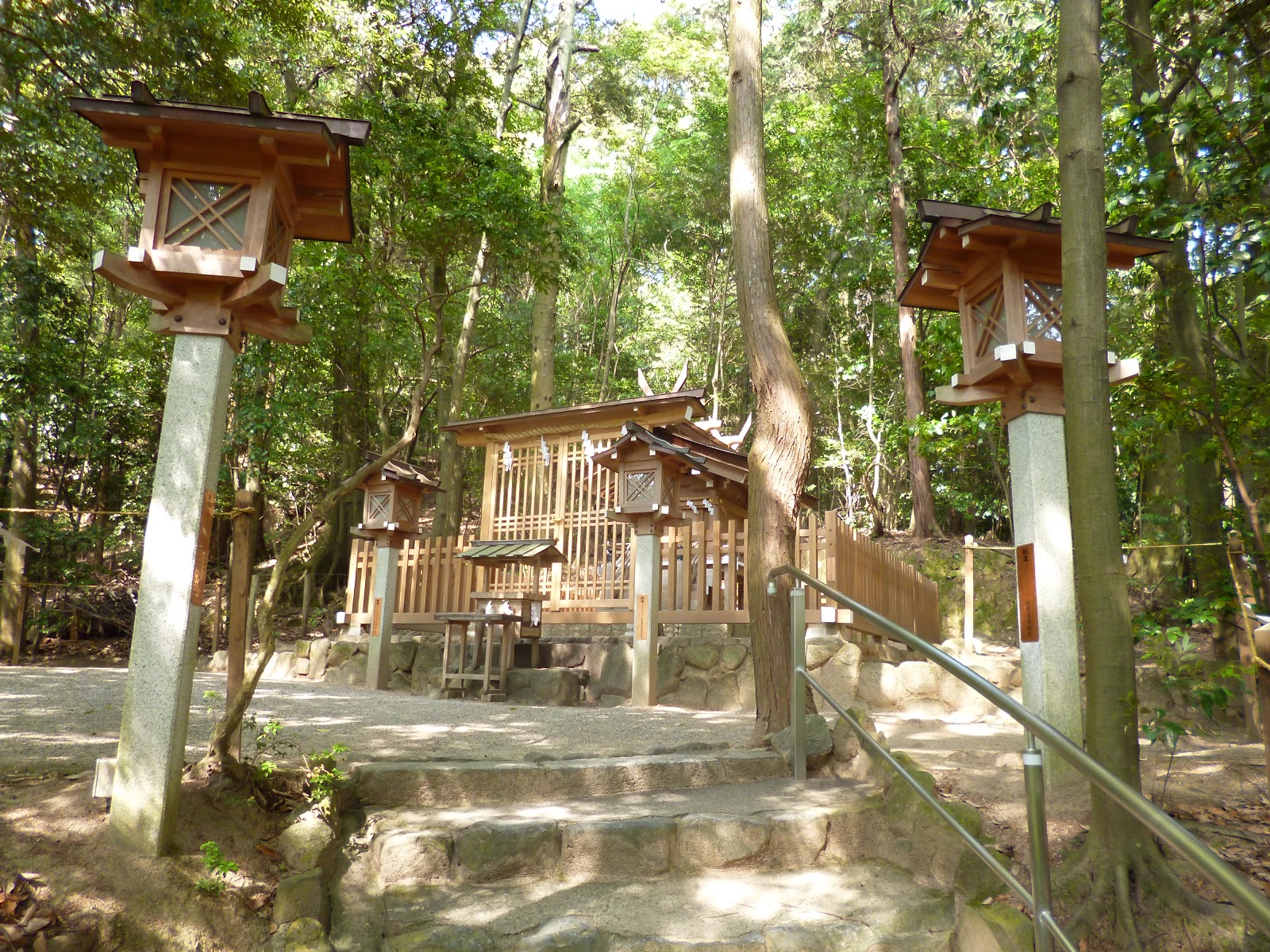
[Ikuhi Jinja, dedicated to the mythical Takahashi Ikuhi,
the first ever Master Brewer (Toji) of Japan]
Otataneko was the ancestor of the priestly lineages of both Miwa, Kamo (the two Kamo shrines in Kyoto) and Hie (at the foot of Mt Hiei in Shiga). "In other words, they were part of an extensive network of intermarrying priestly lineages who controlled a category of earthly deities that threatened the heavenly rule of the Yamato kings with techniques that were at least in part of continental origin," is the conclusion of Breen/Teeuwen.
There existed already an important cult place at Mt Miwa in the Yayoi period (300 BCE - 250 CE); archaeological surveys have shown that offerings continued here until well into the 7th c. The 7th or 8th c. was probably the time that for the first time physical shrine buildings were set up, as happened around that time at many kami cult places in Japan inspired by Buddhist example. The Omiwa Shrine only has a Haiden (prayer hall) and no Shinden (main hall where the deity dwells), because Mt Miwa, right behind the shrine is regarded as the shintai of Omononushi. Behind the Haiden is a triple torii, this time (in contrast to torii in general) with gates (and a fence) which normally remain closed as the mountain is a so-called kinsokuchi or forbidden place. (There is one entrance at the nearby Sai Shrine where pilgrims identified as such and under strict conditions are allowed to follow a path to a rock formation at the summit of Mt Miwa). The present Haiden at Omiwa dates from 1664.

[Sacred cedars in the shrine grounds. Offerings include sake and eggs,
as a snake is said to live at the foot of the tree]
The above mentioned large keyhole-shaped burial mounds in the neighborhood of the mountain probably belong to the first "great kings" (okimi, the term tenno or emperor was only devised in the late 7th c.) of the Yamato lineage. They probably ruled in the second half of the third and in the fourth centuries CE and Sujin, as we saw credited with initiating the worship of Omononushi at Miwa, may have been the first of the line (his real name was Mimaki-iri-biko-inie no mikoto, "Sujin" is a Sinified name devised - as for all emperors - in the 8th c.; also note that the Nihon shoki adds a fabricated calendar pushing the reign back to the impossible dates of 97-30 BCE).

[Sai Jinja is dedicated to the healing aspect of the Miwa deity]
Like the Matsuo Shrine in Kyoto, Omiwa has deep connections with sake brewing: the brew was handed down to mankind by Omononushi, the deity of the shrine, and continues to be offered to him as a way of thanksgiving. In the Manyoshu, "umazake," "delicious sake," is employed as an epithet for the Omiwa Shrine, and the term "miwa" itself was used to designate sake in the past. The Omiwa Shrine holds an annual Sake Matsuri on November 14, when brewers come to pray for a successful brewing season. In contrast to Matsuo Taisha and the Umemiya Shrine in Kyoto, the link of Omiwa with sake is documented in written sources and it was also deeper than that of just a patron deity for the craft of brewing. Deity and sacred drink form a unity, the one is a manifestation of the other. One of the sub-shrines of Omiwa, Ikuhi Jinja, is dedicated to the mythical Takahashi Ikuhi, the first ever Master Brewer (Toji) of Japan. Several songs preserved in the Kojiki and Nihon shoki deny human agency but affirm divine responsibility (through the power of Omononushi, or alternatively, Sukunabikona) for successful sake brewing. The process of alcoholic fermentation must have been considered miraculous and sacred in antiquity. The song in the Nihon shoki occurs when Emperor Sujin has Otataneko worship Omononushi and for that event master brewer Ikuhi has to brew the sake. Ikuhi then sings the following song:
This sacred sake
Is not my sacred sake,
He who brought forth Yamato,
Omononushi,
He has brewed this sake,
Everlasting,
Everlasting.

[Sake brewery in Miwa - Imanishi Shuzo. The brand name is Mimurosugi, or "Cedar of Mimuro (Miwa)"]
Cedar twigs from the shrine forest of Omiwa are traditionally used to make sugidama (also called sakabayashi), globes of cedar twigs and needles hung under the eaves of sake breweries (and also the Haiden of the Omiwa Shrine) when the new brewing season starts. When the twigs turn brown, the new sake is ready for consumption.

[Otataneko Jinja (Wakamiya) - it is clear from the architecture that this hall was originally a Buddhist temple: the jinguji of Omiwa called Daigorinji]
The Meiji-government had a strict and entirely new policy of separating Buddhism from the kami cult (called euphemistically "clarification;" in fact, as Breen and Teeuwen stress, this was when "Shinto" was created [invented?] for the first time). The temples at Miwa were destroyed; one, Byodoji, was leveled completely, as it was a shugendo temple (the Meiji government particularly disliked the yamabushi priests); the other, Daigorinji, was turned into a sub-shrine (Otataneko Jinja) and here the Buddhist-style hall still survives. The main statue of Daigorinji was a magnificent Eleven-headed Kannon, which at the time of the separation in 1868-71, when countless Buddhist treasures were destroyed, was simply thrown into a ditch. There it was found by the priest of Shorinji, a small temple south of Sakurai, where it received a new home. The once discarded statue now even has the status of a National Treasure! (The main statue of Byodoji, a Fudo Myo-o, is now kept in a small temple near Hasedera).
Thanks to its ancient links with the imperial house, Omiwa Jinja was designated as a "state-funded great shrine" (kanpei taisha) from the Meiji-period until the end of WWII (meaning it was counted among the about 65 major shrines in Japan and its then colonies). Also today, the shrine stresses its link with the imperial family; a visit by the Showa Emperor unfortunately motivated it in 1986 to build a massive steel torii, which is an eyesore on the landscape. But the forested surroundings in which the shrine itself stands are beautiful and allow visitors to catch a whiff of the early kami cult and its strong connection to sake.
[Sources: Miwa - der heilige Trank, by Klaus Antoni (Stuttgart, 1988); Yamato/Kii Jiin Jinja Daijiten (Heibonsha, 1997); A New History of Shinto, by John Breen and Mark Teeuwen (Wiley-Blackwell, 2010); The Cambridge History of Japan, Volume I (Cambridge U.P., 1993); Kojiki, translated by Donald Philippi (University of Tokyo Press, 1968); Nihongi, translated by W.G. Aston (reprint Tuttle, 1985); Shinto Shrines, by Joseph Cali and John Dougill (Hawaii U.P., 2013)]
Sake by Region Index
25 juni 2017
Best String Octets
String octets are chamber works for eight string players and usually consist of four violins, two violas and two cellos, but there are also combinations of four violins, two violas, a cello and a double bass. One could say that the string octet originated in the double quartets written by Spohr in the early 19th c.; the most famous string octet was written by Mendelssohn, but there are several interesting works from both 19th and 20th c. An octet is of course not a string quartet with the parts doubled: in the double quartets by Spohr we have two quartets set off against each other in a virtuoso way, and in the "normal" octets we have music for eight differentiated string players.
The string octet has a nice sonority. The number of string octets is, however, relatively small. Although there are string sextets, as far as I know, there are no string septets and very few string nonets (probably because this combination is already so close to a string orchestra that it makes little sense). Of course, there are many sextets, septets, octets and even nonets for mixed combinations of winds and strings, but here we will restrict ourselves to string music.
Best string octets:
1. Felix Mendelssohn, String Octet in E-flat major Op 20 (1825)
The original score is for a double string quartet with 4 violins and pairs of violas and cellos. Composed when Mendelssohn was 16 years old, at a time when Beethoven, Schubert and Weber were still alive and active. Schubert had composed his Octet in F major - a work for winds and strings following the pattern of Beethoven's early Septet - only the previous year. This work marked the beginning of Mendelssohn's maturity as a composer. It is a work in a symphonic style, which is immediately apparent at the opening, impressing the listener more as a serenade than a chamber music work. This broadly proportioned and warm-hearted opening movement accounts for nearly half the work's length. It is followed by an Andante characterized by a song-like siciliano. Then follows a Scherzo (played pianissimo and staccato) which seems to point directly to Mendelssohn's "Midsummer Night's Dream" music, but the inspiration was in fact the "Golden Wedding of Oberon and Titania" in Goethe's Faust. The Presto finale is full of energy. The Octet was one of Mendelssohn's own favorites among his works and I think most listeners will agree.
Recording listened to: Octets by Mendelssohn and Raff, Academy of St. Martin-in-the-Fields Chamber Ensemble on Chandos.

2. Louis Spohr, Double Quartet No 3 in E minor Op 87 (1833)
Spohr was attracted by the prospect of using the richer textures that would result from the interplay between two equal, yet independent, string quartets. The concept of two string quartets sharing the musical argument was gradually developed by Spohr in the four Double Quartets he wrote between 1823 and 1847. The third quartet of 1833 is generally considered as the finest of the series. In a minor key, it starts with a gravely melancholic Adagio-Allegro. This is followed by a virtuoso Andante con variazoni. The third movement is a restless and agitated Scherzo and the Finale eventually brings a mood of optimism.
Recording listened to: Spohr Double Quartets Nos 3 & 4, Academy of St. Martin-in-the-Fields Chamber Ensemble on Hyperion.
3. Niels Gade, String Octet in F Major Op 17 (1849)
Gade's Octet is heavily influenced by the Octet of Mendelssohn, who had been the highly regarded mentor of the Danish composer. The work was written when Gade, just past thirty, was establishing himself in Leipzig. It is interesting he tackled the form of the string octet before writing a string quartet, perhaps because it was a genre with less intimidating examples; and he may have preferred the flexibility and expanded range of tone color afforded by the larger number of instruments. The Octet is closely linked to Mendelssohn's elegant, flowing style and perhaps because of that, has remained one of Gade's most beloved chamber music compositions.
Recording listened to: Chamber Music by Niels Gade, The Kontra Quartet and others on BIS.
4. Johan Svendsen, String Octet in A major Op 3 (1866)
The Norwegian composer Johan Svendsen (1840-1911) was born in Oslo (then Christiana) and studied the violin at the Leipzig Conservatory with Ferdinand David, a colleague of Mendelssohn; problems with his hand forced him to switch to composition which he studied with Carl Reinecke. He worked as a conductor in his native town and also became musical director of the Royal Opera in Copenhagen. In his time, Svendsen was considered as the leading Scandinavian conductor. His compositions are not very numerous (two symphonies, two violin concertos and one for cello, Norwegian Rhapsodies, chamber music) and were mostly written when he was in Leipzig, although they should not be considered as student works. As was the case with Gade and Raff, also for Svendsen's Octet, Mendelssohn's youthful masterpiece served as the great example. The emphatic first subject is announced by all eight instruments in octaves. The inventive second movement has the spirit of a scherzo and is rhythmically intriguing. The slow movement can best be described as a set of free, continuous variations. The sonata-form Finale has an angular main theme and lyrical, curving second subject. The Octet is further characterized by its use of Nordic melody, tonal amplitude (often bordering on the orchestral) and bold and innovative rhythms. A very attractive work.
Recording listened to: Academy of St. Martin-in-the-Fields Chamber Ensemble on Chandos (with Quintet by Nielsen).
5. Joachim Raff, String Octet in C major op.176 (1872)
Joachim Raff (1822-82) was Liszt's assistant in Weimar and later a renowned teacher and composer in his own right. His music is characterized by well-crafted professionalism. Like Gade, his Octet for Strings shows the influence of Mendelssohn - in the opening of the first movement, after a brief statement of the rhythmically powerful first theme, the answering phrase recalls the scherzo of Mendelssohn's Octet. The two middle movements are in ABA form. The C minor scherzo has a delightful central theme; it bounces by like a fast horse ride. The F major slow movement is a "Song without Words" in all but name. The finale, with its moto perpetuo forward momentum, shows the strongest influence of Mendelssohn. The final coda is announced by a brief pizzicato, before the music races down to the finish line. Raff is almost forgotten - by 1920 his music had disappeared from the concert stage - , although happily among collectors his symphonies, concerts and chamber music have made a comeback. In his own time, he was regarded as the equal of Mendelssohn, Brahms, Schumann and Liszt. That is perhaps too much praise, but he certainly was an impeccable craftsman who left behind great chamber music. Raff.org is a website dedicated to his music, with also a detailed discussion of the present Octet.
Recording listened to: Octets by Mendelssohn and Raff, Academy of St. Martin-in-the-Fields Chamber Ensemble on Chandos.
6. Reinhold Gliere, String Octet Op 5 (1900)
Reinhold Gliere (1875-1956) was born in Kiev. He studied at the Moscow Conservatory with Taneyev and Arensky. Later, Gliere himself became professor at his alma mater; among his students were Khachaturian, Prokofiev and Miaskovsky. Gliere was in the first place known for his symphonies and ballets, but he also wrote excellent chamber music. The Octet, written when he was 25, opens with an excited Allegro moderato in sonata-form - both the upbeat main theme and melodious side-theme are unmistakably Russian in character. The composer displays great polyphonic mastery in the development section. The second movement is an elegant intermezzo with a soulful Russian melody as middle section. The epic Andante builds up an expansive theme, which grows from quiet singing to a powerful climax. The Allegro assai finale paints the picture of a Russian festival; there are two main themes, each distinguished by a colorful sound palette. In the coda-cum-apotheosis the Octet reaches near-orchestral power. One of the best string octets ever written.
Recording listened to: Berlin Philharmonic String Octet on MDG (with Sextet by Gliere).
7. George Enescu, String Octet in C Major Op 7 (1900)
George Enescu (1881-1955) was a Romanian composer, violinist and pedagogue who brought unknown sonorities into Western art music by his inventive use of Romanian folk music (for example quarter-tones). Enescu studied at the Vienna and Parisian Conservatories. Chamber music constitutes a major portion of Enescu's musical output. His epic Octet for strings was hailed as an amazing accomplishment for a young man of nineteen. It combines the musical language of the late romantic era with the emerging new language of polyphony. The opening movement Très modéré is characterized by an expansive main theme. In fact, the thematic material of the whole composition is introduced here: accentuated rhythms, descending chromatic progression, and leaping intervals. The second subject is presented in canonic form. The explosive second movement, Très fougueux, is indeed, as the title says, a massive fugue. Lentement is a beautiful slow movement in the form of a mysterious nocturne. Stillness and harmony predominate here. The finale, Movement de Valse, is a limping waltz which combines many of the themes of the earlier movements and ends in a grandiose classical fugue. As the ceasurae between the movements are not very emphatic, the impression of a continuous melody emerges in this wonderful octet.
Recording listened to: Ensembles of "George Enescu" Bucharest Philharmonic Orchestra on Arte Nova (with Dixtuor).
8. Max Bruch, String Octet op. posth. (1920)
Max Bruch (1838-1920) is now only known as the composer of a famous violin concerto, but in fact he wrote more than 100 works in various musical forms, ranging from opera to oratorio, from cantatas to symphonies and from concertos to songs. When he was born in Cologne Mendelssohn was still in his prime; when he died Stravinsky's Le Sacre du Printemps was already seven years old. But Bruch would his whole life be a classical composer in the romantic style of Mendelssohn and Schumann. In the Octet, the last work Bruch composed, the first violin part is more virtuosic than those of its colleagues. Bruch also has replaced the second cello with a double bass. The Octet consists of three movements - the scherzo has been omitted (although the finale contains scherzo elements). Two strong Allegro movements frame an Adagio in the dark key of E flat minor. The opening allegro features a dramatic first theme and a lyrical second theme. The finale is bright and optimistic and ends with a coda.
Recording listened to: Ensemble Ulf Hoelscher on CPO (with Piano Quintet & String Quintet).
The string octet has a nice sonority. The number of string octets is, however, relatively small. Although there are string sextets, as far as I know, there are no string septets and very few string nonets (probably because this combination is already so close to a string orchestra that it makes little sense). Of course, there are many sextets, septets, octets and even nonets for mixed combinations of winds and strings, but here we will restrict ourselves to string music.
Best string octets:
1. Felix Mendelssohn, String Octet in E-flat major Op 20 (1825)
The original score is for a double string quartet with 4 violins and pairs of violas and cellos. Composed when Mendelssohn was 16 years old, at a time when Beethoven, Schubert and Weber were still alive and active. Schubert had composed his Octet in F major - a work for winds and strings following the pattern of Beethoven's early Septet - only the previous year. This work marked the beginning of Mendelssohn's maturity as a composer. It is a work in a symphonic style, which is immediately apparent at the opening, impressing the listener more as a serenade than a chamber music work. This broadly proportioned and warm-hearted opening movement accounts for nearly half the work's length. It is followed by an Andante characterized by a song-like siciliano. Then follows a Scherzo (played pianissimo and staccato) which seems to point directly to Mendelssohn's "Midsummer Night's Dream" music, but the inspiration was in fact the "Golden Wedding of Oberon and Titania" in Goethe's Faust. The Presto finale is full of energy. The Octet was one of Mendelssohn's own favorites among his works and I think most listeners will agree.
Recording listened to: Octets by Mendelssohn and Raff, Academy of St. Martin-in-the-Fields Chamber Ensemble on Chandos.
[Felix Mendelssohn]
2. Louis Spohr, Double Quartet No 3 in E minor Op 87 (1833)
Spohr was attracted by the prospect of using the richer textures that would result from the interplay between two equal, yet independent, string quartets. The concept of two string quartets sharing the musical argument was gradually developed by Spohr in the four Double Quartets he wrote between 1823 and 1847. The third quartet of 1833 is generally considered as the finest of the series. In a minor key, it starts with a gravely melancholic Adagio-Allegro. This is followed by a virtuoso Andante con variazoni. The third movement is a restless and agitated Scherzo and the Finale eventually brings a mood of optimism.
Recording listened to: Spohr Double Quartets Nos 3 & 4, Academy of St. Martin-in-the-Fields Chamber Ensemble on Hyperion.
3. Niels Gade, String Octet in F Major Op 17 (1849)
Gade's Octet is heavily influenced by the Octet of Mendelssohn, who had been the highly regarded mentor of the Danish composer. The work was written when Gade, just past thirty, was establishing himself in Leipzig. It is interesting he tackled the form of the string octet before writing a string quartet, perhaps because it was a genre with less intimidating examples; and he may have preferred the flexibility and expanded range of tone color afforded by the larger number of instruments. The Octet is closely linked to Mendelssohn's elegant, flowing style and perhaps because of that, has remained one of Gade's most beloved chamber music compositions.
Recording listened to: Chamber Music by Niels Gade, The Kontra Quartet and others on BIS.
4. Johan Svendsen, String Octet in A major Op 3 (1866)
The Norwegian composer Johan Svendsen (1840-1911) was born in Oslo (then Christiana) and studied the violin at the Leipzig Conservatory with Ferdinand David, a colleague of Mendelssohn; problems with his hand forced him to switch to composition which he studied with Carl Reinecke. He worked as a conductor in his native town and also became musical director of the Royal Opera in Copenhagen. In his time, Svendsen was considered as the leading Scandinavian conductor. His compositions are not very numerous (two symphonies, two violin concertos and one for cello, Norwegian Rhapsodies, chamber music) and were mostly written when he was in Leipzig, although they should not be considered as student works. As was the case with Gade and Raff, also for Svendsen's Octet, Mendelssohn's youthful masterpiece served as the great example. The emphatic first subject is announced by all eight instruments in octaves. The inventive second movement has the spirit of a scherzo and is rhythmically intriguing. The slow movement can best be described as a set of free, continuous variations. The sonata-form Finale has an angular main theme and lyrical, curving second subject. The Octet is further characterized by its use of Nordic melody, tonal amplitude (often bordering on the orchestral) and bold and innovative rhythms. A very attractive work.
Recording listened to: Academy of St. Martin-in-the-Fields Chamber Ensemble on Chandos (with Quintet by Nielsen).
Joachim Raff (1822-82) was Liszt's assistant in Weimar and later a renowned teacher and composer in his own right. His music is characterized by well-crafted professionalism. Like Gade, his Octet for Strings shows the influence of Mendelssohn - in the opening of the first movement, after a brief statement of the rhythmically powerful first theme, the answering phrase recalls the scherzo of Mendelssohn's Octet. The two middle movements are in ABA form. The C minor scherzo has a delightful central theme; it bounces by like a fast horse ride. The F major slow movement is a "Song without Words" in all but name. The finale, with its moto perpetuo forward momentum, shows the strongest influence of Mendelssohn. The final coda is announced by a brief pizzicato, before the music races down to the finish line. Raff is almost forgotten - by 1920 his music had disappeared from the concert stage - , although happily among collectors his symphonies, concerts and chamber music have made a comeback. In his own time, he was regarded as the equal of Mendelssohn, Brahms, Schumann and Liszt. That is perhaps too much praise, but he certainly was an impeccable craftsman who left behind great chamber music. Raff.org is a website dedicated to his music, with also a detailed discussion of the present Octet.
Recording listened to: Octets by Mendelssohn and Raff, Academy of St. Martin-in-the-Fields Chamber Ensemble on Chandos.
Reinhold Gliere (1875-1956) was born in Kiev. He studied at the Moscow Conservatory with Taneyev and Arensky. Later, Gliere himself became professor at his alma mater; among his students were Khachaturian, Prokofiev and Miaskovsky. Gliere was in the first place known for his symphonies and ballets, but he also wrote excellent chamber music. The Octet, written when he was 25, opens with an excited Allegro moderato in sonata-form - both the upbeat main theme and melodious side-theme are unmistakably Russian in character. The composer displays great polyphonic mastery in the development section. The second movement is an elegant intermezzo with a soulful Russian melody as middle section. The epic Andante builds up an expansive theme, which grows from quiet singing to a powerful climax. The Allegro assai finale paints the picture of a Russian festival; there are two main themes, each distinguished by a colorful sound palette. In the coda-cum-apotheosis the Octet reaches near-orchestral power. One of the best string octets ever written.
Recording listened to: Berlin Philharmonic String Octet on MDG (with Sextet by Gliere).
7. George Enescu, String Octet in C Major Op 7 (1900)
George Enescu (1881-1955) was a Romanian composer, violinist and pedagogue who brought unknown sonorities into Western art music by his inventive use of Romanian folk music (for example quarter-tones). Enescu studied at the Vienna and Parisian Conservatories. Chamber music constitutes a major portion of Enescu's musical output. His epic Octet for strings was hailed as an amazing accomplishment for a young man of nineteen. It combines the musical language of the late romantic era with the emerging new language of polyphony. The opening movement Très modéré is characterized by an expansive main theme. In fact, the thematic material of the whole composition is introduced here: accentuated rhythms, descending chromatic progression, and leaping intervals. The second subject is presented in canonic form. The explosive second movement, Très fougueux, is indeed, as the title says, a massive fugue. Lentement is a beautiful slow movement in the form of a mysterious nocturne. Stillness and harmony predominate here. The finale, Movement de Valse, is a limping waltz which combines many of the themes of the earlier movements and ends in a grandiose classical fugue. As the ceasurae between the movements are not very emphatic, the impression of a continuous melody emerges in this wonderful octet.
Recording listened to: Ensembles of "George Enescu" Bucharest Philharmonic Orchestra on Arte Nova (with Dixtuor).
Max Bruch (1838-1920) is now only known as the composer of a famous violin concerto, but in fact he wrote more than 100 works in various musical forms, ranging from opera to oratorio, from cantatas to symphonies and from concertos to songs. When he was born in Cologne Mendelssohn was still in his prime; when he died Stravinsky's Le Sacre du Printemps was already seven years old. But Bruch would his whole life be a classical composer in the romantic style of Mendelssohn and Schumann. In the Octet, the last work Bruch composed, the first violin part is more virtuosic than those of its colleagues. Bruch also has replaced the second cello with a double bass. The Octet consists of three movements - the scherzo has been omitted (although the finale contains scherzo elements). Two strong Allegro movements frame an Adagio in the dark key of E flat minor. The opening allegro features a dramatic first theme and a lyrical second theme. The finale is bright and optimistic and ends with a coda.
Recording listened to: Ensemble Ulf Hoelscher on CPO (with Piano Quintet & String Quintet).
Chamber Music Index
15 juni 2017
Best String Sextets
String sextets are chamber works for six players and are usually written for an ensemble consisting of two violins, two violas, and two cellos, but there also exist rare combinations for three violins, viola and two cellos or three violins, two violas and cello.

The string sextet was "invented" by Boccherini in 1776. The most famous string sextets were written by Brahms and Schoenberg, and we have several more examples from both the 19th and early 20th c. Excellent are also the sextets by Korngold, Schulhoff and Martinu. But the total original literature is not especially large, so we often find as additions to concerts the first two movements of the incomplete sextet by Borodin, or the string-sextet Introduction to Richard Strauss’s opera Capriccio.
Best string sextets:
1. Luigi Boccherini, Sextuor No. 5 in D major Op 23 (1776)
Boccherini experimented with the limits of chamber music and was always on the lookout for new forms. One such new form was the string sextet, a combination in advance of the times, which on the other hand also means that Boccherini's six sextets Op 23 barely left an echo in musical history, despite being full of originality. In contrast to the double trios of the period (where instruments were simply doubled for effect), Boccherini goes much farther and gives equal importance to each instrument. He is also able to resolve the problem of four-part harmony for six instruments, mainly by means of a brilliant use of unison, not only in the basses but also in the violins and violas. This leads to a truly captivating sound quality. The six sextets Op 23 are quite extraordinarily beautiful pieces, mostly contemplative in mood. No 5 opens with a Grave for muted strings which features some remarkable and highly expressive decorative writing. This is followed by a vivid Allegro. The Minuetto is dedicated to pathos expressed in imitative contrapuntal writing, but the trio is full of dance-like rhythms. This is capped by a joyous Finale. It is a pity Boccherini only wrote six string sextets; another effort in the combination for six instruments were his sextets for flute and strings Op 16, as well as some of his Nocturni (especially those of Op 38).
Recording listened to: Boccherini, Sextets Op. 23 1, 2 & 5 by Ensemble 415 on Harmonia Mundi.
2. Anton Wranitzky, String Sextet in G (around 1800)
Although little known today, the Bohemians Anton and Paul Wranitzky were key figures in the musical life of Vienna at the turn of the 18th c. Anton Wranitzly studied with Haydn and worked most of his life at the court of Prince Lobkowitz. His chamber music output consists of more than 60 works. In the sextet Wranitzky seeks to exploit unusual sonorities and combinations of thematic lead and accompaniment such as are typical for the rare ensemble music of a sextet. The opening movement is in sonata form and held together by bustling scale patterns. The second movement is comparatively fast moving, using decorated versions of the main theme. The final movement starts with a slow introduction that sets up a faster section of a folk-like character.
Recording listened to: Wranitzky, String Quintet and Sextet, by Ensemble Cordia on Brilliant Classics.
3. Louis Spohr, String Sextet in C major Op 140 (1848)
One of the finest late works by Spohr, said to be inspired by the optimism and exuberance of the "revolution year" 1848. The new medium of the string sextet (it is doubtful that Spohr knew Boccherini, or the meager handful of string sextets written since then) is handled resourcefully, making good use of the sonority of the ensemble, but also exploring the possibility of creating contrasts between different groupings, or treating the first of each pair of instruments in a concertante manner. The Allegro Moderato is characterized by thematic expansiveness, but there is also more delicate work, such as the opening trill that runs throughout the movement. Much of the time, the first viola is the thematic leader. The Larghetto begins with a hymn-like theme. Scherzo and Finale are intertwined; the wistful Scherzo also features a waltz-like section. The Presto finale is full of violinistic brilliance, and capped by the surprising return of the Scherzo, before it all ends in a Prestissimo.
Recording listened to: Spohr, String Sextet etc. by Academy of St. Martin-in-the-Fields Chamber Ensemble on Chandos.
4. Johannes Brahms, String Sextet no 1 in B flat Major Op 18 (1860)
This is one of the truly great works of 19th c. chamber music. Brahms probably took his cue from Spohr, as his two sextets were composed only a good decade later and feature similar luxurious textures. Brahms wrote his first string sextet in 1860, the second one followed 5 years later. While the second one is more complex, I like the first one best for its broad, typical Brahmsian melodies. Brahms regarded the string quartet as a "hallowed" genre, just like the symphony, and wanted to thoroughly prepare himself well before attempting it. So the form of the string sextet with its extra instruments to aid with harmony and texture provided an ideal opportunity for him to "get his feet wet." The 27-year old Brahms fully explores the sonorities at his disposal, with the violas often playing in parallel harmony. In the first movement the first cello presents the opening theme against the bass provided by the second cello. The movement is in sonata form with an exposition that ends with the suggestion of a Viennese waltz. The following Andante is a set of variations on a theme of a noble character, the most famous movement of the sextet. The Beethovian Scherzo is concise and vigorous and the main theme of the Finale is in outline similar to that of the opening Allegro. In all, this is sunny and melodious music.
Recording listened to: Brahms, String Sextets, by The Raphael Ensemble on Hyperion.
5. Niels Gade, String Sextet in E flat Major, Op.44 (1865)
The Danish composer Niels Gade was a pupil of Mendelssohn and his teacher greatly influenced his style. The work starts with an elegiac Andante introduction in which the main theme of the first movement is introduced (built on a pervasive falling semitone). In the Allegro vivace that theme is then developed in a passionate way. The lyrical second subject has a winning quality. This is followed by an elf-like, typically Mendelssohnian Scherzo (without separate trio). The Andantino is an abridged sonata form in which the recapitulation ingeniously takes the function of the missing development section. Both Scherzo and Andantino are built from semitonally-obsessed material. The sextet closes with a big-boned Molto vivace, which is based on an idea similar to the one that started the first movement; it is similarly prefaced by a slow movement.
Recording listened to: The Johannes Ensemble on Kontrapunkt.
6. Antonín Dvořák, Sextet in A Major Op 48 B. 80 (1878)
Dvořák's first work to be premiered outside Bohemia, the fruit of a period in his life that he could concentrate on composition thanks to a government grant. It is easy to hear that the sextet was composed at the same time as the Slavonic Dances - it is written in a recognizable Czech style and one of the first works of Dvořák's maturity. The two inner movements are stylizations of the elegiac Dumka (a folksong from Little Russia) and lively Furiant (a Czech folk dance). The first movement is written in the classical sonata form (with three themes), and the last movement is composed in the form of a theme and six variations. The work is typical for its sunny atmosphere, melodic wealth and rich tone color.
Recording listened to: The Raphael Ensemble on Helios.
7. Peter Ilyich Tchaikovsky, Souvenir de Florence for String Sextet Op 70 (1890)
This string sextet (which is perhaps better known in the later version for string orchestra) was named "Souvenir de Florence" because the composer sketched one of the work's principal themes while visiting Florence, where at that time he also composed his opera The Queen of Spades. The first movement is in sonata form and begins boldly with an energetic main theme. The second lyrical theme is the above mentioned Italian souvenir - the only one in a sextet which is mainly Russian in character. The coda of this movement borrows a phrase from The Queen of Spades. The Adagio second movement opens with a kind of slow version of the first movement’s main theme, as an elegant serenade which however embeds a whimsical scherzo characterized by a pizzicato accompaniment. The third movement is an intermezzo that is all carefree brightness; its trio section reminds us that Tchaikovsky had The Nutcracker in his head at the time. In the Allegro vivace finale, a theme of folklore character is subjected to various kinds of treatment, including an unexpected fugato just before the coda. Like other chamber music by Tchaikovsky, this sextet evidences more naturalness and geniality than many of his large-scale compositions with their over-the-top emotionalism.
Recording listened to: Yong Quartet on Telarc (with complete string quartets).
Also on Youtube in a performance at the Internationaal Kamermuziek Festival Utrecht.
8. Arnold Schoenberg, Verklärte Nacht ("Transfigured Night"), Op 4 (1900)
Another work that is often heard in a version for string orchestra, but that started life as chamber music. The one-movement string sextet was inspired by a poem by Richard Dehmel, which describes a man and woman walking through a dark forest on a moonlit night. The woman shares a dark secret with her new lover: she bears the child of another man. It ends with the man's bright acceptance (and forgiveness) of the woman. The poem as well as Schoenberg's music were shocking for their time: filled by a new, anti-bourgeois sexual morality as well as the idea of an all-conquering Eros that shuns every convention. Schoenberg was not yet in his Twelve-tone period, but the sextet is written in a highly advanced harmonic idiom, with a rich chromaticism (deriving from Wagner's Tristan und Isolde) and frequent use of musical phrases which undermine the metrical boundaries. The sextet follows the poem's structure, which consists of five stanzas of differing length; it is in fact based on a rondo-like ABACA pattern, with the recurring A section representing the moonlit walk, the B section the woman's confession and the C section the man's noble reply.
Recording listened to: Leipziger Streichquartett on MDG (with 3rd string quartet).
9. Hakon Børresen, String Sextet in G Major Op. 5 (1901)
Hakon Børresen (1876-1954) was born in Copenhagen and studied with Johann Svendsen at the Royal Danish Conservatory. His String Sextet was dedicated to Edvard Grieg, who spoke highly about it. Borresen was a conservative composer who remained firmly steeped in a romantic / post-romantic musical language, mostly based on Brahms. The Allegro moderato, ma energico, opens with an energetic, Nordic-sounding main theme. It is followed by a genial scherzo and an introspective Adagio characterized by very long-lined melodies. The finale is again a big-boned movement in a Nordic style.
P.S. There exist several more string sextets by little known Nordic composers, as Ölander and Norman.
Recording listened to: Copenhagen Classic on CPO (with 2nd string quartet).
10. Reinhold Gliere, Third Sextet Op 11 (1905)
Gliere dedicated his Third Sextet to Mitrofan Belaiev, a great patron of music and also music publisher; many of Gliere's chamber music works premiered during the musical gatherings Belaiev organized every Friday. In the Third Sextet Gliere tried to capture the musical preferences of Belaiev (which were also his own): welding Moscow's tradition of Tchaikovsky and Taneyev with the Petersburg composer group The Five, in serene and positive music. The opening Allegro is light and folksy in character, reminding one of Borodin. The Larghetto is filled with heartfelt lyricism, an instrumental cantilena as emotionally charged as a human voice. The third movement, Allegro, is a quintessential Russian scherzo with its juxtaposition of contrasting themes. The final Allegro vivace returns to the festive mood of the first movement. Its colorful, full-bodied palette approximates the orchestral level. A sextet that abounds in fascinating ideas.
Recording listened to: Berlin Philharmonic String Octet on MDG (with Octet by Gliere).
11. Max Reger, String Sextet in F major Op 118 (1911)
Reger had firmly promised the String Sextet for the Gewandhaus Chamber Music of March 1911, but the composer found the filling of this obligation to be a hard task: Reger rejected whole measures and composed them again. In October 1910 he destroyed almost the complete first movement. By November he was still far away from finishing, and he had to work even during the Christmas holidays to complete the sextet in time. But at the premiere on March 12, Reger was enthusiastically celebrated: while striving for orchestral sound, he still remained within the framework of chamber music. The first movement, Allegro energico, is robust and rough hewn. In the second movement, Vivace, we find an effective alternation of dramatic and quiet sections. The third movement, Largo con grand espressione, features a deeply moving chorale. The finale, Allegro commodo, is again full of commotion and dramatic contrasts.
Recording listened to: Ensemble Villa Musica on MDG (with Clarinet Quintet)
12. Erich Korngold, String Sextet Op 10 (1916)
Korngold’s finest chamber work and a direct descendant of the sextets of Brahms. The luxurious sextet combines the melodic sweetness of late German romanticism with flecks of dissonance and moments of anxiety - making it sound quite modern. It encompasses an astonishing range of moods within its four-movement scheme. Korngold’s operatic talent is foreshadowed in the lyrical and romantic first subject of the opening Allegro. A calmer melody serves as the second theme. The second movement broods in melancholy. The delightful waltz-like third movement intermezzo contains a variation on a theme from Korngold's Sinfonietta in B Major. In the exuberant Presto finale we find some exotic, Bartokian-sounding elements.
Recording listened to: The Flesch String Quartet on ASV (with 3rd string quartet).
13. Erwin Schulhoff, Sextet for two violins, two violas and two cellos (1920-24)
Erwin Schulhoff (1894-1942) was a Jewish Czech composer, who was born in Prague, and who studied in Vienna, Leipzig and Cologne. In Leipzig he was taught by Max Reger, who guided him towards a neo-classical style. In Germany in the 1920s and 1930s Schulhoff allied himself to the left-wing avant-garde. The Nazis arrested him in 1939; three years later he died in the Wulzburg concentration camp in Bavaria. The fist movement of the string sextet reveals the influence of Schoenberg, although the music is not consciously atonal. It is however strongly chromatic and demonstrates a deeply depressive emotional state. The second movement is a long-breathed cantilena. This is followed by a tempestuous burlesca, fiendishly difficult to play. The last movement is a despondent Molto adagio. "A rough-hewn work of deep brooding fearfulness," as the Hyperion sleeve notes put it.
Recording listened to: The Raphael Ensemble on Helios.
Also on Youtube in a performance at the Internationaal Kamermuziek Festival Utrecht.
14. Julius Roentgen, Sextet in G Major (1931)
Of Roentgen's substantial output of 650 works, 100 were composed after his retirement to Bilthoven, in the last seven years of his life. Julius Roentgen often wrote chamber music for performance at home, by himself with his family (his sons were professional string players) and musical visitors (these included such luminaries as Grieg and Pablo Casals). As he wrote for private entertainment, Roentgen didn't try to break new ground - this String Sextet, too, is not a work that one would ever associate with the sound world of the 1930s. But it is full of energy and drama; it also possesses a brevity and concision that invest it with a serenade-like charm. It is in four short movements, of which the third is in variation style.
Recording listened to: Julius Roentgen, Chamber Music, Arc Ensemble, on RCA Red Seal.
15. Bohuslav Martinů, Sextet for two violins, two violas and two cellos (1932)
Written astonishingly quickly, in just a week. The sextet displays the "progressive tonality" that would be characteristic for the mature works by Martinu. There are three movements: the first Allegro poco moderato is preceded by a short Lento; this is followed by an Andantino which encloses a scherzo; and the work concludes with a short Allegretto poco moderato. A very vital work, that is a real string sextet and not a quartet with two extra instruments.
Recording listened to: The Raphael Ensemble on Helios.
Chamber Music Index