30 maart 2012

Ikanago no Kugini

Tsukudani made with sand lances (ikanago, a tiny fish). いかなごのくぎ煮.

A type of tsukudani (salt-sweet preserve). Local food from the Kobe-Akashi area. The tiny sand lances are simmered in a broth of soy sauce, mirin, sugar, ginger and other ingredients until they turn brown. In fact, they look like rusty, brown nails and that is what they are called - "kugini" means "simmered nails."


The tasty product is eaten over rice. Usually eaten around the end of February - early March when the fish is about an inch long. The dish is therefore also a sort of harbinger of spring. The fishes are caught in the Seto Inland Sea. When the season is over, the sand lances delve into the sand where they stay until the next year.

Traditionally, this was a homemade dish, although now one buys it ready-made in the supermarket. It is also a success story of promotion by the fishing industry, for 30 years ago the sand lances were mostly sold cheaply as cattle feed. Since then it has been put on the gourmet map as a typical regional product and the price has soared for "Ikanago no Kunini" is not only eaten in the Kansai, but shipped around the country.

28 maart 2012

Sakekasu (Sake lees)

Sake -kasu are sake lees used in the Japanese kitchen. At the end of the fermentation process of sake, the moromi is squeezed through a fine mesh. The clear sake will flow out and leave a solid rice substance behind. These "dregs" can be as much as one fourth of total volume.

Happily, these sake lees are not wasted. They are used in the Japanese kitchen as a marinade for fish or meat, made into a sweet rice drink (amazake), or re-used for brewing table sake.

Sake kasu are also used as a pickling agent.

[Sakekasu from Daishichi]

In fact, sake kasu are rich in proteins and very nutritious. They take the form of a thick rice paste sold in plastic bags from which the fragrance of sake still wafts up. Another type is sold in dry form. A more expensive kind are sake lees made from Ginjo sake.

In Japan, you will especially find them in winter, when all breweries are operating. Sake kasu has a distinct umami taste.

[Sakekasu from Daishichi]

Photos own work.

Japanese Food Dictionary

27 maart 2012

Zhuangzi (Best Non-Fiction)

The Zhuangzi has always been one of my favorite texts, thanks to the humor, the wild flights of fantasy, the imaginative stories and parables, the poetry of its language. And of course its philosophical stance, which is a combination of relativism and skepticism, bound together by an all-pervading holism. At the same time, it is one of the most influential works ever written in Chinese, both within the Chinese tradition (think of poets as Tao Yuanming, Su Dongpo, Yang Wanli etc, as well as Zen Buddhism) and Japan (Basho!).

[Zhuangzi's Butterfly Dream by Ike no Taiga]

The core of the Zhuangzi may be of slightly earlier date than the Daodejing (around 270 BCE). These are the so-called Seven Inner Chapters usually ascribed to the historical Zhuangzi (about whom virtually nothing is known except that he lived in the last three quarters of the 4th century BCE). Besides that, the book contains writings by anonymous followers of Zhuangzi's school and others who were sympathetic to it (the Outer Chapters 8-22 and Miscellaneous Chapters 23-33).

The Zhuangzi shares the philosophy of the spontaneous changes of the universe, with which the sage should try to be in accordance, with the Daodejing. Zhuangzi considered the moral patterns of the Confucians and other philosophers as artificial constructs of humans. The universe operates according to spontaneous processes and therefore humans should act spontaneously as well (translator Burton Watson calls this freedom). However, humans have the tendency to make artificial distinctions, thus removing themselves from the spontaneous processes of the natural world.

The playful style and fictive anecdotes in the Zhuangzi have the purpose to help readers break out of their habitual and artificial distinctions. That is why we have Confucius renouncing ritual, or he Sage Kings giving up their positions.

The philosophers of ancient China faced the same problem: how to live in a world of chaos and suffering. While the Confucians and others came with concrete action plans, the mystic Zhuangzi said: free yourself from the world.

When a man named Nanrong Zhu came to visit Laozi, to ask for instruction, the Sage promptly asked: "Why did you come with all these people?" The man whirled around but there was nobody behind him. Of course Zhuangzi means here the baggage of old ideas, of conventional concepts of right and wrong that we all carry about. We must first discard these before we can be free. We human beings are the authors of our own suffering and bondage. Zhuangzi sums this up in the image of the leper woman, who "when she gives birth to a child in the deep of the night, rushes to fetch a torch and examine it, trembling with terror lest it look like herself" (Burton Watson, p. 4).

Zhuangzi tries to shock us out of our bondage by paradoxical anecdotes, nonsensical remarks and pseudo-logical discussions. Another deadly weapon he uses is humor - the very core of his style.

Zhuangzi is the philosopher of naturalness, of spontaneity. By just following nature, everything will be best. Applied to politics, this means the world will be ordered automatically, a spontaneous order without need for (too much) government.

In the same way, death is not to be feared as it is only one of the many natural transformations. Without believing in an afterlife, Zhuangzi just tells us to trust nature:
Zhuangzi's wife died. When Huizi went to convey his condolences, he found Zhuangzi sitting with his legs sprawled out, pounding on a tub and singing... [...] (When Huizi admonished him, Zhuangzi answered:) "You are wrong. When she first died, do you think I didn't grieve like anyone else? But I looked back to her beginning and the time before she was born. Not only the time before she was born, but the time before she had a body. Not only the time before she had a body, but the time before she had a spirit. In the midst of the jumble of wonder and mystery a change took place and she had a spirit. Another change and she had a body. Another change and she was born. Now there has been another change and she is dead. It is just like the progression of the four seasons, spring, summer, fall, winter. Now she is going to lie down peacefully in a vast room..." [modified from Watson, p. 191-92]
The most famous story of the Zhuangzi is the "butterfly story" (here modified from the free Legge translation):
Once Zhuangzi dreamt that he was a butterfly, a butterfly flying about, enjoying itself. He did not know that he was Zhuangzi. Suddenly he awoke, and was himself again, the veritable Zhuangzi. But he did not know whether he was Zhuangzi who had dreamt that he was a butterfly, or a butterfly now dreaming that he was Zhuangzi. Between Zhuangzi and a butterfly there must be a some difference. This is called the Transformation of Things.
In China this epistemological story is so famous that it has become idiom ("Zhuang Zhou Meng Die").

The Zhuangzi is such a difficult text, also for Chinese, that you should do yourself the favor of selecting a translation by a specialist in Chinese. The best complete translation, in my view, is still the one by Sinologist and prolific translator Burton Watson, published by Columbia University Press in 1968, which is still available (just as in the case of the Daodejing, there are some terrible "translations" on the market, made by non-specialists who have put their fantasy to work on the basis of older translations - even Penguin Books has "sinned" in this case).
Burton watson, The Complete Works of Chuang Tzu (Columbia UP, 1968) 
Burton Watson, Early Chinese Literature (Columbia UP, 1962) 
The Columbia History of Chinese Literature (Columbia UP, 2001
A.C. Graham, Disputers of the Tao: Philosophical Argument in Ancient China (Open Court Publishing Company, 1989) 
The online Stanford Encyclopedia of Philosophy has a good article on the Zhuangzi.  
Non-Fiction Index

26 maart 2012

"You, The Living" (2007) by Roy Andersson

You, the Living (2007; Du Levande) is a Swedish movie by director Roy Andersson infused with dark, dark humor. It is a melancholic mosaic containing about 50 vignettes of life among ordinary people who suffer from the small iniquities of life. They are not so nice themselves, either, being exactly like our contemporaries in their selfishness, narcissism and lack of empathy with others.

The film is shot in washed-out pastel colors and drab interiors. The camera is static and we get only medium and long shots. I was reminded of the films of Tati, also by the quiet flow of the film. Some of the scenes are recurring, such as a brass band rehearsing and finally playing, and a drab bar where each time there is a call for last orders as it is going to close. The vignettes are linked together: a man goes to a barber for a quick trim as he has an important business meeting. He quarrels with the depressed barber who sadistically shaves a "punk" line down the middle of his head and then runs away. Later, the man appears in a meeting with other businessmen, now completely hairless. During the meeting, the chairman has a heart attack and dies. Next we have a funeral ceremony where a woman sings - and in another scene she sings the same song in her bubble bath at home.

Some other visions of despondence are:

An alcoholic biker woman sits on a park bench scolding her fat and meek buddy. She screams she will never see him again until she finds out he is cooking veal roast for dinner.

A naked Brunhilde wearing a Viking helmet sits riding on a fat man in a bed-scene (in fact, this is the sousaphone player from the brass band). The man's mind is far away, however, for he only keeps complaining that the bank has lost 34 percent of his retirement fund.

A carpet salesman manages to convince a customer to opt for a red instead of a green carpet (he has no green), but then he still loses the sale because a colleague has sold the end off that carpet so that it is too short now.

A psychiatrist comes to work in the morning and complains to the camera that he has spent 27 years of his life trying to help mean and selfish people be happy. He asks what the point is.

A man tries to do the trick of pulling a tablecloth from under the dishes on a long table and ends up breaking the 200-year old tableware. A surreal process with beer slugging judges follows and he is condemned by the audience to die on the electric chair. When he is being led to the chair, looking sad and despondent, he is advised to "think of something else." This all is a dream, told by a man stuck in a traffic jam.

The film starts with a man waking up and telling us he had a nasty dream about a flight of bombers approaching. The last shot of the film is of several planes hovering above a city with a glistening river - it looked beautiful, until I realized with a shock these  planes were the bombers from the dream at the beginning of the film...

As characters in the movie often say: "Tomorrow is another day" - yes, another day with loads of shit. Andersson's is a typical kind of negative humor that could only have been born under those dark, leaden Northern European skies.

Okamoto Kanoko

Okamoto Kanoko (1899-1939; 岡本かの子; real name Onuki Kano) was a tanka poet and novelist  active in the years before WWII. She was born in Tokyo's Aoyama into the wealthy and distinguished Onuki family. From a young age she was carefully tutored in the Japanese classics, music, dance and calligraphy. She became highly accomplished and developed a charismatic personality. She was also precocious in other ways - she had many boyfriends and eloped with one of them.

[Okamoto Kanoko]

When in Middle School she was inspired by her brother Onuki Shosen, who wanted to become a poet. He also introduced her to Tanizaki Junichiro. At age sixteen she started contributing tanka poetry to magazines as the famous Myojo (published by Yosano Akiko and her husband Tekkan). Her style in tanka was influenced by the passionate poetry of Yosano Akiko. Okamoto wrote her whole life tanka and published four poetry collections (a selection has been incorporated in Makoto Ueda's Modern Japanese Tanka).

In 1910 she married the cartoonist Okamoto Ippei whom she had met two years earlier. Their first child, Taro, was born a year later, and went on to become a famous avant-garde artist. Two more children died in infancy. At about the same time, also her brother Shosen and her father died - and her husband offered no support whatsoever at this crucial time. Okamoto had a nervous breakdown which caused her to turn to religion, and she would publish several books and essays on Jodo Shinshu Buddhism and also give lectures on this subject.

Her marriage with Ippei was a very free one, on both sides. Okamoto Kanoko was something of a femme fatale and continued to see other young men and even persuaded her husband to let one of them live in their house.

In other to develop herself further as an artist, in 1929 she moved with her husband and son (plus one of her boyfriends) to Europe. They visited Paris, London and Berlin before touring the United States, and returned to Japan in 1932. Her son Taro stayed behind in Paris to study painting - he would only return to Japan after the death of his mother.

Her first story, Tsuru wa yamiki ("The Crane Falls Sick") was published in 1936 in Bungakkai with the support of Kawabata Yasunari, who was a constant admirer of her work. It is a biographical sketch about the last years of the famous author Akutagawa Ryunosuke, who had committed suicide in 1927. Okamoto met Akutagawa in the summer of 1923 in Kamakura, where he was staying in the same hotel. They had casual meetings and conversations. Four years later she saw him again, ruined by illness and looking like a sick crane. When she heard of his suicide she regretted not having talked to him at that occasion, as she thought she might have saved him. The work, although controversial (Tanizaki opposed its publication in Chuo Koron because of the unflattering portrayal of his sister-in-law, an actress for whom he wrote two film scripts), was a sensation and Okamoto received so many invitations to write from magazines that she worked at a furious pace - she wrote all her fiction, more than 30 short stories and novellas, in only three years time, from 1936 to 1939. In that year she died of a stroke, at the age of just forty-nine.

Okamoto's protagonists are often beautiful and dangerous femmes fatales, as in the work of Tanizaki Junichiro. For Okamoto, women are a life-giving force, like the ocean. The two keywords in her work are obsession and desire. She was not interested in social criticism. Her style is rich and highly rhetorical -it has a classical ring to it that reminded me of another baroque writer, Izumi Kyoka. Although Donald Keene calls her style "overblown," and takes her task for her "improbably similes and glittering neologisms," translator Tanaka Yukiko admires her "passages of unparalleled beauty." John Lewell calls her style "ornate and intense."

Perhaps because of this gaudiness and the difficulty of her prose, Okamoto is not a popular writer in present-day Japan. Only two anthologies of her stories are available as bunkobon. In English, several of her stories have been translated, but unfortunately scattered over different anthologies and scholarly journals. Recently, J. Keith Vincent has published beautiful renderings of two stories (see below) - I hope more will follow, for Okamoto Kanoko deserves it. Why not publish all her fiction in English?


Selected Works:
  • Tsuru wa yamiki ("The Crane Falls Sick," 1936).
    Her first story, a document about the writer Akutagawa Ryunosuke (see above). Aozora Bunko.
  • Konton Mibun ("In a Chaos," 1936).
    Kohatsu, a swimming teacher, faces a dilemma: Kaibara, a man who has supported her and her father financially, wants to marry her. But she prefers another admirer, Kaoru. She asks Kaibara to wait until after an important swimming contest. During the contest, she swims far out to sea... Aozora Bunko.
  • Boshi Jojo ("Mother and Son, a Lyric," 1937).
    A rather narcissistic autobiographical story that examines the passionate love of a mother towards her son who is in Paris to study painting. With almost incestuous feelings she pursues a young man who seen from the back resembles her son. Aozora Bunko.
  • Hana wa Tsuyoshi ("A Floral Pageant," 1937).
    Depicts the relationship between an overpowering woman and a sick man. She is devoted to flower arrangement and at 38 still unmarried. He, from his side, will not marry her because she should devote herself to her art and not nurse a sick man. At a succesful exhibition she receives the news of the death of her lover... Aozora Bunko.
  • Kingyo Ryoran ("A Riot of Goldfish," 1937). 
    Mataichi has spent almost 20 years to breed a rare species of goldfish, which should exceed the beauty of Masako, a young woman living in a house on a cliff above his goldfish ponds he admires from a distance. Success does not come easy, but one passion fuels the other. Finally, he finds a wonderful type of goldfish in an old pond into which he has thrown defective specimens.  Aozora Bunko. Translated by J. Keith Vincent (Hesperus Press).
  • Tokaido Gojusan Tsugi ("The 53 Post Stations on the Tokaido," 1938). This story tells about a compulsive traveler who explores the historical and literary sites along the old Tokaido highway, even when he has to sacrifice his family for his obsession. Aozora Bunko.
  • Rogisho ("Portrait of an Old Geisha," 1938).
    Kosono, an elderly geisha, supports a young mechanic who dreams of becoming an inventor. But when the plans come to nothing, he feels trapped by her. She, however, doesn't release him and in fact seems to be siphoning off his young life force. Aozora Bunko. Translated in the Oxford Book of Japanese Short Stories.
  • Sushi ("The Sushi," 1939).
    About an elderly gentleman visiting a sushi shop, not so much because he likes fish, but because it calls up memories of his mother. Aozora Bunko.
  • Shokuma ("The Food Demon," 1939).
    The story of a pauper from Kyoto who teaches himself to be an accomplished chef to escape drudgery. Aozora Bunko.  Translated by J. Keith Vincent (Hesperus Press).
  • Karei ("The House Spirit", 1939).
    A young woman is destined to take over the family restaurant. She believes that submitting to her fate will cost her her happiness, but each time she is drawn back by an unseen hand. Aozora Bunko.
  • Kawa Akari ("The Gleam of the River," 1939).
    A search for Buddhist deliverance. Kinoshita doen't want to marry as he dislikes women after seeing the ugly quarrels between his mother and foster mother. He finds peace as a sailor, sailing around the South Seas.
  • Shojo Ruten ("Vicissitudes of Life," posthumous 1940)
    A search for identity by a young woman facing marriage. Choko's father was a wanderer who was adopted into a distinguished family. She feels she has something from his character and finds it difficult to settle down. Finally, she goes to the ocean in the company of an idiot beggar. 

Based on information about Okamoto Kanoko from Modern Japanese Novelists by John Lewell; and Dawn to the West by Donald Keene.

25 maart 2012

Bach Cantatas for Feasts on Fixed Days (58): Feast of Annunciation (BWV 1)

The Annunciation of the Blessed Virgin Mary (Mariae Verkündigung) is celebrated on March 25th. It is the celebration of the angel Gabriel's announcement to the Virgin Mary that she would conceive and become the mother of Jesus, the Son of God. March 25th is nine full months before Christmas.

This feast usually fell during Lent, when Leipzig observed tempus clausum and no music was played in the churches. However, when this day coincided with Palm Sunday, the ban was lifted. Such an occasion occurred in 1725 and again in 1736. We have one complete cantata by Bach for this day, the masterful BWV 1 of 1725. Bach also used BWV 182 for this day, but it was originally written for Palm Sunday and is discussed there. Cantata BWV Anh 156 "Herr Christ der ein'ge Gottessohn" was written for this day, but is not by Bach but by Telemann (TVWV 1:732). Finally, one cantata for this day has been lost: BWV 1135 / BWV Anh. 199, "Siehe, eine Jungfrau ist schwanger", first performed in 1724.

Readings:
Isaiah 7:10–16, prophecy of the birth of the Messiah
Luke 1:26–38, the angel Gabriel announces the birth of Jesus

Cantata Studies:
Bach Cantatas Website | Simon Crouch | Emmanuel Music | Julian Mincham | Wikipedia | Eduard van Hengel (in Dutch) | Bach Companion (Oxford U.P.) | Bach: The Learned Musician (Wolff) | Music in the Castle of Heaven (Gardiner)


[Annunciation by El Greco]
 

Cantata:
  • Wie schön leuchtet der Morgenstern, BWV 1, 25 March 1725

    Coro: Wie schön leuchtet der Morgenstern

    Recitativo (tenor): Du wahrer Gottes und Marien Sohn
    Aria (soprano,oboe da caccia): Erfüllet, ihr himmlischen göttlichen Flammen
    Recitativo (bass): Ein irdscher Glanz, ein leiblich Licht
    Aria (tenor, violins): Unser Mund und Ton der Saiten
    Chorale: Wie bin ich doch so herzlich froh

    "How beautifully the morning star shines"
    Text & translation

    Scored for three vocal soloists (soprano, tenor and bass), a four-part choir, two horns, two oboes da caccia, two solo violins, strings consisting of two violin parts and one viola part, and basso continuo.

    This cantata, despite being labeled BWV No. 1, isn't Johann Sebastian Bach's earliest work of its kind. "Aus der Tiefe rufe ich, Herr, zu dir, BWV 131," written in 1707, is likely his earliest. However, BWV No. 1 was chosen intentionally. When the Bach Society started publishing Bach's complete works in 1850, they planned to start with the Mass in D Minor. But lacking a full score at that time, they opted to publish ten diverse and beautiful cantatas in the first volume instead. Eight of these were from Bach's second cantata collection in Leipzig. "Wie schön leuchtet der Morgenstern," distinguished by its unique instrumentation, led this volume and became cantata number 1.

    Bach introduced this cantata on March 25, 1725, also Palm Sunday that year. Although the cantata alludes to the Annunciation, not Christ's entry into Jerusalem, the "morning star" symbolizes Christ, as mentioned in Revelation 22:16. With its intricate orchestration, including horns, this is one of Bach's most joyful cantatas, fitting its theme.

    Based on Philipp Nicolai's 1599 chorale "Wachet auf, ruft uns die Stimme," expressing yearning for the Savior amidst worldly suffering, the cantata captures a heavenly contrast to earthly pain. Nicolai composed it during a plague outbreak in Unna, Germany. Bach frequently incorporated Nicolai's chorales, highlighting themes of the Messiah's arrival. Bach's orchestration vividly depicts images, with solo violins representing the morning star and oboes accentuating crucial moments. The oboe da caccia's sound, heard first in the opening chorus, recurs in the initial aria. In the closing chorale, the choir and colla parte instruments harmonize the hymn melody while a second horn adds a counter-melody. The instrumentation echoes BWV 65, composed for Epiphany in 1724. Bach later used the horn pair in Part IV of his Christmas Oratorio, relating to Jesus's naming as announced to Mary.

    The first movement, "Wie schön leuchtet der Morgenstern," is a grand chorale fantasia about Christ's future birth and the journey of the Magi. The chorale melody is sung by sopranos in long notes, while other voices create a fugal interweaving. A significant 12-bar orchestral ritornello or sinfonia opens the movement, with solo instruments prominent; its broad harmonic scope contrasts with the mostly F major chorale. The horn calls symbolize the king's majesty, while the virtuosic violin passages represent the morning star and universal joy. This opening chorus is one of Bach's most inspired pieces.

    In a secco recitative, the tenor expresses faith, echoing the hymn's second verse and referencing the Annunciation. The subsequent soprano aria with oboe da caccia obligato maintains a dance-like quality.

    The bass recitative Ein irdscher Glanz, ein leibliches Licht is accompanied secco, emphasizing the text. It refers to the "morning star" as a joyful radiance.

    In the da capo tenor aria, accompanied by two violins to express the "strings" to which the text refers, the structure of the opening chorus is evident. A expression of gratitude and praise, it features a graceful minuet pulse.

    In the final chorale, one horn and the first violin join the sopranos, while the other horn plays its melody. The two oboe da caccia, with the string orchestra, accompany the alto and tenor.

    Video: J.S. Bach Foundation (St. Gallen) - Workshop (in German) - Contemplation (in German)

    24 maart 2012

    Japanese floral calendar

    Japan has flowers for every season and that is how the hanagoyomi, the floral calendar, was born, listing the favorite flower or tree for each month of the year.

    Here is one example of such a list (for certain months there are variants although cherries are always linked with April!):

    January - pine (matsu)

    February - plum (ume)

    [Plum trees in Osaka Castle's Plum Garden]

    March - peach (momo)

    April - cherry (sakura)

    [Cherry blossoms in Ninnaji Temple, Kyoto]

    May - azalea (tsutsuji), peony (shakuyaku), tree peony (botan) and wisteria (fuji)

    June - iris (shobu), hydrangea (ajisai)

    July - morning glory (asagao)

    [Lotus flower in Hokongoin Temple, Kyoto]

    August - lotus (hasu)

    September - bushclover (hagi) and other "seven grasses of autumn"

    October - chrysanthemum (kiku)

    [Maple splendor in Kiyomizu Temple, Kyoto]

    November - maples (momiji)

    December - camellia (tsubaki)


    Tofu (3) - by-products and tofu dishes

    The third part of our tofu post. We look at some by-products of tofu plus a few tofu dishes.

    Already during the production process of tofu, various other foodstuffs come into being:
    • Okara or soy pulp. A white pulp left over when soy milk is extracted from ground soaked soybeans. It looks a bit like sawdust. Although tasteless, okara contains fiber, protein, iron, calcium and riboflavin and is very nutritious. It is in the first place used as livestock feed, but also finds many applications in the Japanese kitchen. Recently, it has been discovered by vegetarians and is for example used as ingredient for vegetarian burgers, also in the West. Okara is also called poetically "unohana," "deutzia flowers." As Okara - like tofu - can't be kept long, it is often sold in dried form.
    • Tonyu or soy milk is a healthy replacement for cow milk. There is also soy milk based ice cream and soy yogurt.
    • Yuba or soy milk skin, a delicacy of Kyoto. Yuba forms on the surface when soy milk is heated. Can be eaten fresh or added to soups. Important ingredient in shojin-ryori (Buddhist vegetarian cuisine)


      [Tofu skin]

      Enjoy tofu in the following ways:
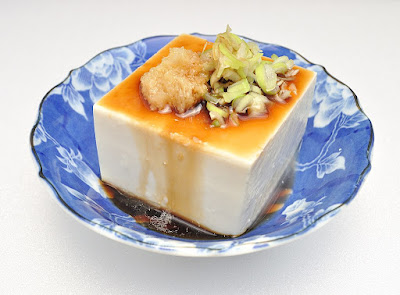
    • As-it-is: Hiyayakko or chilled tofu. Cold blocks of "cotton tofu" with soy sauce, grated ginger and finely sliced spring onions. Typical izakaya food. Summer dish.
    • As-it-is: Yudofu or "Tofu in warm water." Blocks of "cotton tofu" are put in a pot with water and kombu right on the table. After gently warming (never boiling!) the tofu is dipped in a sauce of soy, spring onions, grated ginger and bonito shavings before eating. Typical Kyoto dish. When cooking at home, you can vary it by adding shungiku, shiitake, Chinese cabbage and enokidake to the broth.
    • As-it-is: Shira-ae or vegetables dressed with tofu. Lit. "Salad with white dressing." Carrot, burdock root, green beans etc. are cooked, cooled off and then mixed with a dressing made from drained tofu and dashi, salt, sugar and soy sauce.
    • Grilled: Dengaku. Lightly grilled tofu flavored with various types of miso mixed with sugar and sake.
    • Sauteed: Iridofu. Tofu sauteed with shiitake mushrooms, carrots and snow peas and seasoned with sake, soy sauce, sugar and egg. Even without the addition of egg, this tofu dish reminds one of scrambled eggs!
    • Japanese-Chinese: Mabo tofu. Originally from Sichuan, but domesticated in the Japanese Chuka kitchen. Small squares of tofu in a soupy mixture containing ground pork, seasoned with leeks, ginger, sesame seed oil and soy sauce. Eaten over rice on a plate. Can be spicy, although less so in Japan than in Sichuan.
    Traditionally, Kyoto is famous for its tofu, thanks to its excellent water and emphasis on vegetarian cuisine.


    [Hiyayakko]

    "Miss Pettigrew Lives for a Day" (2008) by Bharat Nalluri

    There are times that a full-bodied red wine is most suitable, but also moments that bubbles are best. In other words, sometimes it is good to enjoy a frothy, sparkling romantic comedy like Miss Pettigrew Lives for a Day, filmed in beautiful period style and magical colors by Bharat Nalluri. This film is in the first place an "actors film," it is the ensemble of Frances McDormand as the solid Miss Pettigrew and Amy Adams as her flamboyant and charming employer Delysia Lafosse - a quick-silvery personality who is subject to ever changing moods and whims - that carries the whole film. Amy Adams reminded me of Jean Arthur or Jean Harlow. Period detail is just as perfect as the casting in this film, including the satin gowns and the fabulous antique cars.

    Miss Guinevere Pettigrew is a middle-aged, straight-laced governess, who keeps getting fired as she can't get along with her employers (she has a wonderful way of arching her eyebrows to put people off) - something rather serious in depression time 1939 London. The employment office refuses to help her any longer, but she overhears a name and address meant for a colleague and quickly heads there.

    As soon as she arrives it is mayhem, for American singer/actress Delysia Lafosse storms around in her pink negligee, trying to balance relations with three different men: the noble Michael (Lee Pace), a penniless pianist; the tough Nick (Mark Strong), who owns the nightclub where Delysia performs and who also pays for her flat and upkeep; and pretty-boy Phil (Tom Payne), a young impresario from whom she seeks a leading role in a new play. With a sturdy hand, Miss Pettigrew shores up the fluttering Amy, sorting out her affairs, and actually enjoying herself like never before as partner in deception. She even has to pretend to smoke cigars to put Nick off the scent when he detects a stub in an ashtray. In recompense she now enters high society herself - getting a very necessary make-over in the process. One running joke in the film is that Miss Pettigrew never manages to eat - people bump into her so that she drops her plate, etc. - so when cucumber slices are applied to the skin of her face, she quickly consumes them.

    At a fashion show she meets lingerie designer Joe Blomfield (Ciarán Hinds), who is involved in an on/off relationship with squeaky-voiced socialite Edythe Dubary (Shirley Henderson). Edythe asks Miss Pettigrew's help to sort things out for her as well, but it seems Miss Pettigrew and Mr. Blomfield feel some magic of their own...

    The whole story takes place in just 24 hours and both leading women of course don't fail to achieve their romantic destines, albeit after a lot of giddy screwball-type confusion. They also draw close to each other, making Miss Pettigrew into a sort of female "buddy" movie. But the film also has its quiet moments - Europe is after all gearing up for the second destructive war in a quarter of a century - and as a whole it is delicate and gentle-spirited rather than a shouting match.

    Great fun, long live the bubbles!

    23 maart 2012

    Tofu (2) - various types

    The second part of our tofu post. We look at some tofu products made by, for example, deep frying tofu.

    When tofu is deep-fried in oil, another variety is created, which comes in four forms (this type is of course never kept under water, but just in the refrigerator; will keep fresh there for one week):
    1. Atsu-age. Thick-sliced (2.5 cm) tofu broiled briefly in hot oil. The inside remains soft and white, while the outside is golden brown. Another name for this type of tofu is nama-age. Difference with aburage: aburage is thinner and fried through. Can be eaten as such in izakaya etc. with flavoring of soy sauce and ginger, used in oden, miso soup, etc. Pour hot water over the cake and lightly press in paper towels before using it to remove excess oil.


      [Atsu-age]


    2. Aburage. Deep-fried, thinly sliced tofu. An ingredient of udon dishes called kitsune (fox) udon, because legend tells that foxes are fond of deep fried tofu!  In small stripes, an ingredient of miso soup, and soups of mizuna, komatsuna etc. Also an ingredient in stir fries. Can also be sliced open and used as a wrapper ("tofu pouch") and filled with vinegared rice to make inarizushi - inari is a name for the fox deity. Also here, remove excess oil before using it.
    3. Agedashi-dofu. Deep-fried tofu breaded with potato starch. Eaten with a sauce of soy sauce, sake, dashi, sugar and salt en dressed with chopped green onions, grated daikon radish and red pepper.
    4. Ganmodoki or "mixed tofu balls." Tofu is mixed with crushed yam and chopped vegetables as carrot, burdock, shiitake mushrooms, as well as sesame seed. This mixture is kneaded into 4-cm balls and deep-fried. Used in oden and simmered dishes. "Ganmodoki" means "like a wild goose," the name was presumably given by a Buddhist priest who ate this instead of the real goose.
    Two more varieties of tofu are:
    1. Flavored tofu includes the pale golden "egg tofu" (tamago tofu),  tofu flavored with green tea, pumpkin or sesame seed (gomadofu).
    2. Koya-dofu. Freeze-dried tofu, originating with the monks of Mt Koya. They reputedly discovered the process accidentally by leaving tofu outside on a winter night. Grayish. Soak in water to reconstitute it before eating. Solves the problem that tofu can't be kept for long.


    [Koya-dofu]

    22 maart 2012

    Tofu (1) - what it is and how it is made

    "Tofu ("bean curd") is one of the most protean of all foods," says Donald Richie (in A Taste of Japan). You can do more things with it than with any other food and its delicate taste serves as a base for thousands of other flavors. Soy protein is of the highest quality, equal to that of meat and dairy products, but without the cholesterol and saturated fat.

    [Kinu-dofu]

    On top of that, it is the perfect health food. It is incredibly easy for the body to metabolize this light food. Soy isoflavones possess a myriad of biological properties that can benefit the body. It helps against fatigue and a weak stomach and encourages a clear skin and healthy complexion. People in East Asia believe it also helps them live longer lives. It is not only nutritious (like the soy beans from which it is made), it is also cheap. Tofu is low in calories and rich in protein, calcium, iron and phosphorus.

    Tofu originated in China and came to Japan in the 8th century - perhaps brought back by priests for whom it formed a valuable protein-rich addition to the vegetarian diet. There is a record that in 1183 it was offered to the Kasuga Shrine in Nara.

    Tofu is made in the following way:
    • Soak soybeans overnight in water
    • Grind them, add water and then boil the mixture (this mixture is called go, soybean puree)
    • Strain it to remove the bean pulp (called okara) - what is left is delicious soy milk
    • Add a coagulating agent, bittern (made from crude salt, contains both magnesium chloride and calcium chloride) or calcium sulfate. This will transform the soymilk into curds and whey. The curds are finally poured into a mold and left to settle.
    Depending on the finishing process there are three types of tofu:
    1. Momen(-goshi). "Cotton tofu." The soy milk curd is put into a mold lined with cotton cloth. The mold has holes in the sides and bottom so that the liquid can be pressed out. This leave a firm block of tofu into which the cotton weave has been impressed. This firm type of tofu is used in yudofu and hotpots. Also eaten by itself.
    2. Kinu(-goshi). "Silk tofu." The name is given not because a silk cloth is used instead of a cotton one, but because this type of tofu looks "silky smooth."  It is in fact not drained, so that a larger amount of coagulant remains; it is very soft and breaks easily. Used in soups as miso-shiru.
    3. Yakidofu. Lightly broiled tofu. There is a light brown mottling on the skin. It is firmer than momen and kinu tofu and most often used in hotpots - it is especially popular in sukiyaki.
    All three types of tofu are fresh and must be kept under water (also the packs you buy in the supermarket contain water!) and refrigerated, otherwise it will not keep for more than a day. Under water and refrigerated, it should be used within 5 to 7 days of manufacturing.

    Ariyoshi Sawako (writer)

    Ariyoshi Sawako (1931-1984; 有吉佐和子) was a novelist born in Wakayama City, and the native scenery of the broad River Ki and its green valley, leading inland from Wakayama City, plays a large role in her work. Four of her novels and five short stories have been translated, so she can't be called "unknown," but her oeuvre is large (more than 100 novels, stories, plays, essays and travelogues) and it is good to have a look at the total of her endeavors.

    Ariyoshi Sawako spent part of her youth in Java (her parents returned in 1941 to Japan) and was educated at Tokyo Women's Christian College, where she studied literature and theater. The theater - especially the Kabuki - and other traditional performing arts formed her lifelong passion. She graduated in 1952.

    In 1956 Ariyoshi made her literary debut with Jiuta, a story set in the strict world of traditional Japanese music. Jiuta are traditional songs accompanied by the shamisen. A jiuta singer, head of a lineage, has trained his daughter in the hope that she will be his successor, but his hopes are shattered when she decides to marry a foreign husband and move to the U.S. The father-daughter conflict is central to the story.

    In 1959 Ariyoshi studied a year at the Sarah Lawrence College in New York on a Rockefeller scholarship, with the theater as her subject. Back in Japan, she worked for a publishing company and at the same time continued writing highly acclaimed short stories and novels, many of them dealing with traditional Japanese performing artists. This interest in the theater also influenced her style. In her novels, there are frequent dramatic confrontations between the characters and she had a great talent to write lively dialogues. She also wrote plays for the theater as well as scripts for TV.

    Ariyoshi was a prolific and very talented novelist. She often raised social issues and women's issues in her novels. Ariyoshi traveled extensively to gather material for her books; she also wrote travel essays. During her lifetime, she was very popular: nine of her novels were filmed, four others made into TV films. Today, her popularity has somewhat decreased, but she is still studied and her best novels remain in print.

    Ariyoshi was a typical storyteller. Her characters are often propelled by a certain feverishness that also grips the reader, such as the fierce competition between mother and daughter-in-law in The Doctor's Wife, or Okuni's obsession with dancing in The Kabuki Dancer.

    Ariyoshi's numerous novels can be divided into six groups depending on the subject matter.

    First we have novels about traditional performance artists. Besides the above mentioned Jiuta this group includes:
    • Izumo no Okuni ("The Kabuki Dancer," 1969), about Okuni, the woman who in the late 16th century "invented" a new form of dance that was an early incarnation of the Kabuki theater. She performed on a stage along the bank of the Kamo River in Kyoto. The novel vividly depicts the historical background as well as the rivalries in Okuni's troupe. Translated into English by James R. Brandon, who is a specialist on the Japanese theater in general and Kabuki in particular (published by Kodansha).
    • Tsuremai, ("Dance for Two"), about the rivalry between two sisters born into the Kajikawa family of traditional dance. 
    • Midaremai ("Disorderly Dance"), a sequel to the previous novel, which takes the rivalry between the sisters one step further when the Iemoto, the head of the school, dies. 
    • Ichi no Ito ("One String"), about a young woman who falls in love with a man who plays the shamisen in the Bunraku theater.
    • Kaimaku beru wa hanayaka ni ("Let the bell for the curtain rise sound gorgeously"), a mystery novel set in the modern theater world.
    Secondly, novels and stories set in the world of geisha and bar hostesses:
    • Shibazakura ("Moss Pink"), a novel about two geisha with very different characters, the one, Masako, very serious, the other, Shimayo, more frivolous; 
    • Keko ("Flowers and Incense," 1965), about the relations between two geisha living in the years between Meiji and the War, a mother, Ikuyo, who is rather vamp-like, and her daughter Tomoko, who forgives her wild streaks. 
    • Here also belongs The Tomoshibi (Tomoshibi, 1961), a short story translated by Keiko Nakamura in The Mother of Dreams about a kind bar hostess.
    Then we have a group of historical novels.

    • Here belongs in the first place Ariyoshi's most famous work, Hanaoka Seishu no tsuma ("The Doctor's Wife," 1966). Dr. Hanaoka Seishu (1760-1835) was the first in the world to operate a patient under a general anaesthetic (in 1804), with techniques which go back to both Dutch and Chinese medicine. Ariyoshi studied his personal papers for her novel, but the famous doctor is not the main character in the book: that is firstly his wife Kae, and after that his mother Otsugi. The rivalry between these two women for his attention is central to the novel and propels the story forward. While he is still developing the powder called tsusensan (a herbal mixture also containing some poisonous elements) they compete for the "privilege" of being his first human subject to test it. The doctor pretends not to notice the rivalry but benefits greatly from it. Kae goes blind as a result. English translation published by Kodansha. 
    • Another interesting novel in this group is Kazunomiya-sama otome ("Her Highness Prinses Kazu," 1978), the famous story of an imperial princess, Kazu-no-miya, who in the late Edo-period for political reasons was forced to marry the shogun. Ariyoshi poses that it was not the real princess, but a substitute who married the shogun.
    The next grouping is of novels describing the life of women in the time of Japan's early modernization from the late 19th century on.

    • Here belongs Ariyoshi's masterwork, Kinokawa ("The River Ki", 1959), the story of three generations of women (Hana, Fumio and Hanako) living from the late 19th to mid 20th century in the countryside outside Wakayama City on the River Ki. The novel explores their changing attitudes and expectations. The novel shows how Hana, a traditional woman, keeps in the shadow of her husband, a politician, but also how she supports him and uses her resources to promote his interests. English translation published by Kodansha. Two sequels (Arita River, 1963 and Hidaka River, 1965) add two more generations, but have not been translated.
    A next group of novels addresses modern life and its problems.
    • An example is Fushin no Toki ("A Time of Distrust"), about Asai Yoshio, a salaryman who has been married for 15 years to Michiko. Asai has two times in the past been unfaithful to his wife, and when he again falls for a hostess, Machiko, his wife plans a terrible revenge. 
    • Interesting is also Yuhigaoka Sangokan ("Building No. 3 at Evening Sun Hill") that describes the problems of Sonoko, the wife of a salaryman who starts living in company-provided housing in Tokyo. The flat is beautiful, but besides facing problems with the education of her son, Sonoko gets entangled in the web of small-time intrigues and rumor-mongering among the housewives in the compound. 
    • Akujo ni tsuite ("About a Bad Woman," 1978) - the heroine is a business woman who has just past away. The novel consist of 27 chapters in which people who knew her give their memories. She is not at all a "bad woman," but the novel shows how  the same person may be "seen" from different angles - some loath her, others love her. Along the way, we also get the expanation of her untimely death. 
    And finally we have the novels about "social problems."
    • An early example is Hishoku ("Not Because of Color", 1964), about a Japanese woman who moves to New York's Harlem as the "war bide" of an African-American soldier. The novel not only addresses racial discrimination, but also looks at what it means to accept life in another culture. 
    • The most famous book in this group is probably Kokotsu no hito ("The Twilight Years," 1972) which depicts the life of a working woman who is caring for her elderly, dying father-in-law in a very moving way. When Akiko's senile father-in-law is rejected by community services, the responsibility for his care automatically devolves upon her, increasing a domestic and employment workload which she already finds hard to cope with. Ariyoshi correctly anticipated the problems that Japan's rapidly aging society would cause. The book is both funny and heart-warming. English translation published by Kodansha.
    • Fukugo Onsen ("Compound Pollution," 1975) - not a novel but reportage about various forms of pollution. Sold one million copies and shook up the public and the government. From this time on, corrective measures were introduced.
    Concluding we can state that the most striking feature of Ariyoshi's novels is the sheer vitality and resourcefulness of her female characters.

    P.S. Since Kodansha International, the publisher of four of Ariyoshi's novels in English has been liquidated last year by its mother company Kodansha, it is questionable whether these translations will still be available. The best option may be a library. It is sad that there is no Japanese publisher with translations of Japanese literature left on the international scene. As is also the case elsewhere, the Japanese seem to have a singular lack of interest in the propagation of their own culture.  

    21 maart 2012

    Zabriskie Point (1970) by Antonioni

    Zabriskie Point, made by Michelangelo Antonioni in 1970 when he received a large budget and a lot of freedom to do as he wanted from one of the major Hollywood studios, is named after the eroded badlands in Death Valley, an old lake bottom and the lowest point in the U.S. (Zabriskie Point in its turn received its Polish sounding name from the manager of the borax company that mined the area in the early 20th c.)

    The strangely eroded badlands and barren mountains of Death valley look great in Antonioni's film and that is saying it all: it has been superbly filmed, with striking color combinations, great "on location" landscapes and sweeping choreographic movements. It is pure eye candy, not to speak about the explosion at the end which is the most beautiful filming ever of such an event, with a blooming fire and a scattering of interior things into the stark blue sky.

    For the rest, the film is an indictment of American consumption society, from the viewpoint of the student demonstrations taking place in 1968 all over the developed world. The film is full of colorful billboards advertising products nobody needs. There is a lot of jargon talk among the students, Marx was still seen as a viable road in those long ago days. One student, Mark (Mark Frechette), decides action is needed and buys a weapon. When the police break into the university campus where the students are squatting down, an officer is shot. It may have been a bullet from Mark's gun.

    He steals a small plane and flees, flying into the desert. There his path crosses that of Daria (Daria Halprin), a young woman working for a real estate company and on her way to the desert home of her boss Lee (who may be her lover) for a conference about a new housing development. She drives a wonderful 1952 Buick. He teases her by flying low over her car, then lands. They travel on in Daria's car because Mark has to buy gasoline for the plane. When they reach Zabriskie Point, they get out excitedly for some sightseeing. Finally they make love in the desert, almost merging into the sand - you have trouble discerning whether a certain round shape is Daria's hip or a desert hill. And their love bears fruit for all of a sudden the whole desert is filled with embracing couples, an orgy of strange flowers.

    Mark decides to return the stolen plane. When he lands, the police shoot him dead as a cop killer. Daria hears the news on her car radio and is shattered. In the meantime, she has reached the futuristic place in the desert where her boss lives and stands at a distance. That resort is also part of consumption society, sullying the clean desert. With disgust, Daria "wills" an explosion (I have no better word, but this can't be anything else than a fantasy in her head) and there the fire blossoms into the sky...

    Antonioni films the same blast repeatedly in close-ups. We see refrigerators spilling their contents, clothes flying from closets and books fluttering in the breeze, this all against the background of a deep blue sky. Never has an explosion been filmed in such detail, as if it were a ballet, accompanied by music from Pink Floyd. Antonioni has created the most beautiful, extended explosion ever (and that says something as there are lots of blasts in Hollywood pictures). This finale alone is worth seeing the film...

    This is an art film. It is beautiful, but don't look for a story. Also don't look for any acting capabilities in the Adam and Eve of the story - Antonioni had enough budget to get big stars, but he must have wanted unknowns with innocent faces as his protagonists. As director he keeps the reigns tight enough to make it work. It is the lights and shapes that count, and the shifting desert sands...


    20 maart 2012

    Vernal Equinox Day (Shunbun no Hi)

    Shunbun no Hi or the "Vernal Equinox" (when day and night are of equal length) is a Japanese national holiday established in the Meiji-period "so that people could commune with nature and show their love for all living things." It is usually celebrated on March 20 or 21. Similarly, in September, there is an Autumnal Equinox Day (Shubun no Hi).

    Both equinox days are associated with the Buddhist Higan practices, held traditionally two times a year in the same period.

    [Nishi Otani Cemetery, Kyoto]

    Higan is a Buddhist term literally meaning "Other Shore." Buddhists believe that our worldy life is symbolically divided from the world of Enlightenment by a river full of pain and sorrow. Only those who manage to pass to the "Other Side" can be free from attachments and enter Nirvana.

    Why was Higan celebrated around this time? That was because of the popular belief that when night and day are of equal length the Lord Buddha will appear to help souls make the crossing to the Other Shore.

    Higan was already observed in Japan in the 8th c., and further institutionalized by Imperial Order in 806.

    In this period, the Japanese usually visit the graves of their ancestors, clean the tombstone, offer incense and flowers. And as the Buddha on this day saves all souls, the visit to the cemetery is considered a joyful event.

    From the old ritual of offering food to the ancestors developed the custom of eating botamochi, a ball of soft rice covered with sweetened bean paste.

    Shunbun no Hi is also the time that the chill of winter finally fades away. Temperatures gradually rise and the colorful riot of cherry blossoms is near...

    18 maart 2012

    Tsukemono

    Tsukemono

    preserved vegetables, "pickles"

    漬物

    [Tsukemono mori-awase, a plate with various pickles]

    Tsukemono, also called "Japanese pickles," are in fact preserved vegetables, pickled both delicately or strongly, in various ways (for example, pickled in salt, in rice bran, etc.). In the past, before the advent of the refrigerator, pickling was an important way of preserving vegetables and get the necessary vitamins also in winter. In the past, Japanese families did their own pickling, as some farmers still do. But most Japanese now buy their pickles in the supermarket or depachika; in some some areas as Kyoto and Nara, visitors can buy famous local pickles as a souvenir or as an elegant gift (omiyage). Many localities strive to develop and promote their own tsukemono.

    There are many ways of making tsukemono, but as none of these involves the use of distilled vinegar or acetic acid, we should in fact call them "preserved vegetables", rather than pickles in the Western sense.

    Tsukemono can be fermented, for example when the process involves rice bran, sake lees or koji, but other types made with for example salt or soy sauce are not fermented.

    Tsukemono are an important part of the meal in Japan. Rice is always accompanied by tsukemono and miso soup, a fixed unit (ichiju issai, "one soup and one vegetable") of the meal (and in leaner times, often the whole meal). The dish of chazuke ("green-tea-over-rice") is always accompanied by pickles.

    Pickles can also be used as a snack (otsumami) with sake, or - in certain areas of Japan - with the afternoon tea. I have my own custom of drinking a cup of green tea in the morning accompanied by a pickled plum!

    On menus, such as of the kaiseki cuisine, tsukemono are called "o-)shinko."

    Here are the major types of pickling:
    • With salt (shiozuke). The easiest and most popular method.
    • With soy sauce (shoyuzuke). Mirin is usually added to the soy sauce.
    • With miso (misozuke). The miso is usually mixed with sake. This method is used for pickling whole vegetables, such as pumpkin.
    • With vinegar (suzuke). Japanese vinegar is low in acidity, so like the other types, this is also more a preserved vegetable than a real pickle.
    • With rice bran (nukazuke). Used with salt and chilies. The vegetables are buried in a bed of the rice bran (nukadoko) for a period of several months.
    • With sake lees (kasuzuke). Sake lees are mixed with shochu, sugar and salt. This method of pickling takes a very long time.
    • With koji (kojizuke). Koji is a mold that is cultivated on rice and that is responsible for the sugarification of the starch in the rice as well as the production of other enzymes. 
    Not all tsukemono fit neatly into these categories. The famous senmaizuke from Kyoto consist of slices of turnip (kabu) pickled with salt plus konbu, mirin and chili pepper so that a distinctive umami flavor develops.

    There is no limit on the types of vegetables which can be used for pickling. So we find not only Japanese vegetables,  but also Western vegetables. I recently found pickled (whole) onion in a pickles shop in Kyoto, and it was sweetly delicious!

    It is nice to visit a depachika or pickle shop just to sniff the aromas from the barrels, crocks and jars filled with all types of tsukemono.


    Japanese Food Dictionary


    17 maart 2012

    Japanese Gardens: Yoshino Baigo in Ome, Tokyo

    One of the best plum viewing areas close to Tokyo (in fact, part of the metropolis although you would not believe it) is the Yoshino Baigo Park in Ome.

    Ome is a municipality in northwestern Tokyo Prefecture, on the river Tamagawa, and interestingly the very name of this city means "green plum," demonstrating an old link with the "Ume" or plum tree. Not surprisingly, it is an area where traditionally plum trees are grown and where the fruit in pickled form is sold as umeboshi. (Rice with a pickled plum on top is called a Hinomaru Bento, because it resembles the Japanese flag: a red circle on white).

    [Yoshino Baigo, Ome]

    In the form of the Yoshino Baigo Park Ome is also one of the best places for plum blossom viewing in early spring. The good thing is that there is a lot of space here and that the park is in a natural state, not deformed by a playground or miniature trains.

    The name Yoshino Baigo points at several large and small plum tree parks that lie south of the Yoshino Kaido Road. 25,000 plum trees have been planted here, and in season their delicate fragrance comes wafting from all sides through the air. The fame of the area for plum viewing goes back to Edo times, and there are many old trees, too. The best place for flower viewing is the 40,000 square meter large plum tree park (Ume no Koen), where 1,500 trees stand in pleasantly hilly terrain.

    [Yoshino Baigo, Ome]

    The plum tree season is from the end of February to the middle of March. It gets crowded in weekends, but not so much as comparable cherry viewing spots do. If you are hungry from the two hour train ride from Tokyo, buy or bring something to eat in the park. There are no restaurants in the area, but you can stock up on onigiri and canned tea in convenience stores on the Yoshino Kaido; there are also "yatai" stands selling yakisoba and other delicacies around the park in season. Do not enter the park via the main entrance, but rather take a small path to the left just before arriving there, which seems to lead to a graveyard. In fact it brings you to a less busy part of the park, from which you will have an excellent view over the whole area.

    Afterwards, take a leisurely scroll in the area along what has been dubbed "Plum Viewing Road" (Kambai-dori) among farmhouses selling plum trees for your garden as well as pickled plums. From the park, there is a pleasant walking route to the rustic house and garden of popular author Yoshikawa Eiji, of Musashi fame. And still further on, in Mitake, stands the a small museum dedicated to the gentle paintings of Kawai Gyokudo, who often painted the scenery of Ome... or you can climb the mountain to the hoary Mitake Shrine.

    Access to Yoshino Baigo:
    Take the JR Chuo Line from Shinjuku Station to Tachikawa Station and transfer to the Ome Line to Hinawada Station (on Sundays there are some direct trains as well). From Hinawada station, it is a 15 min walk to the Yoshino Baigo plum tree park (follow the road over the bridge that leads straight on to the hills). Entrance free.

    Access to the Yoshikawa Eiji House:
    After seeing the park, follow the signs pointing to Yoshikawa Eiji's museum. You will walk over small roads, among houses and farmhouses interspersed with more plum trees and small parks. The hills should be on your left and the Yoshino Kaido Road on your right. It is only a 30 min walk to Yoshikawa Eiji House & Museum.

    16 maart 2012

    Classic Fiction: "Effi Briest" (1896) by Theodor Fontane

    If you thought that German literature was heavy and dreary, with sentences often as long as a whole page, then try Effi Briest by Theodor Fontane (1819-1898). This novel is written in supple and fresh prose that has great musical qualities. Fontane taught his countrymen how to write concisely. And the dialogues are so natural you almost believe the characters are real.

    Effi Briest is one of the three great novels of adultery of the 19th century, with Madame Bovary and Anna Karenina. But as I have indicated in my review of Flaubert's masterwork, the real themes in Madame Bovary are the harshness of society and the boredom of life in a small provincial town. Although Effi Briest is a totally different novel, these two themes are prominently present here as well.

    Effi Briest is a very different person from Emma Bovary. She is well-educated and full of humor. Born as only child in an aristocratic family, when she is just 17, her parents marry her off to the 38 year old Baron Geert von Instetten, who of all things had been the unsuccessful suitor of the mother! This is all the more wrong as Effi is not only still a child, but also has a childish character - she should have been allowed to mature before being thrown out on marriage and society. But having become "Staatsanwalt," Instetten now has a high social position and he seems an ideal party to the parents. From Effi's side, there is of course no love, only respect.

    After the marriage and a honeymoon trip to Italy where Effi is dragged from museum to museum, the couple starts living in an old house in Kessin, on the Baltic Sea, a boring small town filled with boring people. Fontane provides realistic descriptions of the dark scenery of this northern German port town. Effi is often home alone when her husband's duties keep him away and, child as she still is, she is afraid of ghosts in the drafty house (there is a legend of a mysterious Chinese). Her husband is a stiff man for whom only his career and standing in society are important. He has no ear for her silly fears. Effi suffers a nervous breakdown, but there are ups and downs, and a daughter is also born.

    Then the debonair major Crampas arrives in the small town and Effi jumps at the chance of pleasant company. She likes physical exercise, and the major joins her for horse riding in the dunes. They flirt, and in a delicate way Fontane indicates that their relation has gone outside of the boundaries of normal friendship. Effi pulls back, but what has happened, cannot be undone, and she feels guilty.

    Happily, there is a change of location: Instetten is promoted to a job in Berlin. Effi feels freer and happier here, the house near the Berlin Zoo is also nicer, and she loves the cosmopolitan atmosphere of the capital, but the affair with Crampas also makes her increasingly reluctant to be together with her husband as his presence makes her feel guilty. When she visits her parents, she finds pretexts to stay away as long as possible from Instetten. She also makes a long visit to a spa to take a cure for her nervous disorder.

    During that absence Instetten purely by chance - for he never suspected anything - finds the love letters Effi has exchanged with Major Crampas. He explodes, his happiness is gone, his only feeling is to punish those responsible for it. He immediately travels to Kessin to fight a duel with Crampas and manages to kill him. He also divorces Effi for adultery, putting all the shame on her. Instetten gets charge of the child, for society regards Effi as a "depraved woman."

    Even her parents treat her harshly: they support her financially, but do not allow her to come back to the parental home, because of the social disgrace. Nineteenth century Germany was a very strict society.  A "fallen woman" was regarded as a contagious disease, nobody wanted to be near her. So Effi lives secluded in a small house in Berlin with only one trusted servant. Later, there is a meeting with her daughter, but after two years the child is completely estranged from her (something the father has taken care of), so this makes her only more unhappy. Her nervous disorder gets worse, and finally her parents relent and put their daughter above their reputation. They allow her to come back to her old home, vaguely feeling their own responsibility in the matter, without however questioning the rules of society. Finally the illness gets more serious again and Effi dies serenely. So ends the novel that shows how society with its petrified moral concepts can crush an individual life.

    Theodor Fontane wrote novels that were completely different from anything written before him in Germany. His influence on 20th century authors, especially Thomas Mann (Buddenbrooks), was enormous.

    Effi Briest was filmed five times - the most famous version was made in 1974 by Rainer Werner Fassbinder, with Hanna Schygulla as Effi Briest.

    The German original is available at Gutenberg, while also several translated versions exist, for example in Penguin Books. This site has a detailed overview of the novel's contents.

    15 maart 2012

    Morishige Hisaya

    Morishige Hisaya (Morishige Hisaya, 1913–2009; 森繁久彌) was a Japanese actor and comedian, and like Ueki Hitoshi, he worked mostly for Toho - but the types they played could not be more different. While Ueki plays an extroverted type, with lots of swinging of arms and legs, a booming voice and big laugh (not to mention the grin), someone who "goes for it," Morishige in an understated way plays a well-educated, refined type who is also a bit weak and not lacking in pathos. In other words, his is a quiet and subtle type of humor.

    Morishige Hisaya was born in a well-off family in Hirakata, Osaka Prefecture, and after local high-school attended Tokyo's Waseda University to study the theater. Just when he began his career as stage actor in a famous troupe, the war broke out, and in order to evade the draft, he became an NHK announcer - and was after all sent to a war zone when he was made announcer in Manchuria. He was obviously blessed with a good and clear voice and also sang in musicals.

    It was only in the 1950s that Morishige became famous as a film actor. The first role he played was in the film Joyu (Actress) by Kinoshita Keisuke in 1947. Other serious roles in the 1950s were for example: as the husband in Meoto Zenzai ("Marital Relations") by Toyoda Shiro (1955); as Shozo in Neko to Shozo to Futari no Onna ("A Cat, Shozo, and Two Women"), based on the novel by Tanizaki Junichiro and again helmed by Toyoda Shiro (1956); as Kimura in Yukiguni ("Snow Country"), another film by Toyoda Shiro (1957); and as Isomura in Kohayake no Aki ("The End of Summer") by Ozu Yasujiro (1961). Morishige Hisaya also played in period films, such as the "Jirocho sangokushi" series. Unfortunately, except for the Ozu film, none of the films in which he played were canonized in the West, so he has remained largely unknown outside of Japan.

    In 1952 followed Morishige's first comic salaryman role, in Santo Juyaku ("Third Class Executives"), a series of nine films initially based on the "salaryman" novels of Genji Keita (a selection of Genji Keita stories has been translated in 1980 by Hugh Cortazzi as The Lucky One). A "Third Class Executive" is a company president who has been elevated from the ranks of the ordinary salaryman, so not an entrepreneur who with his own talents has set up the company. This role was next the basis for the popular Shacho ("Company President") series, that ran from 1956 to 1970 and in all consists of 33 installments and was produced by Toho. This series was Morishige's major cinematic achievement.

    Morishige played the main role here, a spoiled but lovable company president. Although Morishige and other actors reappeared in these films, the settings are each time different. For example, one time it is a food company, another time a real estate company, a department store, etc. Morishige usually plays the President, in the last films also the Chairman. In the position above Morishige sits in the earlier films the wife of the former president, the main shareholder, a person he very much fears; in later films this is the "Big President," that is to say the President of the mother company, usually played by Tono Eijiro.

    Morishige is married and rather afraid of his wife (usually played by Kuji Asami) who torments him with health foods. More than his daytime work, he seems interested in what happens "after five" when he often has to entertain clients in ryotei (expensive Japanese-style restaurants) and bars. He always becomes enamored with the madams and mama-sans of these establishments, even taking them on business trips, but he never succeeds in being unfaithful to his wife, how hard he tries. At the last moment, before his lips meet hers, there is inevitably a knock on the door, and something unforeseen disturbs his amorous plans.

    Morishige Hisaya can put on the right "company president" airs, so that this role fits him like a glove. The humor is conveyed in the varying expressions he conjures up with his flexible face. One of the frequent faces he makes expresses helplessness, but luckily he has some good staff members.

    In the early films, Kobayashi Keiju plays the steadfast secretary (yes, in Japanese companies the secretaries of top management are male!) who helps Morishige to conceal his dallying. He lives together with his mother (Hanabusa Yuriko) and the wife he marries in one of the early films (an OL from his company, played by Tsukasa Yoko). He is a stable familyman who does not drink or play around.

    Kato Taisuke usually plays the No. 2 in the company, one of the directors, mostly another reliable man. A second director is played by Miki Norihei, a funny type who likes to party and do a comic folk dance with Morishige. In many installments, Frankie Sakai appears as a somewhat funny business partner: either a foreigner or a local with a heavy accent and "funny" Japanese.

    Actresses who play the geisha and hostesses with whom Morishige falls in love, are played by Aratama Michiyo, Kusubue Mitsuko, Awaji Keiko and Ikeuchi Junko. As directors of the films served various comedy genre stalwarts of Toho, such as Matsubayashi Shue. Script writer was the proficient Kasahara Ryozo, who worked on many other Toho series as well, including the Crazy films of Ueki Hitoshi and some Wakadaisho films.

    What the Shacho series shows behind all the antics is how important personal relations are in Japanese business and how these are developed after five in restaurants and hostess clubs, with the help of sake and an expense account. Today, such accounts are much slimmer and new businesses with other customs have sprung up, too, but I believe the basics are still unchanged. Other things you can see in these films are how authority goes with a position and is not dependent on personal skills, and how strictly hierarchically large Japanese companies are organized.

    The "Ekimae" (Station Front) series was also produced by Toho. The first installment, Ekimae Ryokan ("The Inn in front of the Station") was based on a novel by Ibuse Masuji, but after that new stories were freely developed around the trio of Morishige Hisaya ("Tokunosuke"), Ban Junzaburo ("Magosaku") and Frankie Sakai ("Jiro"). There is no fixed setting here. As the railroads were the major type of transport in the late fifties and sixties, a business in front of the station would be a potentially thriving business. These films are also in their own way symbolic of Japan in its period of high growth. The business are: a Japanese-style hotel, a loan shark, a lunch box shop, a spa, a Chinese restaurant, a hospital, etc. The first film is set in Ueno, Tokyo, the others would go into the countryside for local color. The female roles are often played by Awashima Chikage, Awaji Keiko and Ikeuchi Junko. The series is more of a slapstick kind than the Shacho series.

    In all, Morishige Hisaya played in nearly 250 films. He also played on stage and became famous as Teyve in the Japanese version of Fiddler on the Roof. He played in TV series and appeared in talk shows, and besides that also managed to be the long-time head of the Japan Actors Union. Morishige received the Order of Culture in 1991.

    14 maart 2012

    Rice Porridge (Okayu)

    Basically a porridge (called kayu, more politely okayu, or in the Kansai familiarly "okayusan") made with rice and water flavored with some salt. Cooked with a little bit more water than usual. Although some toppings as an umeboshi, or furikake, may be used, these should be sober and the rice should not be cooked with ingredients because then it would become zosui.

    Often eaten for breakfast instead of an ordinary bowl of rice, especially by the elderly or people who are ill. Soft and easily digestible. Also regularly served as part of the Japanese breakfast in hotels and ryokan.

    Nanakusa-gayu or "seven herb porridge" is a dish  traditionally eaten on January 7. Small amounts of seven different herbs are added to the porridge. This custom is believed to invite good luck and longevity in the new year.

    In supermarkets, okayu is sold "ready to eat" in retort pouches.


    Kojizuke

    Kojizuke

    Pickled with koji

    麹漬け

    [Bettarazuke]

    Koji is a mold that is cultivated on rice and that is responsible for the sugarification of the starch in the rice as well as the production of other enzymes responsible for the taste of the sake.

    Kojizuke is a pickling method for winter.

    Best example: bettarazuke, using daikon. Has a sweet flavor and alcoholic aroma. The name derives from the "stickiness" (bettara) of this type of pickle.


    Classic Film: "La Strada" (1954) by Fellini

    La Strada ("The Road;" 1954) was the film that established Federico Fellini as a top-notch Italian director. It is the heartbreaking story of a half-witted young woman, Gelsomina (Giulietta Masina, the director's wife), who is sold by her poverty-stricken mother for 10,000 lire and a few kilos of food. The buyer is Zampano (Anthony Quinn), a cruel traveling showman who drives his ramshackle caravan pulled by a motorcycle around Italy and performs in village squares and open spaces near towns. His act is as brutish as the man: by expanding his lungs, he breaks a chain that has been fastened around his chest. He lives from what the small crowd is willing to give for this dumb spectacle.

    The carnival strongman decides to use Gelsomina as his assistant. He teaches her a drum roll and trumpet tune to announce his act, made up like a clown. Although he introduces her to others as his wife, in fact she is no more than his slave. The innocent and childlike woman does everything he asks, without resistance, but even the smallest mistake makes him violent and abusive. He lashes her with a tree branch, abandons her when he feels like it and forces her to steal from a convent where they spend the night during a storm. Yet, she never complains - she truly is  a pure and naive character without any malice.

    They eventually join a small traveling circus where they meet Il Matto, "The Fool" (Richard Basehart), a high-wire artist whose tenderness towards Gelsomina enrages Zampano - especially when he is taunted for his jealousy. A fist fight between the two men leaves Zampano for a while in jail. Although Il Matto gives up Gelsomina, Zampano can't control his rage. In the end, tragedy arrives when Zampano attacks Il Matto on a lonely road and kills him.

    This causes everything to fall apart. Gelsomina goes mad. As she is no use to him anymore, and only serves to remind him of his foul deed, Zampano simply abandons her on the road, in a cold and deserted landscape. In an apotheosis, we see how a few years later he comes across a young woman who is humming the song that Gelsomina used to sing. Gelsomina herself has died. Plagued by his conscience, Zampano finally breaks down in defeat. As Roger Ebert says: His tragedy was that he loved Gelsomina but never realized it.

    The film is in fact a type of road movie that shows the byways and backwaters of Italy where we are taken by Zapano's small truck, from the lonely seashore to the snowy mountains. This is accompanied by a haunting musical score by Nino Rota which lifts the film out of its sordid surroundings.

    The acting is excellent all around - Giulietta Masina is perfect - not to say uncanny - as Gelsomina. It is also the best role Anthony Quinn ever played.

    The film won the Silver Lion at the Venice Film Festival of 1954 as well as the Academy Award 1956 for Best Foreign Language Film.

    12 maart 2012

    Kasuzuke

    Kasuzuke

    Pickled with sake lees (kasu)

    粕漬け

    [Narazuke, the most famous type of kasuzuke]

    Kasu are sake lees, the residue of rice mixed with yeast, koji and sake, which is pressed out of the fermented sake to obtain a clear and transparent liquid. On average, a tank of sake contains about 30% of lees, more in the case of ginjo sake. These lees are of course not thrown away, but they play an important role in the Japanese kitchen. They still contain about 8% alcohol and the faint but agreeable fragrance of sake. Sakekasu is used for cooking, for example for marinating fish, or to make soup from. And they are used for pickling.

    When used for pickling, sake lees are mixed with salt and some sugar to make a pickling bed. This method of pickling takes a long time.

    Sakekasu as a method of preserving vegetables has already been recorded in a 10th century source.

    Best example: narazuke, the representative pickle of Nara City, mostly made with pickling melon (shirouri).

    A sub-type of kasuzuke is karashizuke where karashi, Japanese mustard, is mixed through the kasu bed. Best example: karashi-nasu, using eggplant.