29 juli 2012

Bach Cantatas (39): Trinity VIII (BWV 136, 178 & 45)

The eighth Sunday after Trinity treats the theme of warning against false prophets and hypocrites.

There are three cantatas for this Sunday.

Readings:
Romans 8:12–17, "For as many as are led by the Spirit of God, they are the sons of God"
Matthew 7:15–23, Sermon on the Mount: warning of false prophets

Cantata Studies:
Bach Cantatas Website | Simon Crouch | Emmanuel Music | Julian Mincham | Wikipedia | Eduard van Hengel (in Dutch) | Bach Companion (Oxford U.P.) | Bach: The Learned Musician (Wolff) | Music in the Castle of Heaven (Gardiner)


Cantatas:
  • Erforsche mich, Gott, und erfahre mein Herz, BWV 136, 18 June 1723

    1. Chorus: Erforsche mich, Gott, und erfahre mein Herz
    2. Recitativo (tenor): Ach, daß der Fluch, so dort die Erde schlägt
    3. Aria (alto, oboe d'amore): Es kömmt ein Tag
    4. Recitativo (bass): Die Himmel selber sind nicht rein
    5. Aria (tenor, bass, violins): Uns treffen zwar der Sünden Flecken
    6. Chorale (violin): Dein Blut, der edle Saft


    "Examine me, God, and determine my heart"
    Text & translation

    Scored for three vocal soloists (alto, tenor and bass), a four-part choir, corno, two oboes, strings and basso continuo.

    The cantata interprets the Gospel of the 8th Sunday of the Trinity, Matthew 7:15-23, a passage from the Sermon on the Mount: "Beware of the false prophets, who come to you in sheep's clothing, but among them are ravenous wolves. You will recognize them by their fruits. Can grapes be gathered from thorns, or figs from thistles? So every good tree bears good fruit, but every bad tree bears only bad fruit. This is why the unknown lyricist chose the opening text from Psalm 139, verse 23, a prayer for God's help in resisting crafty enemies. The rest of the cantata deals with the tension between Adam's fall from grace in the Old Testament and his redemption through the suffering of Jesus in the New Testament.

    This cantata is the first of a group of ten cantatas that follow the same structure of biblical text - recitative - aria - recitative - aria - chorale. The ten cantatas were dedicated to the 8th through 14th and 21st through 22nd Sundays after Trinity and the second Sunday after Easter.

    Bach scholar Alfred Dürr concludes from the autograph that only the middle section of the third movements and the chorale were composed with certainty in 1723 - the other parts may be based on a previously unknown secular or church cantata.

    The opening chorus (with horn) has an almost otherworldly beauty. It focuses on God's examination of the believer's heart. The meandering theme may be symbolic of the text, which focuses on the words "searching" and "determining. The music, in the style of a gigue, expresses confidence in the face of examination. However, the festive nature of the movement is at odds with the almost penitential tone of the text.

    In the secco recitative for tenor, "Ach, daß der Fluch, so dort die Erde schlägt," Bach interprets the curse of sin, man's hopeless situation, and the threat of the Last Judgment in music full of dissonances.

    The alto aria "Es kömmt ein Tag" has an interesting line for the oboe d'amore. Despite the "cool" walking bass, the text describes the trembling of the hypocrites at the Last Judgment.

    The bass recitative emphasizes the liturgical theme of the cantata: the warning to beware of false prophets. The duet for tenor and bass ("Indeed the stains of sin cling to us"), accompanied by haunting violins, emphasizes that the fall of Adam and original sin can only be washed away by the "mighty river of blood" of Jesus' wounds. Pretty heavy Lutheran theology!

    The closing chorale is the ninth stanza of Johann Heermann's hymn "Wo soll ich fliehen hin" (1630) on the melody of "Auf meinen lieben Gott", which Bach used again in 1724 as the base for his chorale cantata Wo soll ich fliehen hin, BWV 5.

    Video: J.S. Bach Foundation (St. Gallen) - Workshop (in German) - Contemplation (in German)


  • Wo Gott der Herr nicht bei uns hält, BWV 178, 30 July 1724

    Chor: Wo Gott der Herr nicht bei uns hält
    Choral und Rezitativ A: Was Menschenkraft und -witz anfäht
    Arie B: Gleichwie die wilden Meereswellen
    Choral T: Sie stellen uns wie Ketzern nach
    Choral und Rezitativ B T A: Auf sperren sie den Rachen weit
    Arie T: Schweig, schweig nur, taumelnde Vernunft!
    Choral: Die Feind sind all in deiner Hand


    "If the Lord himself had not been on our side"
    Text & translation

    Scored three vocal soloists—alto, tenor and bass—a four-part choir, horn, two oboes, two oboes d'amore, two violins, viola and basso continuo.

    A chorale cantata "per omnes verses" from Bach's second annual cycle, which literally uses the text of six numbers from the eponymous hymn "Wo Gott der Herr nicht bei uns hält" (1524) by Justus Jonas, a paraphrase of Psalm 124 - one of four that Bach wrote in this ancient style. The text is about God's support in times of human conflict. The opening chorus, a chorale fantasia, presents the hypothetical situation of God abandoning his followers and leaving them at the mercy of "raging enemies," the phrases of the chorus set in simple block form symbolizing God's stability, the unsettled and "wild" phrases representing the raging enemies. The chorale with interpolations of the alto soloist's commentary is another example of the old style.

    The energetic bass aria is the musical climax of the cantata. It is a simile aria in which a soul disturbed by the wrath of an enemy is compared to a storm-tossed ship at sea. Bach takes full advantage of this opportunity for wordplay!

    Next, the tenor sings another hymn verse, this time with an ostinato accompaniment of oboes d'amore.

    A chorale setting for full choir plus another interpolated chorale (now by bass, tenor, and alto) is then followed by a second tenor aria. The text here speaks of "frenzied reason," which is transformed into a stormy seascape, with a disjointed rhythm, until the call to "be silent" comes.

    The cantata concludes with a chorale setting that restores stability with its blocky evocation of the power of God.

    Audio: Koopman


  • Es ist dir gesagt, Mensch, was gut ist, BWV 45, 11 August 1726

    Part I
    1. Coro: Es ist dir gesagt, Mensch, was gut ist
    2. Recitativo (tenor): Der Höchste läßt mich seinen Willen wissen
    3. Aria (tenor): Weiß ich Gottes Rechte

    Part II
    4. Arioso (bass): Es werden viele zu mir sagen an jenem Tage
    5. Aria (alto): Wer Gott bekennt aus wahrem Herzensgrund
    6. Recitativo (alto): So wird denn Herz und Mund selbst von mir Richter sein
    7. Chorale: Gib, daß ich tu mit Fleiß


    "He hath shewed thee, o man, what is good"
    Text & translation

    Scored for three soloists, alto, tenor and bass, four-part choir, two flauti traversi, two oboes, two violins, viola and basso continuo.

    Bach composed the cantata in Leipzig for his third cantata cycle. The prescribed Sunday readings were from Romans, "Those who are led by the Spirit of God are children of God," and a passage from the Sermon on the Mount, the warning against false prophets. The text is attributed to Ernst Ludwig, Duke of Saxony-Meiningen, and was published in a collection in 1705. The cantata concludes with the second verse of Johann Heermann's hymn "O Gott, du frommer Gott" (1630). The cantata is symmetrically structured around the central Gospel quotation, the warning against false prophets from the Sermon on the Mount.

    The words of the opening chorus of this powerfully declamatory cantata are imbued with Old Testament austerity - Micah 6:8, one of the Twelve Minor Prophets, which reminds man of his duty to God. God has ordained what he requires of you: to keep his word, to be humble, and to practice love. The cantata begins with a beautiful fugal choral movement with an energetic orchestral introduction. There are frequent repetitions of "Es ist dir gesagt." This is Bach at his best, a magnificent concerto!

    The tenor aria, preceded by a secco recitative, has an attractive melody, although the text is a stern admonition to prepare for the day of reckoning: "Misery and shame threaten your transgression!"

    The second half of the cantata begins with Christ's fierce words of rebuke to the false prophets, conceived as a vividly dramatic arioso for bass. The concept of obedience is thus refined: not everyone who says they obey God really does. There is a crackling energy in the string parts to support the fierce denunciation.

    The wonderful alto aria is accompanied by a trio sonata with an irresistible flute, almost independent of the vocal line. It is perhaps a little too friendly, given the text: "Whoever acknowledges God from the true depths of his heart, God will also acknowledge him. For he must burn forever who only calls Him Lord with his mouth.

    After another recitative, the cantata ends with a rich harmonization of “O Gott, du frommer Gott” on a melody by Ahasverus Fritsch.

    This cantata is occasionally performed. Rating: B

    Video: Netherlands Bach Society /
    J.S. Bach Foundation (St. Gallen) - Workshop - Contemplation - English explanation "Bach factory"


27 juli 2012

"The Zen of Fish" by Trevor Corson (review)

The Zen of Fish: The Story of Sushi, from Samurai to SupermarketThe Zen of Fish: The Story of Sushi, from Samurai to Supermarket by Trevor Corson
My rating: 2 of 5 stars

This is an engaging book that reads like a page-turner, and on top of that it is also based also on solid research. Only the title The Zen of Fish: The Story of Sushi, from Samurai to Supermarket strikes the wrong note - it probably was tacked on by an editor who only knew two things about Japan, "Zen" and "Samurai" and who was too fond of alliteration. Zen cuisine is solely vegetarian, fish nor sushi have any place there (perhaps the title is meant to be read in the sense of Zen And The Art of Motorcycle Maintenance," but even then...). Neither have the Samurai anything to do with sushi, they played out their role long before sushi was invented in Edo as a quick snack for the urban masses.


The author, Trevor Corson, observes the students of a sushi chef training academy in a Japanese restaurant in California during their three month course. (For good measure: in Japan, a sushi chef or itamae trains five years by daily working in a sushi restaurant, where the first year he will be doing only menial tasks and certainly not be allowed to appear in front of guests at the sushi counter!). Condor reports how the students learn to use their sharp knives to filet various kinds of fish in sushi size bites, deftly squeeze the rice, make California Rolls, etc. The reporting focuses on Kate, a twenty year old woman who at first seems singularly unfit to be a sushi chef (she almost feels sick when she has to gut and clean her first fish), but who struggles on and finally succeeds. Together with other sushi novices she has to learn "cooking without cooking," juggling the razor-sharp knives, and coping with Zoran, their demanding teacher, not to speak of fighting the prejudice against female chefs.

Still, this narrative framework is not the best part of the book, as the story looses itself all too frequently in "human interest" which is mostly rather trivial. Corson could have cut away some flab here. I am sorry for the humans, but the real heroes of the book are the fish.

Indeed, it was the bizarre behavior of the creatures that come on top of sushi that kept me glued to these pages. Corson, who earlier wrote a book called The Secret Life of Lobsters: How Fishermen and Scientists Are Unraveling the Mysteries of Our Favorite Crustacean, delves into the mysteries of tuna and yellowtail, the biology of eel and squid, the natural history of sea bream and salmon.

He looks at the origins of sushi (a way of preserving fish, the rice was originally thrown away) and provides valuable suggestions for the best way of eating the bite-sized delicacy (without chopsticks and without soaking it in soy sauce!). And did you know that sashimi refers to any kind of raw meat, not only fish? Or how rare (and expensive) real, freshly grated wasabi is and that you usually are served a cheap and indifferently tasting mustard paste instead?

In addition, we get an inside report an the Aspergillus Oryzae, the mold used in making miso paste, but also for brewing Sake, as well as a lesson how to perfectly cook the short grained rice for sushi. We learn about parasites in mackerel, the role of amino acids in Japans fifth taste, umami, the mysterious mating of eels and the important role an English woman played for Japan's nori (laver) industry.

The natural history, related in an entertaining, dramatic way, and the culinary insights are the real strengths of this book. It helps you bluff your way to connoisseurship next time you visit a sushi restaurant: sit down at the counter and ask the chef for an omakase meal. You will be served the best and freshest ingredients the chef has been able to procure that day, but first check the contents of your wallet, as an "omakase" in one of the sushi shops covered in the Michelin Guide to Tokyo will set you back hundreds of dollars per person! (This humble writer prefers the financial safety of conveyor-belt sushi...).


View all my reviews

22 juli 2012

Shinagawa Historical Museum - Omori Shell Mound

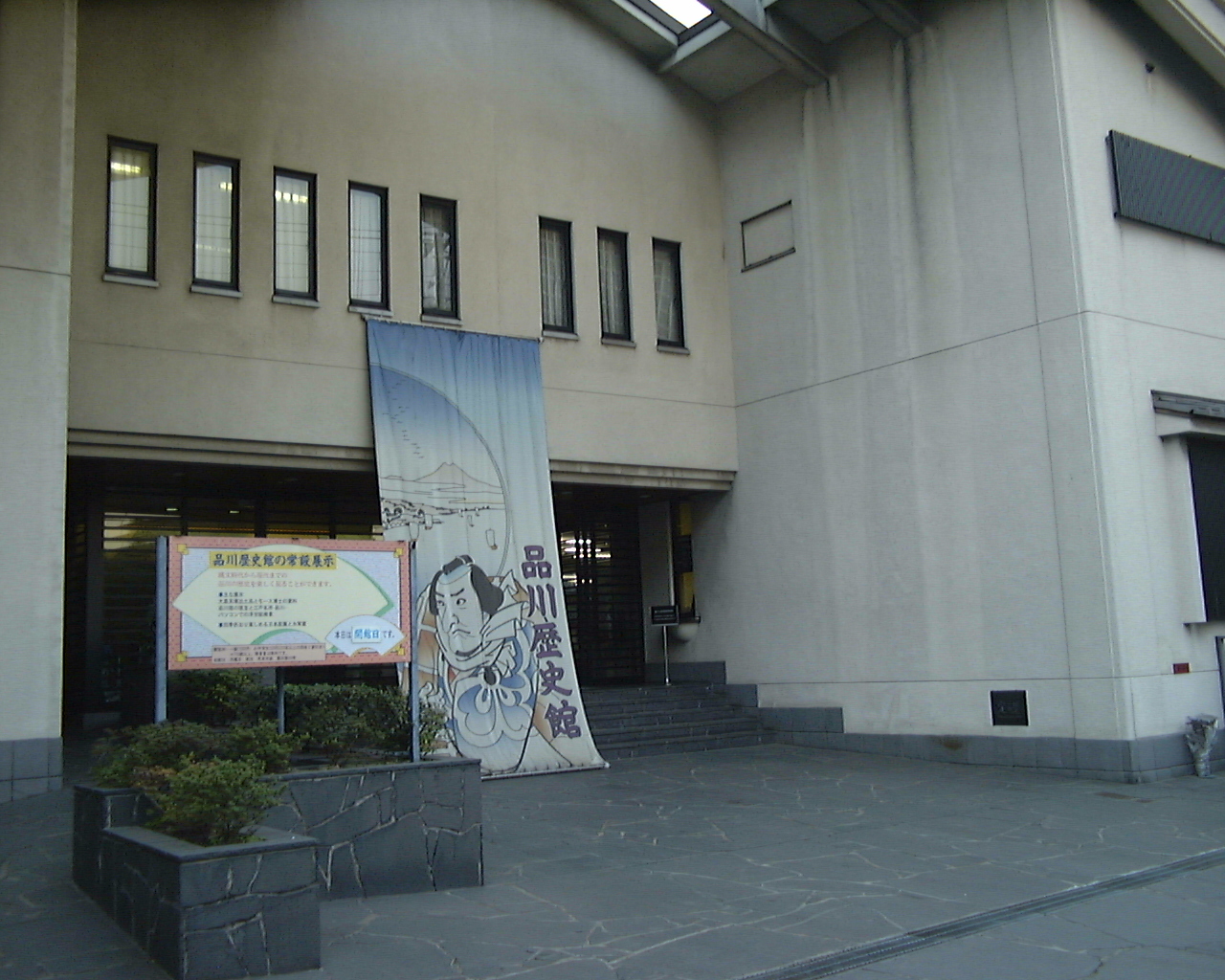
The Shinagawa Historical Museum stands a short walk from Omori Station. It has a permanent exhibition in two rooms about the history of the part of Tokyo that today is called Shinagawa City.

[Shinagawa Historical Museum]

The ancient history centers on the Omori Shell Mounds and the Jomon pottery discovered there. This tableland at the coast was convenient for hunting and fishing and therefore settled from an early time.

About halfway between Omori Station and the museum you will have passed the Omori Shell Mounds Garden, where in 1877 Edward S. Morse undertook the first scientific archeological excavation in Japan. The shell mounds are from late and final Jomon (2500-400 BCE) and have delivered Jomon pottery, stone tools, bone article sand skeletons. Nothing remains of the 80 meter long site, but the garden contains a monument to Morse.

[Edward Morse examining a Jomon pot]

In later history Shinagawa’s function as the first post town on the Tokaido Highway occupies central position. An elaborate small-scale model of the post town takes central stage in the room (to see what is left of it: turn left from Shinagawa station, walk along the railway and cross this via the old iron bridge. You will then enter a shotengai shopping street which stands on the spot of the old Tokaido highway and its post station).


[Omori Shell Mound, Shinagawa, Tokyo]

There are displays about Shinagawa as a sightseeing spot in the Edo-period, centering on Gotenyama and its cherry-blossoms; about the Mt. Fuji cult; about Edo-period daimyo mansions; about fishing off the coast and the cultivation of seaweed in the bay when it was cleaner than today; and the coming of the railroads.

The second room focuses on more recent history and especially writers who lived in Shinagawa. There is also garden with a tea house, and in all this is a nice place to drop by, despite the lack of English.
Tel: 03-3777-4060
Hrs: 9:00-17:00; CL Mon (next day if NH), NH, NY (12/29-1/3)
Access:
From JR Oimachi St take a Tokyu bus bound for Ikegami or Kamata and get of at Kashima Jinja-mae stop. Or 10 min. on foot from the Sanno N exit of JR Omori St.

Bach Cantatas (38): Trinity VII (BWV 186, 107 & 187)

The seventh Sunday after Trinity deals with the theme that God can satisfy the hunger of all living creatures, but also that earthly deprivation is a necessary step toward heavenly rewards.

There are three cantatas for this Sunday. A fourth possible cantata, Widerstehe doch der Sünde, BWV 54, has been discussed for Oculi.

Readings:
Romans 6:19–23, "The wages of sin is death; but the gift of God is eternal life"
Mark 8:1–9, "The Feeding of the 4000"

Cantata Studies:
Bach Cantatas Website | Simon Crouch | Emmanuel Music | Julian Mincham | Wikipedia | Eduard van Hengel (in Dutch) | Bach Companion (Oxford U.P.) | Bach: The Learned Musician (Wolff) | Music in the Castle of Heaven (Gardiner)


[Feeding the multitudes by Bernardo Strozzi, early 17th c.]


Cantatas:
  • Ärgre dich, o Seele, nicht, BWV 186 (Leipzig, 1723)

    1. Chorus: Ärgre dich, o Seele, nicht
    2. Recitativo (bass): Die Knechtsgestalt, die Not, der Mangel
    3. Aria (bass): Bist du, der mir helfen soll
    4. Recitativo (tenor): Ach, daß ein Christ so sehr
    5. Aria (tenor, oboe and violins): Mein Heiland läßt sich merken
    6. Chorale: Ob sichs anließ, als wollt er nicht
    after the sermon:
    7. Recitativo (tenor): Es ist die Welt die große Wüstenei
    8. Aria (soprano, violins): Die Armen will der Herr umarmen
    9. Recitativo (alto): Nun mag die Welt mit ihrer Lust vergehen
    10. Aria (soprano, alto, violins, oboes and taille): Laß, Seele, kein Leiden
    11. Chorale: Die Hoffnung wart' der rechten Zeit


    "Do not be vexed, O soul"
    Text & translation

    Scored for four soloists, four-part choir, two oboes, taille (tenor oboe), strings and basso continuo with bassoon.

    This cantata was written in Leipzig in 1723 for the 7th Sunday after Trinity and is based on an Advent cantata BWV 186a from Bach's Weimar period. The text of this cantata was by Salomon Franck, Bach's regular cantata poet in his Weimar days. He used a somewhat old-fashioned structure: no ("modern") recitatives, and therefore only an opening and closing chorus and four consecutive arias in between. Since tempus clausum was observed in Leipzig during Advent and no cantatas were performed, Bach could not perform the work there during Advent. He reworked it into a cantata in two parts by adding recitatives, changing the texts of the arias slightly, replacing the final chorale with verse 11 of the chorale Es ist das Heil uns komm her (1523) by Paul Speratus and adding verse 12 of that chorale as the conclusion of the first part of the cantata. The new librettist is unknown. The eleven movements are divided into two parts, one before and one after the sermon. Thus a new cantata for Trinity VII was born. The old Weimar cantata was lost, but has been reconstructed on the basis of the Leipzig cantata and can now be performed again. The original cantata contained movements 1, 3, 5, 8 and 10 of the later work and a different final chorale by Ludwig Helmbold.

    The text alludes to Jesus' miraculous feeding of the four thousand and dwells on the contrast between physical nourishment on the one hand and spiritual satiation on the other. In other words, the acceptance of earthly deprivation leads to the hope of heavenly rewards.

    The somber opening chorus is based on the readings for the original cantata for Advent III: the Gospel of Matthew (11:2-10), where we read how John the Baptist, Jesus' predecessor, wonders in prison whether Jesus, who shows so few divine traits, is really the promised Messiah; and Jesus asks his disciples to tell John about the miracles they have seen him perform, and "do not be offended that I come in the form of a servant" - after all, this is how God's glory comes over the earth. The chorus focuses on the words "Do not be troubled.

    The four recitatives all end in an arioso. The bass recitative was originally in the voice of John the Baptist, but was changed to reflect the thoughts of this Sunday, about hunger and food, and to connect with the miraculous food story. This is followed by an energetic bass aria that further develops these thoughts.

    The scoring of the four arias shows increasing complexity and a progression from the lowest voice to the higher, with soprano and alto only appearing in the second part. The first bass aria is accompanied only by the continuo, the next two by a trio, and the final aria is a duet with orchestra.

    The tenor aria, accompanied by violin and oboe, continues: "You can recognize the Redeemer by his works: he gives a new perspective to the spiritually paralyzed, and makes the spiritually blinded see light again". The basso continuo runs step by step with the singing voice, together with the radiant dark tone of the oboe da caccia.

    The sixth movement is an upbeat chorale fantasy, "Es ist das Heil.

    The second part of the cantata states that the suffering of the world can bring people closer to the Word of God. After a long accompanied recitative for tenor in which the focus shifts from nourishing the transient physical body to nourishing the spirit, there is a beautiful aria for soprano with a chromatic and tortured harmony. The text is about the living Word as the highest treasure of life; the Lord embraces the lowly and the poor.

    In the fourth aria, the soprano and the alto sing in a sophisticated duet to the dance rhythm of a Siciliano, bouncing energetically along, about eternal faithfulness through all suffering and pain. This is the musical climax of the cantata.

    The work concludes with the same chorale that ended the first part.

    Audio (Leipzig version): Gardiner
    Video (Weimar version): Kay Johannsen


  • Was willst du dich betrüben, BWV 107 (Leipzig, 1724)

    Coro: Was willst du dich betrüben
    Recitativo (bass): Denn Gott verlässet keinen
    Aria (bass): Auf ihn magst du es wagen
    Aria (tenor): Wenn auch gleich aus der Höllen
    Aria (soprano): Er richts zu seinen Ehren
    Aria (tenor): Drum ich mich ihm ergebe
    Chorale: Herr, gib, daß ich dein Ehre


    "Why do you want to distress yourself"
    Text & translation

    Scored for three vocal soloists (soprano, tenor and bass), a four-part choir, corno da caccia to support the chorale tune in the outer movements, two flauti traversi, two oboes d'amore, two violins, two violas and basso continuo.

    Chorale cantata set "per omnes versus" on "Was willst du dich betrüben" by Johann Heermann (1630). The use of the choral text for all musical numbers in the cantata was old-fashioned - Bach used it only in four cantatas. The text does not literally refer to the reading, but has certain themes in common, such as trust in God, even when facing adversaries including the devil.

    In the ephemeral opening chorus the instrumental accompaniment is emphasized rather than the voices; after a recitative by bass, there are four arias in a row: for bass, tenor, soprano and again tenor. The bass aria (with strings) depicts a "hunting scene," playing on the double meaning of the German word "erjagen" ("to achieve," but also "to hunt for").

    The first tenor aria is accompanied by a snaking bass line that clearly symbolizes Satan slithering out of the depths. The mellifluous soprano aria has a lovely oboe d'amore accompaniment and the last one for tenor a lighthearted unisono flute accompaniment.

    The cantata closes with a beautiful siciliano setting of the chorale.

    Video: J.S. Bach Foundation (St. Gallen) - Workshop (in German) - Contemplation (in German)


  • Es wartet alles auf dich, BWV 187 (Leipzig, 1726)

    Part I
    1. Chorus: Es wartet alles auf dich
    2. Recitativo (bass): Was Kreaturen hält, das große Rund der Welt
    3. Aria (alto, oboe): Du, Herr, du krönst allein das Jahr

    Part II
    4. Aria (bass, violins): Darum sollt ihr nicht sorgen
    5. Aria (soprano, oboe): Gott versorget alles Leben
    6. Recitativo (soprano, strings): Halt ich nur fest an ihm
    7. Chorale: Gott hat die Erde zugericht


    "Everything waits for You"
    Text: Chorale by Hans Vogel

    The text of this cantata focuses on the power of the Lord to appease the hunger of all creatures. The expansive and complex opening chorus is based on Psalm 104:27–28, directly related to the reading. The alto aria praises God as the sustainer of life; it is accompanied by the full orchestra in a dance-like rhythm. Part two is opened by a striding bass aria as Vox Christi - with an obbligato of all of the violins - on Matthew 6:31–32 from the Sermon on the Mount. The ensuing soprano aria is the musical highlight of the cantata, with a falling octave that pictures God's forgiveness. The interplay of the voice with the accompanying oboe is very interesting. The cantata is closed by verses 4 and 6 of Hans Vogel's chorale "Singen wir aus Herzensgrund" (1563). Bach parodied the music of this cantata in his g minor Mass BWV 235.

    Video: J.S. Bach Founation (St. Gallen) - Workshop (in German) - Contemplation (in German)

Bach Cantata Index

    20 juli 2012

    Best Science Fiction Films (Movie Reviews)

    Science fiction films don't need an introduction, let alone definition, as the genre has existed for as long as there are feature films: in 1902 already, Georges Melies' A Trip to the Moon amazed audiences with its trick photography effects. The next major example came from Germany in 1927: Metropolis by Fritz Lang. While during the 1930s, 40s and 50s the genre consisted mainly of low-budget B-movies aimed at children (although there are a couple of good noir films as well), a  landmark came in 1968 with Stanley Kubrick's 2001: A Space Odyssey. In France, too, some good and serious films were made in the 60s. From the late 1970s on, following in the wake of Star Wars and Close Encounters of the Third Kind, big-budget science fiction films packed with special effects became popular. The 1980s and 1990s were a golden time for SF films. In the present century, the genre has gradually become lost in "computer game" films only after visual effects.

    I discuss ten of my favorite films from the late 1950s on, leaving out subgenres as monster films and disaster films, which can better stand on their own.
    • Invasion of the Body Snatchers (1956) by Don Siegel and with Kevin McCarthy, Dana Wynter and Larry Gates. A small-town doctor discovers that due to an extra-terrestrial invasion the population of his local community is being replaced by alien clones devoid of any emotion or individuality. The film has been interpreted as an indictment of both Communism and McCarthyism, but the director said he meant it more broadly: "I think that the world is populated by pods and I wanted to show them. I think so many people have no feeling about cultural things, no feeling of pain, of sorrow..." (quoted from Wikipedia). How scary it is to loose one's personality and humanity, is made vividly clear by Don Siegel. This is not only a great and concise scifi film, but also one of the best noir films ever made. Criterion essay. 
    • The Blob (1958) by Irvin S. Yeaworth Jr. and with Steve Mcqueen and Naeta Corsaut. Independent production. An alien resembling a giant amoeba-like blob of jelly lands on earth from outer space and terrorizes a small community. The locals refuse to listen to a group of teenagers who have witnessed the blob's destructive power. In the meantime, the Thing just keeps growing, by ingesting more and more inhabitants, turning red by their blood. The lethal lump can't be killed, but finally a solution is found. Campy fun (with a tongue-in-cheek opening song by Burt Bacharach), typical of 1950s schlock sci-fi. Or is there something deeper as well - is the blob's hungry mass perhaps symbolic of the fast growth of consumerism in the 50s? Criterion essay one and two.  
    • Alphaville (1965) by Jean-Luc Godard and with Eddie Constantine, Anna Karina and Akim Tamiroff. A trenchcoat-wearing secret agent with a characteristic weathered visage has been sent to the space city of Alphaville, the capital of a technocratic dictatorship, to find a missing person and free the city from its tyrannical ruler, an evil scientist who has outlawed love and self-expression and rules with the help of a supercomputer, Alpha 60 (the terribly croaking speech synthesizer with which this computer "speaks" is the only defect in the film).. In this weird world women are bar-coded (many of them work as "Seductress Third Class"), and dictionaries are bibles but words as "conscience" or "tenderness" are banned and crossed out. People who don't fit in are executed via a pool-side ceremony - female swimmers pull the bodies out of the water. A combination of dystopian science fiction with film noir that foregoes special effects or elaborate sets, but has been shot at night in the Parisian suburbs. “What transforms darkness into light?” “La poèsie.” Criterion essay. 
    • Fahrenheit 451 (1966) by Francois Truffaut and with Oskar Werner, Julie Christie and Cyril Cusack. After the novel by Ray Bradbury. In an oppressive future, books have been banned by a government fearing an independent-thinking public. People are drugged into compliance and get their (dis-) information from wall-length television screens. Books are destroyed by groups of firemen with flamethrowers. The film tells the story of one such fireman, who begins to question his task when he falls in love with an unconventional neighboring girl who secretly reads books. In the end, both escape to the countryside where they find groups of Book People trying to keep the cultural tradition alive. In the beautiful climax we see the Book People walk through a snowy countryside reciting the poetry and prose they've memorized. An indictment of all forms of tyranny over the human mind. 
    • 2001: A Space Odyssey (1968) by Stanley Kubrick and with Keir Dullea, Gary Lockwood and William Sylvester. Iconic "cult film," in which traditional narrative has been replaced by a purely cinematic audiovisual spectacle. The Dawn of Man opening sequence is very impressive: a group of early humans learns how to use a bone as a weapon and so take the next evolutionary step; when hurled into the air, the bone changes into an earth orbiting satellite. The film tells about the appearance of a mysterious black monolith on the moon that has apparently been influencing human evolution (it is perhaps a token sent by a more advanced civilization). The monolith emits a signal that points at Jupiter so a group of astronauts, led by the "infallible," intelligent computer H.A.L. 9000, is sent on a secret mission to the giant planet. The psychedelic light-show at the end of the film is perhaps a curio from the bygone 1960s, but the "star child" idea - the astronaut regressing into a fetus staring from afar at the earth - is very beautiful - it signifies a new beginning for mankind. The pioneering special effects found throughout remain impressive and 2001 has been called a "creative Big Bang" by other film makers. This is a film of pure, nonverbal beauty. 
    • Alien (1979) by Ridley Scott and with Sigourney Weaver, Tom Skerritt and John Hurt. Scifi horror with impressive images based upon the work of Swiss surrealist artist H. R. Giger, who also cooperated on the film and won an Academy award for his design. A highly aggressive extraterrestrial creature stalks and one by one kills the crew of a spaceship. The bio-mechanical monster with its elongated head and mouth full of steel teeth (and second mouth inside the first one) is the most frightening thing to appear in the history of film. Initially, just out of its egg, it hugs the face of one of the crew members, and then hides inside his body, suddenly bursting forth from his chest. A complicating factor is that one of the crew members is a crypto-robot, working against the others to save the monster and bring it back to earth. A film that will have you on the edge of your seat! 
    • Blade Runner (1982) by Ridley Scott and with Harrison Ford, Sean Young and Rutger Hauer. fter a story by Philip K. Dick. Beautifully filmed images of a post-apocalyptic Los Angeles overpopulated by Asians, in a retro-fitted style, but the story, a clichéd detective yarn, is a bit of a letdown. A "Blade Runner" (a futuristic, burnt out Philip Marlowe) has to track down and kill ("retire") a small group of rebel android "replicants." These are organic robots meant to do hard work in space and forbidden to visit the earth. As a safety measure, they only have a lifespan of four years - now four of them have come down to earth and are looking for the corporate head that created them in order to force him to let them live longer. That makes them very human, for what is after all the difference of a few score years? The leader of the replicants also saves the life of the detective, but his kindness only serves to offset the cruelty of the blade runner who coldly exterminates them - including two women. The film rightly puts in doubt whether he is really human. An excellent neo-noir (at a nicely slow pace) with a well-deserved cult status. 
    • The Fly (1986) by David Cronenberg and with Jeff Goldblum and Geena Davis. A remake of the 1958 film The Fly, of which it retains only the basic premise of a scientist accidentally merging with a housefly during a teleportation experiment. The first half of the film lets us get acquainted with the scientist and a female journalist he has picked up at a party - when asked for something personal to be used in a demonstration of teleportation, she removes one of her stockings. They agree that she will document his experiments and write a book about it, and become lovers on the side. The accident with the fly happens when the scientist is in a jealous rage because his reporter-cum-girlfriend has left to straighten things out with a former partner. After that the film zooms in on the slow transformation and progressive decomposition of the human body and what it does to the owner. This has been interpreted as a metaphor for the AIDS epidemic that started in the 1980s, but it can also be seen as symbolic for illness and old age in general.  On top of everything, the girlfriend discovers she is pregnant and thinks with dread about the monster that may be gestating in her womb... Great special effects, with Academy Award-winning makeup. 
    • Total Recall (1990) by Paul Verhoeven and with Arnold Schwarzenegger, Rachel Tricotin, Sharon Stone and Michael Ironside. Based on a story by Philip K. Dick. In 2084, a construction worker visits a memory-implant travel service to transport him to Mars for an adventure trip. After arriving at Mars, he realizes that his life on earth was in fact a set of artificial memories, implanted by his enemies to take him out of action. In reality, he is a secret agent fighting against the evil Mars administrator Cohaagen. What follows is series of breath-taking, tense action sequences. As Cohaagen controls the Mars population by manipulating the supply of oxygen, his power can be neutralized by restarting an oxygen generator, that will create a normal atmosphere on Mars. Complex and visually mesmerizing, with wonderful make-up effects - and Schwarzenegger for once is not a macho type, but just a confused guy, allowing him the opportunity to really act. There are also some interesting mutants in Venusville, the red light district on Mars. 
    • The Cell (2000) by Tarsem Singh and with Penelope Lopez, Vince Vaughn and Vincent D'Onofrio. A mixture of science fiction with a psychological thriller about a serial murderer a la Hannibal Lecter. A psychotherapist is adept at an experimental treatment which allows her mind to literally enter the mind of her patients. She is persuaded by an FBI agent to enter the mind of a comatose serial killer in order to learn where he has hidden his latest kidnap victim - who over a 40 hour period is slowly being drowned in a glass tank ("the cell"). In a race against time, the psychotherapist has to explore the twisted mind of the killer to get the information she needs, but his damaged personality poses a threat to her own life and sanity. Great visuals, and beautiful costumes by Eiko Ishioka of "Dracula" fame. Despite the pyrotechnics, this is a film that cares about its characters, and that poses important questions, as: how can an ordinary child become such an inhuman monster? 
    • Solaris (2002) by Steven Soderbergh and with George Clooney and Natascha McElhone. Based on the novel by Stanislav Lem and the 1972 legendary movie by Tarkovsky. A psychological drama in the guise of a scifi film. A troubled psychologist is sent to investigate the crew of an isolated research station orbiting a bizarre planet, whose ocean functions as a huge, fluid-like brain.This "brain" may be responsible for the mental disruptions the crew members experience - it apparently gives life to the contents of the unconscious mind. In the station, the psychologist meets his deceased wife, with whom he had a passionate relationship before she committed suicide. It is of course not really his wife - she is an amalgam of his memories of her that have taken physical shape. But our memories of even those closest to us are never the complete, other person - we always know others only partially, and on top of that, through our own prejudices. The wife is suicidal, she complains, because that is how her husband views her. While we see his previous life with his wife on earth via flashbacks, the psychologist struggles with his memories and his feelings of regret and tries to find an opportunity for a second chance. Not a special effects extravaganza, but rather a sharp and incisive exploration of the unreliability of reality and the power of the human unconscious.  

    19 juli 2012

    Japanese Masters: Ichikawa Kon (film director)

    Ichikawa Kon (1915-2008; 市川崑) was born in Ise and educated at a technical college in Osaka. He was interested in animation and joined the local J.O. Studios. Later he moved to the feature film department and worked as assistant for, among others, Abe Yutaka. In the early 1940s, J.O.Studios merged with other film companies and became the large Toho. At Toho, Ichikawa Kon met translator Wada Natto (real name Mogi Yumiko), whom he married in 1948 and who would be the script writer for many of his movies.

    Ichikawa's first film, Musume Dojoji (1946), on a Joruri subject, was forbidden by the U.S. military censorship that prevailed in Japan from 1945 to 1952, because it was deemed "too feudal." But he was fond of such literary subjects and in collaboration with his wife, between 1950 and 1965, produced his masterworks which were often based on contemporary novels. Wada had a great talent for adapting literature to the screen and she wrote 34 scripts in this period. Adaptations include Tanizaki's The Key and The Makioka Sisters, Kawabata's The Old Capital, Mishima's The Temple of the Golden Pavilion, Soseki's Kokoro and I am a Cat, and Ooka Shohei's Fires on the Plain.

    This last war film also brought Ichikawa some recognition in the West, as did another war tale (based on a novel by Takeyama Michio) called The Burmese Harp. In 1965 Ichikawa made Tokyo Olympiad, a large documentary about the Olympics of the previous year.

    After the middle sixties, Ichikawa's output declined. Tokyo Olympiad was in retrospect a sort of watershed. One reason was the gradual breaking up of the studio system - even big studios like Toho didn't have the resources anymore to make art films. In order to lure what audience they could to the cinema, films became more extreme in the use of violence and sex. Wada was not happy with this new tone and retired from script writing - and this was a great loss for the films her husband Ichikawa made.  In the second half of the sixties, the once so productive director only made one feature-length film, in the five years after that only three, among which the best was The Wanderers (1973).

    In 1976 Ichikawa bowed to the demands of commerce and started his series of thrillers based on the popular murder mysteries by Yokomizo Seishi. Starting with The Inugami Family, he made five such films until the end of the 1970s, and three more later on. The last film he helmed (aged 87!) was in fact a remake of The Inugami Family (2006).

    But in the 1980s, Ichikawa also made a sort of come-back with literary subjects. He filmed The Old Capital by Kawabata, Ohan by Uno Chiyo and, more notably, The Makioka Sisters by Tanizaki. He also remade his own The Burmese Harp. Besides more thrillers, in the 90s he also addressed a perennial Japanese subject in The 47 Ronin. 


    Some of Ichikawa's best films are:
    • The Heart (Kokoro, 1955) 
      Adaptation of Natsume Soseki's famous novel about a student idolizing a guilt-ridden teacher.
    • The Burmese Harp (Biruma no Tategoto, 1956)
      Rather sentimental film about a Buddhist monk searching for the bodies of Japanese war dead. Based on a novel by Takeyama Michio. This compassionate anti-war film became the first work by Ichikawa Kon to attract attention in the West (Venice Film festival, Academy Award nomination for best foreign film). In 1985, Ichikawa remade the film in color with different actors. 
    • Conflagration (Enjo, 1958)
      Adaptation of Mishima Yukio's The Temple of the Golden Pavillion, about a novice who destroys the temple he loves to preserve its purity. With Ichikawa Raizo as the novice monk. This is one of Ichikawa Kon's best works.
    • Odd Obsession (Kagi, 1959)
      Adaptation of "scandalous" novel by Tanizaki Junichiro, an irreverent satire on aging and sexuality. With Kyo Machiko, Nakamura Ganjiro and Nakadai Tatsuya. Won the Jury Prize at Cannes in 1960.
    • Fires on the Plain (Nobi, 1959)
      The hellish experiences of a Japanese soldier lost in the mountains of the Philippines at the end of the war. Often considered as Ichikawa Kon’s masterpiece. Funakoshi Eiji plays the lost Japanese soldier. Note that being captured by the enemy was considered as a great dishonor at that time. 
    • Her Brother (Ototo, 1960)
      Family drama about a delinquent brother ill with tuberculosis. After a novel by Koda Aya, and with Kishi Keiko, Tanaka Kinuyo and Kawaguchi Hiroshi. Special mention at Cannes festival. Remade in 2010 by Yamada Yoji as a tribute to Ichikawa Kon. 
    • The Outcast (Hakai, 1962)
      Adaptation of Shimazaki Toson's well-known novel (translated as "The Broken Commandment") about the persecution of the burakumin underclass.
    • An Actor's Revenge (Yukinojo Henge, 1963)
      Period film about a Kabuki female impersonator (Hasegawa Kazuo) who seeks revenge for the death of his parents. All-star cast, great cinematography. 
    • The Wanderers (Matatabi, 1973) 
      Satiric period film in which the yakuza code compels one of the protagonists to kill his father.
    • The Inugami Family (Inugamike no Ichizoku, 1976)
      Convoluted murder mystery with supernatural overtones, based on a popular novel by Yokomizo Seishi. Understated detective Kindaichi, a sort of Japanese Columbo, is played by Ishizaka Koji. Other Kindaichi films made in the following years were A Rhyme of Vengeance (Akuma no Temari-uta, 1977); Island of Horrors (Gokumonto, 1977); Queen Bee (Joobachi, 1978); and The House of Hanging (Byoinzaka no kubi kukuri no ie, 1979).
    • The Makioka Sisters (Sasameyuki, 1983)A Sensuously gorgeous film, a worthy adaptation of Tanizaki's masterful novel about the lives of four sisters from a traditional merchant family in the Kansai. The major plot consists of attempts to find a husband for the second sister. 
    • Crane (Tsuru, 1988)
      Based on a folk tale and with Yoshinaga Sayuri as protagonist. One snowy night a beautiful woman named Tsuru (Crane) visits a poor peasant and says she will become his wife...
    • The 47 Ronin (Shijushichinin no shikyaku, 1994)
      Ichikawa's take on Chushingura. With Takakura Ken and Miyazawa Rie. 
    My personal favorites are: Conflagration, Odd Obsession, The Makioka Sisters and An Actor's Revenge.

    15 juli 2012

    Bach Cantatas (37): Trinity VI (BWV 170 & 9)

    The sixth Sunday after Trinity treats two themes: the Lutheran belief that salvation from sin is only possible by God's grace; and a passage from the Sermon on the Mount about better justice than the justice of merely observing laws and rules.

    Readings:
    Romans 6:3–11, "By Christ's death we are dead for sin"
    Matthew 5:20–26, Sermon on the Mount: "better justice"

    Cantata Studies:
    Bach Cantatas Website | Simon Crouch | Emmanuel Music | Julian Mincham | Wikipedia | Eduard van Hengel (in Dutch) | Bach Companion (Oxford U.P.) | Bach: The Learned Musician (Wolff) | Music in the Castle of Heaven (Gardiner)


    Cantatas:
    • Vergnügte Ruh, beliebte Seelenlust, BWV 170, 28 July 1726

      Aria: Vergnügte Ruh, beliebte Seelenlust
      Recitativo: Die Welt, das Sündenhaus
      Aria: Wie jammern mich doch die verkehrten Herzen
      Recitativo: Wer sollte sich demnach wohl hier zu leben wünschen
      Aria: Mir ekelt mehr zu leben


      "Delightful rest, beloved pleasure of the soul"
      Text & translation


      Scored for an alto soloist and a small ensemble of oboe d'amore, two violins, viola, obbligato organ and basso continuo.

      Cantata for alto with organ obbligato. The theme is "sin" and the need to renounce it in order to attain salvation. Bach composed the cantata for the 6th Sunday after Trinity in Leipzig. It was premiered on July 28, 1726, together with the cantata "Ich will meinen Geist in euch geben" by Johann Sebastian Bach's cousin Johann Ludwig Bach in the main service, so that one cantata was heard before and one after the sermon. It is not known which cantata was sung before the sermon - probably the work of Johann Ludwig Bach, since only his text clearly refers to the Sunday Gospel.

      With "Vergnügte Ruh, beliebte Seelenlust," Lehms begins a song of praise for "true peace of mind" and the "stillness and tranquility of the heart." But the first movement is only a gentle prelude. In the following recitative, which makes reference to the Sunday Gospel, the author then rails against the multitude of sinners. In the text of the second aria, he laments the false way of the human heart. As at the beginning, the last line of this aria reads: "Wie jammern mich doch die verkehrten Herzen". Thus Lehms returns to the beginning. The next recitative continues the lament until it finally returns to God's command to love even the enemy as a friend. The final aria completes the thought and returns to the "happy peace" of the beginning.

      The opening aria is indeed one of the most beautiful and soothing arias Bach ever wrote, a rocking lullaby that brings a "delightful rest" to the soul.

      The recitative and second aria, on the other hand, are more desolate, with tortured chromatisms in the music to depict the "perverted heart set against God". The aria also lacks a continuo, perhaps symbolic of the lack of direction in the lives of those who ignore the Word of God.

      After another recitative, the final aria turns away from the world and looks to heaven - it is more upbeat, even buoyant, even though the text calls for death as the only possible release from sin.

      Video: J.S. Bach Foundation (St. Gallen) - Workshop - Contemplation /
      Netherlands Bach Society - Interview with altus Alex Potter


    • Es ist das Heil uns kommen her, BWV 9, c 1732–1735

      Coro: Es ist das Heil uns kommen her
      Recitativo (bass): Gott gab uns ein Gesetz
      Aria (tenor): Wir waren schon zu tief gesunken
      Recitativo (bass): Doch mußte das Gesetz erfüllet werden
      Aria (soprano, alto): Herr, du siehst statt guter Werke
      Recitativo (bass): Wenn wir die Sünd aus dem Gesetz erkennen
      Chorale: Ob sichs anließ, als wollt er nicht


      "It is our salvation come here to us"
      Text & translation

      Scored for a chamber music ensemble of four vocal soloists (soprano, alto, tenor and bass), a four-part choir SATB, flauto traverso, oboe d'amore, two violins, one of them solo, viola, and basso continuo.

      Bach composed the cantata in Leipzig between 1732 and 1735 for the 6th Sunday after Trinity. When he composed his second cycle of chorale cantatas in 1724, he was not in Leipzig that Sunday but in Köthen with Anna Magdalena, probably for a concert for his esteemed former principal, Prince Leopold, so he added this late cantata to the cycle. It is based on the Lutheran chorale Es ist das Heil uns kommen her by Paul Speratus, which was published in 1524 in the Achtliederbuch, the first Lutheran hymnal. The theme of the chorale is a summary of the Lutheran doctrine that only faith and God's grace bring salvation, not good works. The three recitatives - all three for bass - can be seen as a sermon, deepened by the inserted arias.

      The cantata begins with a chorale fantasia on this very theme, the cantus firmus sung by the soprano in unadorned long notes, with an "unusual sound" quality produced by the combination of flute and oboe d'amore in the accompaniment.

      All three recitatives (secco) are sung by the bass as Vox Christi, a kind of sermon on the law of God. The tenor aria with solo violin accompaniment is an evocation of spiritual resignation - it depicts the "sinking" of "we were already too deeply sunk" in downward motifs.

      The duet for soprano and alto is set in intricate canonic counterpoint. In Bach's time, canons were a metaphor for God's law and also - since they can be continued indefinitely - a bridge to the next world.

      In the final chorale, the lower voices sing in unusual polyphony.

      Video: J.S. Bach Foundation (St. Gallen) - Workshop (in German) - Contemplation
      (in German)

      8 juli 2012

      Bach Cantatas (36): Trinity V (BWV 93 & 88)

      The fifth Sunday after Trinity treats the theme of Peter (Simon) as a "fisher of men."

      Readings:
      1 Peter 3:8–15 "Be patient in affliction"
      Luke 5:1–11, "The miraculous catch of fishes"

      Cantata Studies:
      Bach Cantatas Website | Simon Crouch | Emmanuel Music | Julian Mincham | Wikipedia | Eduard van Hengel (in Dutch) | Bach Companion (Oxford U.P.) | Bach: The Learned Musician (Wolff) | Music in the Castle of Heaven (Gardiner)


      Cantatas:
      • Wer nur den lieben Gott läßt walten, BWV 93, 9 July 1724

        Coro: Wer nur den lieben Gott läßt walten
        Recitativo (+ chorale, bass): Was helfen uns die schweren Sorgen?
        Aria (tenor): Man halte nur ein wenig stille
        Aria Duetto (soprano, alto): Er kennt die rechten Freudenstunden
        Recitativo (+ chorale, tenor): Denk nicht in deiner Drangsalhitze
        Aria (soprano): Ich will auf den Herren schaun
        Chorale: Sing, bet und geh auf Gottes Wegen


        "If you but permit God to prevail"
        Text & translation

        Scored for four soloists (soprano, alto, tenor and bass) a four-part choir, two oboes, two violins, viola, viola da gamba and basso continuo.

        A symmetrically composed chorale cantata, as the chorale melody "Wer nur den lieben Gott läßt walten" by Georg Neumark (which Bach often used and must have liked very much) is at the beginning, end and in the central duet, and both halves also contain a recitative and an aria. The chorale is connected in general to the prescribed readings. The treatment of the chorale in this cantata is atypically complex, with chorale melody and text skillfully - and inventively - interwoven throughout the cantata. With no da-capo arias, the work has the characteristics of a chorale partita (despite the sections of freely versified text), and its concisely structured movements make for a particularly dense and highly persuasive composition.

        The opening chorale fantasia is like a small concerto, composed with unusual care even for Bach. In both recitatives, individual passages of the chorale are interspersed with recitative commentary - an interesting technique.

        The moving tenor aria is a classic slow movement. Note the short pauses every two bars - after all, the text says, "Only hold yourself still a little".

        In the central duet, again based on the chorale, the soprano, alto, and continuo form a sort of independent trio, while the chorale melody is heard in the unison strings. Bach later transformed this movement into an organ chorale (BWV 642).

        The final soprano aria (sung by a boy soprano in Bach's time) is - as Bach often did after a difficult theological argument - a childlike affirmation of faith. The concluding chorale harmonization is deliberately simple.

        Video: J.S. Bach Foundation (St. Gallen) - Workshop (in German) - Contemplation (in German)


      • Siehe, ich will viel Fischer aussenden, BWV 88, 21 July 1726

        Part I
        "Basso solo": Siehe, ich will viel Fischer aussenden
        Recitativo (tenor): Wie leichtlich könnte doch der Höchste uns entbehren
        Aria (tenor): Nein, Gott ist allezeit geflissen

        Part II
        Arioso (tenor, bass): Jesus sprach zu Simon: Fürchte dich nicht
        Aria Duetto (soprano, alto): Beruft Gott selbst, so muss der Segen
        Recitativo (soprano): Was kann dich denn in deinem Wandel schrecken
        Chorale: Sing, bet und geh auf Gottes Wegen

        "Behold, I will send out many fishers"
        Text & translation

        Scored for four vocal soloists (soprano, alto, tenor and bass), a four-part choir SATB only in the chorale, two horns, two oboes d'amore, taille, two violins, viola, and basso continuo.

        The two parts of this cantata are like exposition and resolution. The cantata begins with the bass as the voice of God, announcing the sending out of many fishermen, based on the prescribed Gospel reading of the great catch of fish by Peter. Again, the music paints a seascape, with an undulating barcarolle. Then suddenly, at the words "And afterwards I will send out many hunters," the music changes to a hunting scene, and horns join the orchestra. Since this is not a real aria, Bach called it a "basso solo," but it is easily the musical highlight of the entire cantata.

        The next tenor recitative ends with the question of whether God will forsake us, which is immediately answered with "Nein, nein" in the tenor aria. This then changes to "Yes, yes" as the aria sings of the right path, and the clear, even structure of this piece may well symbolize that path.

        The second half of the cantata begins with an arioso for bass as Vox Christi: "Do not be afraid, for from now on you will catch people. This is followed by a buoyant, confident duet for soprano and alto on the theme that if God is calling us, "then blessing must rest in abundance on all our deeds.

        After a brief exhortation in the soprano recitative to be patient in tribulation, the cantata closes with a straightforward setting of Neumark's chorale, "Wer nur den lieben Gott lasst walten.

        Video: J.S. Bach Foundation (St. Gallen) - Workshop (in German) - Contemplation (in German)


      Bach Cantata Index

      3 juli 2012

      All's Well That Ends Well by William Shakespeare

      All's Well That Ends Well is a cynical comedy that angered the Victorians because of its sexual politics - a determined woman gets what she wants, even to the point of forcing herself on her man. It has often been called the "Unfortunate Comedy" because spectators and critics seem to have a hard time cracking this nut.


      Helena, the orphaned daughter of a famous doctor, cures the King of France of a fistula, and as a reward chooses Bertrand de Roussillon, her childhood love, for spouse. Bertrand refuses, claiming the difference in social rank and only relents when the king puts pressure on him. He goes through the marriage ceremony, but then immediately leaves for Florence to fight in a war, without sharing his bed with Helena and thus leaving the marriage unconsummated. He tells Helena he will only regard her as his wife if she manages to get hold of a precious ring that never leaves his finger and can produce offspring that is manifestly his. Two things impossible without his cooperation, so we should read this as "I will never consider you as my wife." But Helena takes him legalistically up on his word. She travels as a pilgrim to Florence, where Bertrand has just returned from the battle field and is courting a young woman, Diana. With the help of Diana and her mother, Helena not only obtains Bertrand's ring, but by a "bed trick" also lies with him in Diana's stead (a trick made possible since due to the presence of the mother in the next room, things have to proceed in the pitch-dark and in utter silence). Back in France, she confronts Bertrand in front of the King, the baby that was the fruit of the bed trick on her arm, and although Bertrand first rather weakly tries to wriggle out of it, he has to receive her (although conditionally) as his wife.

      Considering such a story, the title can only be meant ironical: things do seem to end well, but of course they are not well at all. The story Shakespeare uses is from Boccaccio's Decamerone, and concentrates on the successful trick, instead of developing character. It is a romantic comedy with cardboard characters, fun but flat. Shakespeare manages the opposite: his characters are real, three-dimensional people and in his realistic world, tricking people into compliance does not work. People, after all, have their own feelings, their own thoughts and their own likes and dislikes. In other words, this marriage is not going to work. Bertrand's consent is conditional - he wants a good explanation - and of course he will not be happy when he hears he has been tricked into sleeping with Helena.

      Why does Bertrand refuse marriage with Helena? Probably because as his childhood companion and a great friend of his mother, she is too close. As a man, he wants to be independent from the two women with whom he has spent his adolescence.

      Why is Helena so bent on marrying Bertrand? She is treated as a daughter by the Countess, Bertrand's mother, and she probably wants to put that relation on a legal basis. And of course she wants to get the better of Bertrand, because after his public refusal of marriage her feelings are hurt.

      So this is not a flawed play or an imperfect text, as some critics will have it. It is a mature play by a mature author, showing us that in the real world fairy tales don't work.

      Resources:
      Play text.
      Audio file (Librivox)
      Tale from the Decamerone (scroll down to Tale 3.9)
      Article "Dark Shades in the Unfortunate Comedy"
      Article: "The Search for the Lost Husband"

      The Plays of Shakespeare

      2 juli 2012

      Bach Cantatas for Feasts on Fixed Days (60): Visitation (BWV 147 & 10)

      The Visitation of the Blessed Virgin Mary refers to Mary's visit to Elizabeth as told in the Gospel of Luke, 1:39-56.

      Mary visits her cousin Elizabeth at a time when both are pregnant, Mary with Jesus and Elizabeth with John the Baptist. Mary wants to bring divine grace to Elizabeth and her unborn child, exercising for the first time her function as "mediator" between God and man. During the encounter, Mary also proclaims the Magnificat ("My soul magnifies the Lord"), which is why this hymn is traditionally reserved for this feast.

      This feast is of medieval origin (mid-13th century). It was kept by the Franciscan Order, which spread it to many churches. In 1389, Pope Urban VI included it in the Roman calendar to be celebrated on July 2.

      Readings:
      Isaiah 11:1–5, Prophecy of the Messiah, "A rod shall come out of Jesse"
      Luke 1:39–56, Visitation and Magnificat

      Cantata Studies:
      Bach Cantatas Website | Simon Crouch | Emmanuel Music | Julian Mincham | Wikipedia | Eduard van Hengel (in Dutch) | Bach Companion (Oxford U.P.) | Bach: The Learned Musician (Wolff) | Music in the Castle of Heaven (Gardiner)


      Cantatas:
      • Herz und Mund und Tat und Leben, BWV 147, 2 July 1723 (adapted from BWV 147a for Advent IV)

        Part 1
        Chorus: Herz und Mund und Tat und Leben
        Rezitativ T: Gebenedeiter Mund!
        Aria A: Schäme dich, o Seele nicht
        Rezitativ B: Verstockung kann Gewaltige veblenden
        Aria S: Bereite dir, Jesu, noch heute die Bahn
        Chorale: Wohl mir, dass ich Jesum habe
        Part 2
        Aria T: Hilf, Jesu, hilf, dass ich auch dich bekenne
        Rezitativ A: Der höchsten Allmacht Wunderhand
        Aria B: Ich will von Jesu Wundern singen
        Chorale: Jesu bleibet meine Freude


        "Heart and Mouth and Deed and Life"
        Text and translation

        Scored for four vocal soloists (soprano, alto, tenor and bass), a four-part choir, trumpet, two oboes (oboe d'amore, oboe da caccia), two violins, viola, and basso continuo including bassoon).

        This cantata is famous for the melody "Jesu bleibet meine Freude" at the end of both parts. The text is from a Weimar cantata by Salomon Franck for the 4th Advent. Since no cantatas were performed in Leipzig between Advent and Christmas, it couldn't be used there. For the 4th Advent, the texts focused on John the Baptist, with the Gospel being his testimony of himself and of the one who would come after him. This influence is evident in the opening refrain of the Leipzig version: "Heart and mouth and deed and life must bear witness to Christ...". By adding recitatives and changing the chorale, an unknown poet adapted the music for the feast of the Visitation of the Blessed Virgin Mary on July 2, 1723. This change, as well as the transformation into a two-part sermon cantata, reflects the changed demands on Bach's church music in Leipzig compared to his time in Weimar. But the arias, with their intimate and soloistic qualities, reveal their origins in Bach's Weimar court music. The original closing chorale was replaced by the hymn "Jesu, meiner Seelen Wonne" (1661) by  Martin Janus, using the melody of "Werde munter, mein Gemüte" by Johann Schop.

        The cantata opens with a lively chorus featuring trumpet, oboe, and strings, followed by a choral fugue, a movement unchanged from the Weimar version. The tenor recitative, accompanied by lush strings, aligns the cantata text with the Marian feast and draws connections to the Magnificat. The alto aria, similar to the opening chorus, expresses confession to the Savior. It is scored as a trio for the oboe d'amore, alto and continuo, in an overall very expressive air that has characteristics of an intimate meditation. The bass recitative echoes Mary's canticle and calls for preparation to receive the Savior.

        In the soprano aria, Bach employs his characteristic "walking music," with a walking bass and a high, silvery soprano calling on Jesus to prepare the way. Scored as a trio, the solo violin expresses confidence in divine mercy through triplets punctuated by the continuo. The soaring soprano gives a serene and gracious feeling to a movement which otherwise appears quite simple. The cantata concludes with the familiar "Jesu bleibet meine Freude" chorale, in which the choir sings line by line, interspersed with orchestral interludes. The choral movement is homophonic with the soprano cantus firmus, the latter reinforced by the trumpet.

        The heartfelt tenor aria that opens the second part remains unchanged, expressing confession to the Lord and ardent love in the context of the Marian feast. The aria is based on a three-note motto: "Help, Jesu, help.

        The long alto recitative, referring to Mary's visit to Elizabeth, is accompanied by two English horns. The energetic bass aria has been significantly rewritten to shift its focus from John the Baptist to a more general praise. It features the trumpet and full orchestra and leads into the final "Jesu bleibet meine Freude.

        Video: Netherlands Bach Society - Interview Tenor Immo Schröder en hoboïst Emma Black /
        J.S. Bach Foundation (St. Gallen) - Workshop (in German) - Contemplation (in German) - Explanation "Bach Factory" (in English)


      • Meine Seel erhebt den Herren, BWV 10, 2 July 1724

        Coro: Meine Seel erhebt den Herren
        Aria (soprano): Herr, der du stark und mächtig bist
        Recitativo (tenor): Des Höchsten Güt und Treu
        Aria (bass): Gewaltige stößt Gott vom Stuhl
        Duetto (alto, tenor) e chorale: Er denket der Barmherzigkeit
        Recitativo (tenor): Was Gott den Vätern alter Zeiten
        Chorale: Lob und Preis sei Gott dem Vater


        "My Soul Magnifies the Lord"
        Text and translation

        Scored for four soloists (soprano, alto, tenor and bass, four-part choir, trumpet (or tromba di tirarsi), two oboes, two violins, viola and basso continuo.

        This cantata is based on Martin Luther's German translation of the Magnificat. The original plainsong melody, known as the Tonus Peregrinus, is prominent throughout, beginning with the opening ritornello of the first choral movement. This chorus carries a powerful intensity, perhaps reflecting Mary's joyful anticipation. The long lines of the orchestra contrast with the lively parts of the choir, creating a sense of vibrant gaiety and energy.

        The soprano aria is notable for its catchy, dance-like melody, evoking the leaps of joy felt by the baby in Elizabeth's womb. It is followed by a secco recitative for the tenor.

        In contrast, the bass aria, accompanied only by the continuo, carries dramatic weight and even incorporates humor in its depiction of the fall of the mighty with rapidly descending scales.

        The duet for alto and tenor, also recognized as one of the " Schubler Chorals" for organ (BWV 648), is haunting, with the trumpet reintroducing the tonus peregrinus.

        In the tenor recitative that follows, there's clever tone painting as the strings evoke the image of waves crashing on the shore at the mention of "His seed would multiply, like the sand on the seashore." The robust Gregorian tonus peregrinus returns to close the cantata.

        Video: Netherlands Bach Society


      Bach Cantata Index

        1 juli 2012

        The Japanese Seasons: July

        July is also called Fumizuki, based on the custom that people used to offer poems and expose books to the night wind on the occasion of the Tanabata festival on the seventh of this month. Another name is not surprisingly Tanabatazuki.

        July consists of the following mini-seasons. "Shosho" or Lesser Heat, on July 7 or 8, is the traditional time for moving into the summer mode of living, even though the rainy season still lingers. These two weeks bring the Tanabata Festival. Taisho, Greater Heat, falls on July 23 or 24. Schools start summer vacation just before Taisho, and the signs of summer emerge, such as fireworks, watermelons, cotton kimonos and the whirring of cicadas. A word you hear often around that date is "dog days," in Japanese doyo. There are several "doyo no ushi" days around July 20, and it is custom to eat unagi, eel, on these days, for the necessary stamina (or, as eel is now a scarce resource, anago, sea eel or hamo, pike conger (in the Kansai, see below).

        As weather phenomena go, summer clouds (natsu no kumo) are cumulonimbus clouds and look like piled up mountains, so they are also called kumo no mine, "peaks of clouds" - a favorite subject in haiku written during this month. On the other hand, yudachi or evening showers are welcome for the refreshment they bring. In that case a rainbow or niji may appear - another symbol of summer.

        Tanabata or the Star Festival is an important event this month. This festival goes back to a beautiful Chinese legend, about a Cowherd Star and Weaver Girl Star, who were in love but could not meet because they were separated by the River of Heaven (our Milky Way). So once a year, on 7/7, magpies would join their wings together and build a bridge over which the lovers could cross and meet each other... Nowadays, it is an uncomplicated festival where people (often children) write wishes on colorful strips of paper and tie these to branches of bamboo especially set up for this purpose. The Hyakunin Isshu contains a beautiful poem that is based on this legend.


        [Tanabata festival at Kitano Tenmangu shrine]


        Tanabata is quiet and demure, quite different from the more lively Gion Festival (Gion-e) held in Kyoto this month. In fact the Gion festival is much more than only the parade of floats on July 17 - there are numerous events during the whole month of July. This a great time to be in Kyoto. Everywhere in the city you hear the Gionbayashi from loudspeakers, the music of the festival which fits perfectly with the hot and humid weather. I find it has a hypnotizing quality. And it is fun to visit the Yoi-Matsuri on the night before the float parade, clad in a light summer kimono and carrying a fan.


        If you are a sportive type, you may feel like climbing Mr Fuji - nowadays the climbing season starts on July 10. In the past when the climbing was also a pilgrimage, one spoke more poetically of Fuji-mode.

        An old custom is mushiboshi: during a fine day, clothes, paintings and books are taken out and aired to prevent them from being damaged by insects (mushi). At Daifukuji and Tofukuji in Kyoto this day is an opportunity to bring out normally hidden temple treasures.

        The first half of July is also the period that chugen gifts are sent out: expensively packaged food items are sent to those who have supported one professionally or privately - business relations, teachers, guarantors - always superiors and others to whom one feels indebted. Department stores and other shops set up special sections where customers can select chugen items and have them forwarded directly to the recipient.

        And from July 20 to the Risshu day in August (August 7 or 8) Shochu Mimai greetings are sent out on postcards. The summer in Japan is extremely hot and humid, so it is easy for one's physical condition to decline during the summer. The purpose of sending these greetings is to ask how the addressee is coping with the weather. When you forget to send shochu mimai, you can still send a Zansho Mimai after August 8.


        [Morning glory market in Iriya, by Hiroshige]

        An important flower is the blue or purple asagao or morning glory, a symbol of summer. You see them everywhere in Japan, potted in alleys in downtown Tokyo, in gardens in Kyoto, and even just along the road, cared for by unseen hands. In Tokyo, two imported potted plant fairs are held in early July: the morning glory fair in Iriya in the early mornings of July 6 through8, and the Chinese lantern plant (hozuki) fair at Sensoji temple is Asakusa on July 9 and 10.

        Typical July vegetables are uri (gourds) and nasu (eggplant). Pickled as tsukemono, nasu are great with sake.

        Talking about food, chimaki is a traditional confectionery served during the Gion festival: mochi of glutinous rice are steamed and then wrapped in bamboo leaves.

        Somen are refreshing summer noodles and in Kibune north of Kyoto one eats then seated on kawadoko, platforms built over a small river. At Hirobun, the thin noodles are delivered via open bamboo pipes through which water flows (nagashi-somen). Very cool! Another Kyoto summer specialty is hamo, "dagger-tooth pike conger", and indeed a fierce fish that survives the long trek from the Inland Sea to Kyoto's kitchens. It contains countless small bones and takes a special technique to prepare, but it has a subtle taste.

        And of course the umeshu (plum liquor) you have made the previous month is now delicious, enjoyed with a big chunk of ice in it. A traditional summer snack is tokoroten, small cubes made from the gelatin (kanten) of seaweeds, eaten with soy sauce, vinegar and mustard and served ice-cold.

        Festivals in July are:
        - July 1 to 29: Gion Festival in Kyoto. Begun in the 9th c., the Gion Matsuri lasts for a full month. The biggest events are the Yoiyama (the eve of the festival) on July 16, the Yamahoko junkai (float procession) on July 17 and a second procession of floats on July 24. See the Gion Festival Dictionary at this blog.
        - July 1 to 15: Hakata Gion Yamagasa in Fukuoka. "Yamagasa" is the name of the floats parading during the festival. Early in the morning of July 15, an exciting "Oiyama" race is held.
        - July 24 and 25: Tenjin Matsuri, Osaka is, like the Gion festival, one of Japan's biggest festivals. The lively festival includes a parade of mikoshi through the city, a parade of 80 boats up the Dojima River, performances of special music called danjiri-bayashi, and firework displays.
        - Last Saturday in July: Sumida River fireworks in Tokyo. The Sumidagawa Hanabi Taikai follows the Japanese tradition of being a competition between rival pyrotechnic groups. It is a revival of celebrations held in the Edo period (starting in 1732), and annually attracts close to a million viewers. 
        (Festivals may be canceled or postponed due to pandemic or severe weather conditions)

        Bach Cantatas (35): Trinity IV (BWV 185, 24 & 177)

        The fourth Sunday after Trinity, with as theme the admonition to compassion of the Sermon on the Mount.

        Readings:
        Romans 8:18–23, "God's children await the glory of the body's redemption"
        Luke 6:36–42, Sermon on the Mount: be merciful, judge not

        Cantata Studies:
        Bach Cantatas Website | Simon Crouch | Emmanuel Music | Julian Mincham | Wikipedia | Eduard van Hengel (in Dutch) | Bach Companion (Oxford U.P.) | Bach: The Learned Musician (Wolff) | Music in the Castle of Heaven (Gardiner)


        [Sermon on the Mount by Carl Bloch (1877)]


        Cantatas:

        • Barmherziges Herze der ewigen Liebe, BWV 185, 14 July 1715, revised 1723

          Arie e chorale (soprano, tenor): Barmherziges Herze der ewigen Liebe
          Recitativo (alto): Ihr Herzen, die ihr euch in Stein und Fels verkehret
          Aria (alto): Sei bemüht in dieser Zeit
          Recitativo (bass): Die Eigenliebe schmeichelt sich
          Aria (bass): Das ist der Christen Kunst
          Chorale: Ich ruf zu dir, Herr Jesus Christ


          "Merciful Heart of Eternal Love"
          Text & translation

          Scored for four vocal soloists (soprano, alto, tenor and bass), oboe, two violins, viola, and basso continuo including bassoon.

          The text (by Salomon Franck) of this short Weimar cantata recalls the admonitions of the "splinter in your brother's eye" and the "blind man who would lead another blind man". In other words: If you want to change the world, start with yourself!

          The cantata begins not with the usual opening chorus, but with a duet for soprano and tenor, with an important role for the cello. The duet has a dancing melody in 6/8 time, reminiscent of a forlana. In the text, the believer reflects on God. Bach represents this by mirroring the melody of the two voices: where one voice goes up a tone, the other goes down a tone. Throughout the duet, the oboe (or trumpet) plays the melody of the final chorale, which is based on Agricola's hymn "Ich ruf zu dir". Bach thus links the first and last parts.

          After an arioso recitative follows the alto aria, which is warm and pastoral, accompanied by figurative oboe solos. The text is the heart of the cantata: "He who has sown good will reap joyfully".

          The bass recitative discusses the Gospel parable of the beam and the splinter: "Do not reproach your neighbor without first looking at your own faults". The bass aria (as Vox Christi) preaches the Christian attitude to life. The text is not very poetic and is really just a summary of Christian virtues, and the bass is accompanied only by the continuo. To make the stanza melodic, Bach uses the words "This is the Christian art" in a six-note motif.

          Finally, the final chorale asks for help in realizing the desired ideal. In the four-part harmonization of the hymn "Ich ruf zu dir" by Johann Agricola, the oboe (or trumpet) plays a fifth upper voice.

          Video: Netherlands Bach Society - Interview conductor and oboist Bernardini / Interview Bass Dominik Wörner /
          J.S. Bach-Foundation (St. Gallen) - Workshop (in German) - Contemplation (in German)


        • Ein ungefärbt Gemüte, BWV 24, 20 June 1723

          Aria: "Ein ungefärbt Gemüte" for altus, strings, and continuo.
          Recitativo: "Die Redlichkeit ist eine von den Gottesgaben" for tenor and continuo.
          (Coro): "Alles nun, das ihr wollet" for choir, clarino, oboes, strings, and continuo.
          Recitativo: "Die Heuchelei ist eine Brut" for bass, strings and continuo.
          Aria: "Treu und Wahrheit sei der Grund" for tenor, oboes d'amore, and continuo.
          Chorale: "O Gott, du frommer Gott" for choir, clarino, oboes, strings, and continuo.


          ("An Unblemished Conscience")
          Text & translation

          Scored for three vocal soloists (alto, tenor and bass), a four-part choir, clarino, two oboes, two oboes d'amore, two violins, viola and basso continuo.

          This cantata was first performed in Leipzig, but its tone is based on Bach's Weimar cantatas - which may have been done to ensure stylistic consistency with the 1715 cantata "Merciful Heart of Eternal Love" (BWV 185), which was repeated in the same service after the sermon.

          The Gospel reading for the cantata, intended for the Fourth Sunday after Trinity, is taken from Luke 6:36-42, a section of Jesus' famous "Sermon on the Mount" in which he articulates principles for the Christian life. This passage includes teachings such as "Judge not, lest ye be judged" and "With the measure that ye mete, with that ye shall be measured," which represent various formulations of the Golden Rule, echoed in phrases such as "Do unto others as you would have them do unto you. Bach used a cantata text by Erdmann Neumeister, published already in 1714 in the collection Geistliche Poesie mit untermischten Biblischen Sprüchen und Choralen (Spiritual poetry with inserted biblical quotations and chorales).

          The cantata is built rather didactically as a palindrome around the weighty message of the stern chorus in the third and central movement: "Now everything you want people to do for you, do also for them. This is typically baroque: the reciprocity of the central message is exactly mirrored in the surrounding movements. The preceding tenor recitative meditates at length on "sincerity," and the following bass recitative castigates "hypocrisy. So the Sermon on the Mount is framed by two other sermons!

          The rather casual and lighthearted opening alto aria sings of an "unblemished conscience," and this is reflected in the fifth movement, which is a warmly expressive tenor aria about "faith and truth. The final chorale is a beautiful setting of "O Gott, du frommer Gott."

          Video: J.S. Bach Foundation (St. Gallen) - Workshop (in German) - Contemplation (in German)


        • Ich ruf zu dir, Herr Jesu Christ, BWV 177, 6 July 1732

          Coro: Ich ruf zu dir, Herr Jesu Christ
          Aria (alto): Ich bitt noch mehr, o Herre Gott
          Aria (soprano): Verleih, daß ich aus Herzensgrund
          Aria (tenor): Laß mich kein Lust noch Furcht von dir
          Chorale: Ich lieg im Streit und widerstreb


          ("I call to You, Lord Jesus Christ")
          Text & translation

          Scored for three soloists (soprano, alto and tenor), a four-part choir, two oboes, two oboes da caccia, two violins, viola, basso continuo, an obbligato violin and an obbligato bassoon.

          Bach composed this cantata in Leipzig around 1732 to complete his second annual cycle of chorale cantatas of 1724/25. This addition was necessary because the original cycle did not include a cantata for the Fourth Sunday after Trinity; instead, the Feast of the Visitation was celebrated with BWV 10.

          BWV 177 is a chorale cantata "per omnes versus," meaning that the unaltered chorale verses serve as the cantata text. The text consists of five stanzas from Johann Agricola's chorale "Ich Ruf zu Dir" (1529), which corresponds to the Gospel reading for the day.

          The opening chorus is grand and complex, presenting the chorale line by line, with the soprano carrying the cantus firmus. The original hymn tune is used, and the extended movement serves as an elaborate musical fantasy. The vocal writing is woven into a concerto with solo violin and two oboes harmonizing with the soprano, strings, and continuo.

          The following three arias show increasing instrumental complexity. The first, for alto (emphasizing trust in God over one's own strength), is subtle and poignant with sparse accompaniment. The soprano aria (alluding to Jesus' commandment of mercy in the Sermon on the Mount) is lively and joyful, even dance-like. The brisk tenor aria features a quartet with a prominent violin, solo bassoon, and continuo.

          The final chorale brings the composition back to simplicity, which proves remarkably effective.

          Video: Residentie Bachkoor

        Bach Cantata Index