Posts tonen met het label Japanese food. Alle posts tonen

5 januari 2022

Cha Kaiseki, the meal during the tea ceremony

Cha Kaiseki, the meal during the tea ceremony. ちゃかいせき、茶懐石

We often only know the part of the tea ceremony where a bowl of strong green tea is prepared by the host and offered to the guests in the small and soberly decorated tea room. But a full tea ceremony also includes a light meal because strong matcha tea can be a bit heavy on the stomach. This is called “a stone in the bosom” (kaiseki), after the legendary custom of Buddhist monks to hold a warm stone to their chest to combat the feelings of hunger.


[Wanmori]

The menu is seasonal and based on the structure of ichiju sansai. It starts with a tray with three dishes: rice on the left, miso soup on the right, and farthest from the guest mukozuke, “the dish on the other side of the tray” - usually sashimi. Sake is also served at this time. While this tray with bowls is left to eat more rice, a cooked dish follows in a lacquerware bowl with a lid (wanmori) – the ingredients, which are usually seafood, are in a soup or stock. Wanmori is difficult to prepare and has been referred to as the focal point of cha-kaiseki. This is followed by yakimono, a grilled dish, usually fish again, now served on an earthenware dish or plate.

On special occasions, which warrant a more elaborate meal, another course called azukebachi is then served. This means “entrusted bowls” and indeed it involves two dishes, a niawase or several ingredients simmered together, and a cooked salad. More sake is also served here, while guests can also ask for extra rice. Then a clear soup (suimono, also called hashi-arai, literally “to wash the chopsticks”) with hassun, two small delicacies, one from the sea and one from the mountains. The name of this dish comes from the earthenware dish that is used, which measures eight sun (hassun) or 24.1 cm. If the guests allow themselves to be persuaded to more sake after this dish, a small snack is served with it, called shiizakana ("a forced bite"). The meal concludes with konomono (pickled vegetables) and yuto, literally washing the rice bowl with hot water so as not to lose even the last, scattered grains. That hot water, already flavored by boiling it in the rice pan, is presented in a beautiful lacquer pot with a spout and lid.

Cha-kaiseki is light and relatively simple in principle. Initially, it was cooked by one person, the host at the tea ceremony who also had his other duties. However, he did not eat. Cha-kaiseki is served in the tea room and is surrounded by the necessary ritual courtesies and formalities. Japanese haute cuisine, kaiseki, which is more elaborate and festive, finds its origin in this cha kaiseki meal.

Photo own work.

Japanese Food Dictionary

30 december 2021

Koji-kin, Aspergillus oryzae

Koji-kin, koji mold, Aspergillus oryzae こうじ、麹

A fungus (mold, kabi) used in East Asia to saccharify rice, sweet potato, and barley in the making of alcoholic beverages such as sake and shochu, rice vinegar and also to ferment soybeans for making soy sauce and miso. Because of its importance in Japanese food and beverage production, koji-kin has been called a "national fungus", and the Japanese kitchen a "koji kitchen." Note that while koji-kin refers to the spores of the fungus, the word "koji" is used for the rice, barley etc. after the koji has grown on it. The spores are also called "tane-koji," "seed koji."


[Aspergillus oryzae growing on rice]

Aspergillus oryzae is a type of mold that is native only to the warm and humid Southeast and East Asian regions. Koji is made by sprinkling tane koji over steamed rice and cultivating the fungus under temperature conditions suitable for its growth. As the fungus propagates, enzymes break down the grains' starch and proteins into sugars and amino acids. The enzymes produced are thus also responsible for the taste of the final product.

Different koji are employed for different fermented foods, such as sake, soy sauce, miso, vinegar, shochu, mirin, natto, and pickles.

Seed koji are distributed by seed koji dealers, centuries old family companies which possess the special skills for producing and storing seed koji. That knowledge has been kept strictly secret by each dealer, and consequently only a dozen or so dealers exist in all of Japan.

Making koji is the beginning of the brewing process. It takes place in a koji-mura, a separate room in the brewery, which is warm with high humidity. Koji for high-quality sake is always made by hand. For standard sake it can also be made by machine.

Note: koji is sometimes translated as "malted rice," but as the process of making koji is completely different from malting (which relies on germination), this is misleading.

Photos from Wikimedia Commons

Japanese Food Dictionary

29 december 2021

Wagashi, Japanese sweets

Wagashi is a general term for traditional Japanese confectionery. The term was coined in modern times to differentiate Japanese sweets eaten with green tea from Western-type cakes.

Although already the prehistoric Jomon people ate cookies made from chestnut powder, wagashi as we know them are of more recent origin.

[Sakura-mochi, typical wagashi]

In fact, there were five stimuli, through the course of history:

1. Chinese confections in the Nara period (brought back by Japanese scholars studying in China);

2. Zen Buddhism (wagashi were part of the vegetarian diet of priests);

3. Contact with Spain and Portugal in the 16th c., which led to the introduction of Namban-gashi as kasutera.

4. Also in the 16th c., the introduction of sugar (before that, sweet bean paste (an) and dried fruits like persimmon were used for sweetening). In the Edo-period, Amami-Oshima became the production center of sugar cane. Further, a new type of sugar, wasanbon was perfected in this period and is still used exclusively to make wagashi.

5. The fifth and biggest stimulus was the development and popularization of the tea ceremony during the Edo period.

In the late 17th c., the first kashiya, confectionery shops appeared in Kyoto, Osaka and Edo (Tokyo). Regional varieties of wagashi also developed.

Japanese confectionery is very different from its Western counterpart in the following respects:
  • Japanese confectionery contains no butter, baking powder or yeast
  • Japanese confectionery is not baked
  • Japanese confectionery originally contained no sugar
  • The main ingredient of Japanese confectionery is an, a paste made from red azuki beans and other ingredients
  • The other main ingredients are rice flour and mochi (glutinous rice cakes)
Wagashi are made from natural, plant-based ingredients. Oil or dairy products are not used and there are no strong aromas (and of course, no artificial flavoring). The most distinctive ingredient (often used in one way or another) is a sweet paste (an) made from red azuki beans, which was first developed in the Kamakura period. Wheat flour and glutinous rice are also often used.

[Wagashi in the shape of ayu, sweetfish, are sold in early summer]

Like all things Wa, wagashi are by their shape and color attuned to the seasons – some types are only sold at certain times of the year. The names of wagashi can be fanciful and sometimes contain allusions to classical literature. Certain wagashi are part of the formal tea ceremony, even more types are eaten informally, but always with green tea. Wagashi are a popular gift among the Japanese and when visiting a Japanese family, one can not go wrong when bringing a nicely packed box of wagashi.

Wagashi are sometimes divided into several types as namagashi (“moist” i.e. uncooked confections), higashi (dry confections) and yakigashi (grilled confections), but as most types belong to the category of namagashi, this division is not very useful. And there are also new types as “chilled wagashi!” Note that usually wagashi can not be kept very long.

Types
The most popular Japanese confection is probably the manju, a sort of dumpling made from wheat flour, filled with red bean paste and steamed. There are countless types of manju, for example with a green tea taste or different fillings as chestnuts, and travelers will find them to take home in onsen towns and other tourist destinations.

Also yokan are very popular. This is a jellied dessert made of red bean paste, sugar and kanten (agar-agar), sold in block form and eaten in slices. There are various types: neri-yokan, which is sturdier, and mizu-yokan, which contains more water and is often eaten chilled in summer. Yokan contain much sugar and can be kept longer than other wagashi.

[Mizu-yokan packed in a bamboo container]


Daifuku ("great luck"), is a popular cake consisting of a quantity of red bean paste wrapped in a mochi, a layer of glutinous rice.

Sakuramochi are a special type of Daifuku and are wrapped in pickled cherry leaves. Traditionally they were eaten at the Doll’s Festival on March 3.

Chimaki are soft rice dumplings wrapped in bamboo leaves. They were eaten especially on the Boy’s Festival on May 5.

Dango are small rice-flour dumplings served three to four on a skewer and eaten coated with bean paste. They can also be grilled on a wire rack and then coated with a sticky sauce. In 1998, dango experienced a surge of popularity when the song Dango san kyodai (“three dango brothers”) was released – dango being a wordplay on Tango.

Ohagi are steamed balls of glutinous rice wrapped in red bean paste (so the reverse of Daifuku) or kinako (soy bean powder). Traditionally, they are made during the Spring and Autumn Equinoxes. The term ohagi derives from the autumn flower hagi (bush clover), while in spring the confection is called botamochi, after the spring flower botan (peony).

Monaka is a thin, crisp wafer filled with red bean paste, often round on shape.

Kasutera is a typical Namban-gashi, learned from the Portuguese who came to Nagasaki in the 16th c. It is a sponge cake made from eggs, wheat flour and sugar.

Higashi are a dried and hard form of wagashi. The best example are Rakugan, a sugar and flour mixture pressed into various shapes with wooden molds.

Toraya is the most famous wagashi shop in Tokyo (main shop in Akasaka, but also on the Ginza and in other places). In Kyoto, there is a huge choice. I'd like to mention Heianden (near the Heian Shrine) and Surugaya (main shop in Fushimi).


Photos own work.

Japanese Food Dictionary

28 december 2021

Oden, hodgepodge

Oden, hodgepodge. おでん

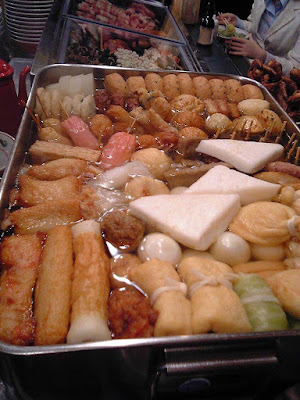
Various ingredients are simmered for a long time in a broth of dashi. Popular items are: slices of daikon (white radish), konnyaku (devil's tongue jelly), shelled boiled eggs, ganmodoki (type of deep-fried beancurd), yakidofu (grilled beancurd), fresh tofu, atsu-age, satsuma-age, chikuwa (fish paste rolls), kamaboko (fish paste), hanpen, cabbage rolls, potato, gobo rolls, tsukune, grilled pork, chicken, sausages, wakame (sea weed), etc.


[Oden stewing at an oden stall.]

Oden is eaten hot with a little stock in the bowl and a dab of karashi (Japanese mustard). It is a typical blue-collar yatai dish, but now also going more upscale.

The full name of oden is nikomi dengaku. In the Kansai it may also be called Kanto-daki, in Nagoya Kanto-ni. This points at the Kanto origin of the dish - it began as fish dumplings from Tokyo Bay eaten with miso. These dumplings were served on wooden skewers and became known as "dengaku" after an ancient dance where performers walked on stilts. "Dengaku" was later abbreviated to "den," which became oden with the honorific "o" in front.


[Portion of oden]

Although you can easily buy the ingredients separately and make an original combination, supermarkets also sell oden sets. Besides that, fresh oden is nowadays sold in most convenience stores in Japan in wintertime. Most street stalls selling the dish have disappeared, but there are still some specialist restaurants. Where fresh oden is sold, it sits simmering in large steel containers divided into compartments for the various ingredients. New ingredients can be added all the time. Besides that, it is normally served in izakaya during winter. It is excellent with sake!
Photos from Wikimedia Commons

Japanese Food Dictionary

27 december 2021

Surimi, fish paste

Processed fish paste product. すり身。

"Surimi" literally means "ground flesh." Surimi was developed in Japan many centuries ago (first documented in 1115; tsumire is even older) when it was discovered that washing minced fish meat, and then heating it, resulted in a natural gelling. Such "fish gel products" can then be mixed with other ingredients as starch or egg.


[Kanikama]

Neriseihin or nerimono is the general name for such "kneaded seafood." It has a smooth, somewhat resilient texture. Usually white fleshed fish such as cod or pollock is used of a type that easily gels. The minced fish is then mixed with starch, sugar, salt and egg white. In the 1960s frozen surimi was developed.

Products made from surimi are popular in the Japanese kitchen and take many forms.


[Tub of surimi]

Types:

  • Kamaboko, fish cake formed into distinctive loaves. First produced in Kanagawa prefecture.
  • Kanikama, imitation crabmeat sticks, also popular outside Japan. Wide variety of use, from futomaki sushi to salads.
  • Chikuwa, tube shaped, broiled fish cake
  • Satsuma-age, deep-fried fish cake from Kagoshima (in the past called Satsuma), small, flat disks with a distinctive, rich flavor
  • Tsumire, fish balls
  • Gobo-maki, surimi rolled around a piece of burdock and fried
  • Hanpen, soft and fluffy white fishcake, made by mixing pureed fish with grated yam. The mixture is whipped to create air bubbles and then placed in a mold and simmered.
  • Jako-ten. Tempura made with surimi and shaped as flat rectangles.
  • Ebi-dango, surimi from shrimp made into balls
  • Ika-dango, surimi from squid made into balls
  • Fish sausage or gyoniku sausage. Sausage made from surimi - tastes unexpectedly fishy!
All products - except the fish sausage - are used as ingredients in Japanese hot pot (nabemono) and oden.

Photos from Wikimedia Commons

Japanese Food Dictionary


Zoni, mochi in soup

Zoni, soup with rice cake (mochi). 雑煮。Also called o-zoni.

Traditionally served at New Year. Eaten in the morning after a toast with otoso, the spicy New year's sake.


[Zoni]


There are many regional variations. For example, in East Japan a clear soup (sumashijiru) flavored with dashi and soy sauce is favored, while in Western Japan the soup is made from white miso (shiromiso). And as the name "simmered miscellany" already indicates, a variety of ingredients can be added besides the mochi. These include fish, chicken, leafy vegetables, carrot, kamaboko, etc. But the rice cake is the determining part. The name "zoni" itself also indicates that miscellaneous items of food (such as mochi, vegetables and seafood) have been boiled together.

The preparation of the mochi for the dish also varies by region. In the Kanto and Tohoku regions, the mochi are cut into squares and grilled before being added to the stock. In the Kansai region and the Chugoku region, a round, boiled mochi is generally preferred.

Sadly, sometimes zoni is literally a "killing" dish. The half-molten rice cakes get extremely sticky and every year several persons - mostly elderly - choke on them. The advice is to use smaller mochi vy cutting them into pieces and to take small bites off them - take care not to suck them up together with the soup!
Illustrations from Wikimedia Commons

Japanese Food Dictionary


Cha, tea

For the Japanese, “tea” is the bitter green tea (ryoku-cha). Tea (cha or o-cha) in the form of the tea ceremony (cha-no-yu or chado) is the essence of Japanese aesthetics and it has influenced many other art forms, from architecture to ceramics, from ikebana to Japanese cuisine (in cha-kaiseki), from painting to landscape gardening.


[Camellia sinensis]

Tea plants (Camellia sinensis) are native to East Asia and probably originated in the borderlands of southwestern China and north Burma. Although tea may in fact be much older, the earliest record of tea drinking in China concern a Han dynasty emperor in the 2nd century BCE. Tea became a popular drink in the Tang (618–907) and Song (960–1279) Dynasties. The first tea was drunk in Japan as early as the 9th century, but it only became popular when it was reintroduced by Japanese Zen monks who had studied in China in the 12th century. For meditating monks, strong tea was an effective means of staying awake - tea has a stimulating effect in humans primarily due to its caffeine content. It was also initially also drunk for medicinal reasons.

These monks drank matcha, powdered green tea, the tea that is still used in the tea ceremony. Some powdered tea is put in the bowl, hot water is added and it is then whipped into a frothy whole with a bamboo whisk. Matcha is strong and bitter. Matcha powder is also used in the Japanese cuisine: for matcha ice creams, matcha–latte, matcha-shio (salt with matcha) and cha-soba (green soba noodles containing matcha). Matcha is enjoyed with the most refined traditional confectionery (higashi), often inspired by the season. These are eaten first before drinking the tea.

It took until the 16th century for tea made from leaves to become popular. Easier to prepare than matcha, this type of tea caught on quickly. As with matcha, it is always green tea: tea whose young leaves are first steam sterilized to prevent fermentation (oxidation) (this also preserves the original green color), then rolled to release the juices and enzymes and finally dried with warm air. Green tea is rich in vitamin C and contains antioxidants. Shizuoka Prefecture has the largest production of green tea (40% of total Japanese sencha production), but the oldest tea-producing region in Japan is Uji, near the former capital of Kyoto. It is thought that seeds sent by the Zen priest Eisai were planted in Uji, becoming the basis of the tea industry there. Today, Japan's most expensive premium teas are still grown in Uji.


[Sencha]

There are four different grades of green tea.

  • Matcha (“powdered green tea”). Like gyokuro, matcha leaves are shaded before plucking. The plucked and processed leaf is called tencha. These are then ground into a fine powder, matcha. Because tea powder is very perishable, matcha is usually sold in small quantities and is rather expensive. Matcha is the type of tea used in the tea ceremony. It is prepared by whisking the tea with hot water in a bowl, until the surface is frothy.

    • Gyokuro (“dewdrop”). The highest and most expensive quality green tea, for which tender, young leaves are used. These are grown in the shade for three weeks prior to plucking, protected by bamboo screens. The shading technique imparts a sweeter flavor, and produces a particularly rich color thanks to the higher amounts of chlorophyll in the shaded leaf. The leaves are carefully picked by hand. Gyokuro is light green in color. It may only be brewed with warm (50˚ C) water, preferably soft water with a low mineral content. Savored in small amounts – for guests and on special occasions rather than just personal use. Like sencha often served with wagashi, traditional confectionery to neutralize the bitterness of the tea.
Gyokuro is one of the most exclusive varieties of tea produced in Japan and is associated with the Uji region, the oldest tea-growing region in the country. It is often made using smaller-leaf cultivars of the tea plant.

    • Sencha (“pulled tea”). Also quality tea intended for guests or for special occasions. From young soft leaves brewed with water of 80˚ C. A sencha ceremony also developed in the Edo period, but it is little known compared to the tea ceremony using matcha, especially outside of Japan. Both gyokuro and sencha use a small teapot called kyusu. This is made of earthenware or porcelain and has a handle on the side. Sencha makes up 80% of all tea grown in Japan.

    • Bancha. Ordinary green tea, used at home with meals and sometimes drunk throughout the day. Also the tea that is served for free in restaurants. It is a coarse tea of ​​somewhat older leaves that still have twigs in them and which must be brewed with hot boiling water. It also has to be brewed longer than sencha. But there is nothing wrong with the flavor, which is somewhat bolder than sencha. Bancha leaves are plucked each season after sencha production is finished.


[Hojicha]

Besides these four basic grades, there  are also different types of Japanese green tea:

    • Shincha ("new tea"). The first harvest of tea, made from the youngest new growth leaves, plucked from early April to early May. Because of the limited quantities in which it is produced, shincha is highly prized.

    • Kukicha ("twig tea") has a mildly nutty flavor, unique due to its being composed of parts of the tea plant that are excluded from most other teas: it is made of the stems, stalks, and twigs of the plants with which sencha and gyokuro are made. When exclusively coming from gyokuro's production, it takes the name karigane. Kukicha is steeped in water between 70 and 80 °C.

   • Hojicha ("roasted tea"). Roasted coarse green tea. Sencha leaves are combined with kukicha twigs. Has a wonderful smell, a smoky taste and less caffeine than usual, so it is suitable for drinking late in the evening. A 20th century invention from Kyoto.

    • Genmaicha ("brown rice tea"). Coarse green tea to which with toasted puffs of rice (rice popcorn) have been added. Has a somewhat nutty taste.

With these last three types of coarse tea, a somewhat larger pot is used because more leaves are needed. Hot boiling water is always used.

By the way, English tea is called kocha (“black tea”) in Japan and is drunk with a Western breakfast or in coffee restaurants by people who don't like coffee.

Recently, oolong tea from China is also very popular because it neutralizes fatty foods. This is mainly drunk in cold form.

Cold tea in PET bottles and cans has really taken off in Japan. All kinds of flavors of green tea, of course without additives, oolong tea, pu-erh tea and also English tea are sold from vending machines as well as in the ubiquitous convenience stores. Both sell cold and warm cans and PET bottles. Tea in all forms is the largest category among all bottled and canned beverages sold in Japan. The consumption of green tea has grown enormously as a result of this modern way of selling. As green tea is trendy, a number of tea cafes have sprung up, and Starbucks Japan also sells lattes made with matcha instead of coffee.

Finally, it should be mentioned that "tea" (in a wider sense of the word) is also made from roasted barley, the popular mugicha that is drunk cold in the hot summer; from soba (sobacha) – especially served in soba restaurants; from konbu (kobu-cha), from shiitake and from yuzu... and so on.

Images from Wikimedia Commons

Japanese Food Dictionary


26 december 2021

Buta no Shogayaki, ginger pork sauté

Ginger pork sauté (buta no shogayaki), also called "pork shogayaki," consists of thin slices of lean pork (buta), browned in the pan, and then briefly braised with a sauce of grated ginger (*shoga), soy sauce and mirin.

[Buta no shogayaki]


The ginger helps remove the oil and any unpleasant smell. Shoga also improves the appetite. This pork dish is typical Japanese home cooking. It is usually accompanied by rice and miso soup. In the picture you see sauteed *moyashi, but shredded cabbage is also often used. This is the second most popular Japanese pork dish after *tonkatsu.

The recipe for shogayaki occurs already in the early Taisho period, but only became popular thanks to delivery menus of restaurants in the immediate postwar years because it can be prepared very quickly. After that, it was also added to catered lunch boxes and quickly became a menu for eating out as well as for home cooking.

Shogayaki is usually eaten hot, but can also be enjoyed cold as an addition to bento boxes.

Photo own work.

Japanese Food Dictionary


Chikuwa, tube-shaped fish cake

Chikuwa, tube-shaped, broiled fish cake. ちくわ、竹輪

Ingredients are surimi, salt, sugar, starch and egg white. After are made into a paste by mixing them well, then are wrapped around a bamboo or metal rod and steamed or broiled. Chikuwa, "bamboo ring," refers to the shape it has after slicing into smaller rings.


[Chikuwa]


Chikuwa is eaten as follows:
  • As a side dish during lunch or dinner
  • It is also often used as an ingredient for nimono like oden, chikuzenni, chirashizushi, yakisoba, and yasai-itame (vegetable stir fry). 
  • As a snack. In that case the hollow center may also be stuffed with cheese, cucumber or other ingredients. It is delicious with beer or sake!

Chikuwa is a cheap and low-fat source of protein.

Other well-known surimi-based products are kamaboko and satsuma-age.


Photo from Wikimedia Commons

Japanese Food Dictionary

Chawan-mushi, steamed savory custard

Chawan-mushi. Steamed, savory custard. 茶碗蒸し、ちゃわんむし

Literally, "steamed (mushi) in a tea bowl (chawan)." Usually served in special china cups with lids and eaten with a spoon. Normally served warm, in summer it has sometimes been cooled. Unlike many other custards, it is usually eaten as a dish in a meal, as it contains savory rather than sweet ingredients.


[Chawan-mushi]

The custard consists of an egg mixture flavored with soy sauce, dashi, and mirin, with numerous ingredients such as shiitake mushrooms, kamaboko, ginkgo nuts, thin slices of yuzu and mitsuba, and boiled shrimp, placed into a tea-cup-like container. Since egg custard cannot be picked up by chopsticks, it is one of the few Japanese dishes that is eaten with a small spoon.

Photo from Wikimedia Commons

Japanese Food Dictionary

24 december 2021

Oshizushi, "pressed sushi"

Oshizushi "pressed sushi," (押し寿司), also known as hako-zushi, "box sushi" (箱寿司).

In contrast to Edomae-zushi from Edo/Tokyo, oshizushi is Osaka's contribution to the sushi world. Sushi rice and seafood are pressed in a rectangular wooden box (oshibako) and then cut into slices. The chef lines the bottom of the mold with the toppings, covers them with sushi rice, and then presses the lid of the mold down to create a compact, rectilinear block. That block is next cut into bite-sized pieces. In oshizushi, all the ingredients are either cooked or cured and different from nigirizushi raw fish is never used.


[Selection of oshi-zushi}

Osaka is especially famous for battera (バッテラ), a pressed sushi of mackerel (saba). The name has been derived from the Portuguese word "batteira," boat. The vinegared mackerel is topped with a transparently this slice of konbu.


[Battera]

Not all oshizushi are from Osaka. Two other famous types are:

  • Kakinoha-zushi, from Nara and Wakayama prefectures. Sliced mackerel, sea bream or salmon is added to bite-sized vinegared rice, and then wrapped in persimmon leaves (kaki-no-ha) and pressed. The persimmon leaves are removed when eating. They are thought to have an antibacterial effect, and help preserve the sushi. To soften the leaves, they are pickled in salt.
  • Masuzushi, from Toyama. Bamboo leaves (sasa) are placed around the base of a round container, and covered with a layer of vinegared rice. On top of this are placed slices of trout (masu) that have been salt-pickled and seasoned. The sasa leaves are folded over the top and then a weight is placed on top to press the sushi into a firm cake.

[Kakinoha-zushi]

Photos own work.


Japanese Food Dictionary


23 december 2021

Bakagai, Surf clam, round clam

Bakagai, Surf clam バカガイ、馬鹿貝
(Mactra sinensis)
Alternative names in English: Japanese orange clam, hen clam, round clam

The Japanese bakagai is found all over Japan, living in sandy substrates in shallow marine habitats. Main production areas are the Bay of Tokyo, the Bay of Ise, the Inland Sea, the Ariake Sea and Hokkaido. It is the same size as the hamaguri clam (ark mussel) - 4 cm wide and about 9 cm long.


[Bakagai, Aoyagi]

The Japanese name "baka-gai" literally means "idiot clam" and has its origins in the fact that when this shell lets its orange-colored foot loosely hang out, it looks like an idiot with the tongue out of the mouth. This is not politically correct, which is why it is now called “aoyagi” (青柳, "green willow") after a place outside Tokyo where it is commonly found (and the orange tongue has the form of a willow leaf).

Bakagai is a classical topping of Edomae-zushi. When the round shell is opened, the intensely orange-colored leg (peduncle) is visible. This is lightly beaten with a knife and then parboiled. When after butterflying it is put on the sushi, care is taken to keep the foot intact and have it stick up in the air like the tail of a rooster.

The most prized part of the clam are however the adductor muscles (columella) which are called kobashira ("little pillars"). Large ones are called "oboshi" ("big stars") and smaller ones "koboshi" ("small stars"). They are usually served on gunkanmaki and are an expensive and rare delicacy.

Bakagai has been a favorite since the Edo period, and continues to appeal to sushi fans today thanks to its crunchy texture, sweet flavor and concentrated umami. The best season (shun) is winter and early spring. Besides being eaten on sushi, it is also prepared as sunomono or used as an ingredient in kakiage.

In the Edo period there was another use for bakagai as shown on the ukiyo-e below: they were used in Fukagawa-meshi instead of asari clams.


[Preparing bakagai at Fukagawa]

Illustrations from Wikimedia Commons


Japanese Food Dictionary


22 december 2021

Ayu, Sweetfish

Ayu, sweetfish あゆ、鮎
(Plecoglossus altivelis)

Popular freshwater fish. Both caught and farmed in mountain streams. Can grow up to 30 cm in length, but the usual size is about 15 cm.

The food of this herbivorous river fish consists of algae. They have a very long intestine for digestion.

The main methods for catching ayu are by means of fly fishing, by using a fish trap, and by fishing with a decoy which is known as "ayu-no-tomozuri" in Japan. The decoy is a living ayu placed on a hook, which swims when immersed into the water. It provokes the territorial behavior of other ayu, which assault the "intruder" and then get caught. Ayu is also fished commercially, and captive juveniles are raised in aquaculture before being released into rivers for sport fishing.

A very romantic way to catch ayu is with trained cormorants and flares at night. The fishermen work from shallow, wooden boats and each of them leads about a dozen cormorants on leashes which swim alongside the boat and dive under the water to catch ayu by swallowing them whole. The bird stores the fish in its crop, and delivers it later to the fisherman (the catch is prevented from being swallowed by a snare around the bird's neck). After that the catch goes via the grill straight into the mouths of the eaters. Cormorant fishing (ukai) is practiced on the Nagaragawa River, Gifu City (May 11 to October 15), on the Hozu River, Arashiyama-Kyoto (July 1 to September 23) and the Uji River, Uji (July to September). These events are popular with tourists from all over the world and special sightseeing courses are offered.

But these are rare, touristic events. Most ayu are caught by rod and line, or trapped as indicated in the above, by sport fishermen.


[Salt-grilled ayu]

The white flesh of ayu has a delicate, somewhat sweet flavor with "melon and cucumber aromas." It is consequently highly prized as a food fish.

Ayu is usually sprinkled with salt and grilled whole (shioyaki). The best season (shun) is summer and autumn. The late season fish, ochiayu, heavy with roe, is especially prized. Ayu are not cleaned, but eaten whole. A common method of preparing ayu in Japan is to skewer it in such a way that its body forms a wave, making it look as though it is swimming.


Photos from Wikimedia Commons

Japanese Food Dictionary


Buri, Yellowtail

Buri. Yellowtail, Japanese amberjack.  ぶり、鰤
(Seriola Quinqueradiata)

Large fish about 15 kilos in weight and reaching a length of 1.3 meters. It is a migrating, fast swimming, predatory fish, found in the north-western Pacific, and belonging to the family of the Carangidae. It is an important fish in the Japanese cuisine.
 

[Buri no terayaki]

Buri is extensively cultivated artificially (about 120,000 tonnes per year) in cages in the sea. In May, small wild fry (mojako), which can be found under floating seaweed, are caught for that purpose.

In Japan, buri is called "shusse-uo," literally a "fish that makes career," which is indicated by the different names by which it is called at different stages of growth. In other words, buri is not always called buri! On top of that, there are many regional differences in naming - I give here those from the Kanto and Kansai which are most common, but note that for example in the Hokuriku area again totally different names are used! The system is basically as follows:

Kanto (Eastern Japan): wakashi (less than 35 cm) → inada (35-60 cm) → warasa (60-80 cm) → buri (more than 80 cm)

Kansai (Western Japan): tsubasu (less than 40 cm) → hamachi (40-60 cm) → mejiro (60-80 cm) → buri (more than 80 cm)


[Buri-daikon]

To make things more complicated, "hamachi" is used in the Kanto area to designate cultivated buri.

The largest number of wild buri is caught in Shimane Prefecturre, followed by Tottori, Nagasaki, and Ishikawa. Cultivated buri mainly come from Kagoshima Prefecture, Ehime, Nagasaki and Oita.

Among the wild buri, the most delicious is the so-called "kan-buri," or "buri from the cold season." This fish has the highest fat content, as it puts on fat in winter before producing eggs in spring. This type of buri, caught in the wild, is a typical delicacy of the Hokuriku area such as Toyama. As also the Sinograph with which buri is written (alluding to "shiwase," the poetical name for the month of December) indicates, buri indeed is a typical winter fish, best from December to February. In Western Japan, the fact that its is a "career fish" gives it an auspicious quality, and therefore it is often used in the meal eaten at the New Year (osechi).


[Nigirizushi of hamachi]

The small fish called inada (hamachi in the Kansai) is in contrast to the full-grown buri a summer fish. The use in the Japanese cuisine is also different:

inada: sashimi, zuke (pickled in soy sauce), marinated.

buri: teriyaki (grilled with a glaze of soy sauce and mirin - see the photo above), shioyaki (grilled with salt), buri-daikon (a form of aradaki, the head and body with the bones still on it simmered in stock flavored with soy sauce, sake and mirin).


Photos from Wikimedia Commons

Japanese Food Dictionary


Bettarazuke, Daikon pickled in Koji

Daikon (radish) pickled in koji. べったら漬.

A type of tsukemono (pickled or preserved vegetables) popular in Tokyo. It can be rather sticky or "bettara" due to the amazake on the surface and that is how it got its name. The taste is crisp and sweet, and it has an alcoholic aroma.


[Betterazuke]

The main difference with takuan, another pickle made from daikon (with the nukazuke method) is that the radishes used for bettarazuke are not dried. Therefore the liquid content of the pickle may be as high as 80%. It does not keep very well and should be consumed soon after opening.

Bettarazuke stems from the Edo period, when at the Takarada Ebisu shrine in Nihonbashi Honcho a "Bettera Fair" (Bettera Ichi) was held on the night of October 19 - a custom which still continues.

Photo own work.

Japanese Food Dictionary

Awabi, Abalone

Awabi, Abalone あわび、鮑
(Haliotis discus discus).

Abalones are small to large-sized edible sea snails, marine gastropod molluscs. These slow-moving, konbu-eating sea snails are very expensive. They can reach a length of up to 20 cm.

Abalone shells are round or oval with a dome towards one end. The shell has perforations sitting in a row, through which water is drawn into the gill cavity and waste products are removed. The muscular foot has strong suction power permitting the abalone to hold on to rocky surfaces. The inside of the house usually shows iridescent mother-of-pearl colors, which are used to make jewelry or mother-in-pearl decorations.


[The raw meat of abalone]

The meat of abalone is since the Heian-period seen as a delicacy. It has a crunchy texture and is full of the aroma of the sea. It is eaten raw as sashimi or on sushi. In kaiseiki and kappo cuisines, one encounters awabi also served steamed, grilled, boiled, or simmered in soy sauce. While the chewiness of raw awabi is quite popular, steaming increases the umami of awabi, and sushi made with steamed awabi (mushi-awabi) is a type of Edomae-zushi that has an exceptional appeal in summer. The intestines (wata) eaten with ponzu sauce are also very flavorful. Awabi is best from summer to fall (shun).


[Ama diving for abalone, by Utamaro (1788-90) ]

In all, this is a real delicacy and a luxury item. In central Honshu (the Bay of Ise) awabi used to be harvested by female divers (ama) - it now still exists as a spectacle for tourists.


[Inside of an abalone]


Photos from Wikimedia Commons

Japanese Food Dictionary

Atsu-age, thick slices of deep-fried tofu

Atsu-age, あつあげ、厚揚げ.

Thick-sliced (2.5 cm) tofu broiled briefly in hot oil. The inside remains soft and white, while the outside is golden brown. Another name for this type of tofu is nama-age. Difference with abura-age: abura-age is thinner and fried through. Can be eaten as such in izakaya etc. with flavoring of soy sauce and ginger, used in oden, miso soup, etc. Pour hot water over the cake and lightly press in paper towels before using it to remove excess oil.


[Atsu-age]

Photo Wikimedia Commons

Japanese Food Dictionary

Asari, Short-necked clam

Asari, Short-necked clam あさり、浅蜊
(Tapes Philippinarum)

A bivalve mollusk that can reach 7.5 cm in length and 3.5 cm in width. This clam is native to the coasts of the Indian, Philippines and Pacific Oceans from Pakistan and India north to China, Japan, Korea and the Kuril Islands. It can be found in shallow waters in substrates of coarse sand, mud, and gravel. It lives in the littoral and sublittoral zones. It burrows no more than about 10 centimeters into the substrate. It sometimes lives in eelgrass beds.

The color can vary from yellowish white or tan to brown. The shell is often spotted.


[Asari in miso soup]

Only eaten in winter and early spring and never raw. Mainly added with shell and all to miso soup. Also (without shell) used in tsukudani, kakiage and zosui.

This clam is considered to be a sustainable aquaculture product.

Photo Wikimedia Commons

Japanese Food Dictionary


21 december 2021

Anko, Anglerfish

Anko, Anglerfish あんこう、鮟鱇
(Lophiomus setigerus).

Also called "angler," "monkfish" and "seadevil." Grows from 1 to 1.5 meter. One of the most fearsome and ugly fishes in existence. Called "anglerfish" because the first ray of its spinous dorsal sticks out of the head like a line and bait, a device for attracting prey to the wide mouth. Head extremely big, mouth filled with large and sharp teeth. As the body is very soft, anko is not cut on a cutting board, but while hanging down. Lives on sandy mud bottom. Feeds on other fishes, octopus and squid. Found from Hokkaido to Japan's southern prefectures. There are more than 200 species of anglerfish worldwide.

Here is a detailed description of this weird fish from the 1911 Encyclopædia Britannica at Wikisource:

"The wide mouth extends all round the anterior circumference of the head; and both jaws are armed with bands of long pointed teeth, which are inclined inwards, and can be depressed so as to offer no impediment to an object gliding towards the stomach, but to prevent its escape from the mouth.

The pectoral and ventral fins are so articulated as to perform the functions of feet, the fish being enabled to move, or rather to walk, on the bottom of the sea, where it generally hides itself in the sand or among sea-weed.

All round its head and also along the body the skin bears fringed appendages resembling short fronds of sea-weed, a structure which, combined with the extraordinary faculty of assimilating the color of the body to its surroundings, assists this fish greatly in concealing itself in places which it selects on account of the abundance of prey.

To render the organization of this creature perfect in relation to its wants, it is provided with three long filaments inserted along the middle of the head, which are, in fact, the detached and modified three first spines of the anterior dorsal fin. The filament most important in the economy of the angler is the first, which is the longest, terminates in a lappet, and is movable in every direction. The angler is believed to attract other fishes by means of its lure, and then to seize them with its enormous jaws. It is probable enough that smaller fishes are attracted in this way, but experiments have shown that the action of the jaws is automatic and depends on contact of the prey with the tentacle.

Its stomach is distensible in an extraordinary degree, and not rarely fishes have been taken out quite as large and heavy as their destroyer. It grows to a length of more than 5 ft.; specimens of 3 ft. are common.

The spawn of the angler is very remarkable. It consists of a thin sheet of transparent gelatinous material 2 or 3 ft. broad and 25 to 30 ft. in length. The eggs in this sheet are in a single layer, each in its own little cavity. The spawn is free in the sea. The larvae are free-swimming and have the pelvic fins elongated into filaments. "


[Anglerfish]

The anglerfish described above is only a female specimen. Males do not hunt on their own, but have turned into permanent parasitic mates of the female. When a young male anglerfish encounters a female, he latches onto her with his sharp teeth and gradually fuses his body with hers. He connects to her skin and bloodstream and looses his eyes and internal organs except the testes. Females may carry several males on their body.


[Ingredients for Anko-nabe]

Despite its hellish appearance, this fish tastes excellent! Anko is best in winter when it is often eaten as anko nabe (hotpot) after simmering in a sauce of soy and mirin (warishita). The liver (an-kimo) is especially sought after (it is one of the chinmi, special delicacies of Japan) and many people think it tastes even better than foie gras. The cities of Mito in Ibaraki and Iwaki in Fukushima are known for their anko cuisine.
Photos from  Wikimedia Commons

Japanese Food Dictionary

An, Red bean paste

An, anko, azukian, sweet paste mostly made from red beans 餡こ、餡子、小豆餡

A paste (mostly) made of red beans (also called "azuki beans"). The paste is prepared by boiling the beans, then mashing or grinding them, and kneading them into a paste. The paste can be sweetened with sugar or left as it is. The color of the paste is usually dark red, which comes from the husk of the beans. The skins of the beans can be removed by sieving, resulting in a smoother and more homogeneous paste.

Red bean paste is distinguished according to its consistency, sweetness, and color. The most common types are Koshian and Tsubuan. Here is a complete list::

  • Tsubuan (粒餡): Whole red beans are boiled with sugar but otherwise untreated
  • Tsubushian (潰し餡): The beans are mashed after boiling
  • Koshian (漉し餡): The beans are passed through a sieve to remove bean skins. This is the most common type
  • Sarashian (晒し餡): The beans are dried and reconstituted with water
  • Ogura-an (小倉餡): A mix of koshian and tsubuan.


[An]

Strictly speaking, the term an can refer to almost any sweet, edible, mashed paste, although without qualifiers red beans are assumed, while azukian refers specifically to the paste made with red beans. Other common forms of an include shiroan (白餡, "white bean paste"), made from white kidney beans, and kurian (栗餡), made from chestnuts (kuri).  Other ingredients can be potatoes, sweet potatoes and lily roots.

An is the basis of all kinds of fresh confectionery (namagashi) that go well with green tea. It is also used in a sweet hot soup with mochi rice cakes called shiruko or zenzai. Also popular are anpan, sandwiches with a filling of an.


[Yokan]

Here is a complete list:

  • Anmitsu, a dessert consisting of red bean paste, small cubes of agar jelly, and pieces of fruit served with syrup.
  • Anpan, a sweet bun filled with red bean paste.
  • Daifuku, a confection consisting of a small round rice cake stuffed with red bean paste.
  • Dorayaki, a confection consisting of two small pancake-like patties made from castella wrapped around a filling of red bean paste.
  • Manju, a steamed cake filled with red bean paste.
  • Oshiruko or Zenzai, adzuki bean soup, commonly served with rice cake.
  • Sakuramochi, a Japanese sweet consisting of sweet pink-colored rice cake (mochi) with a red bean paste (anko) center, and wrapped in a pickled cherry blossom (sakura) leaf.
  • Taiyaki, a fish-shaped cake stuffed with red bean paste.
  • Yokan, a thick jellied dessert made of red bean paste, agar, and sugar.


Photos from Wikimedia Commons

Japanese Food Dictionary