Posts tonen met het label Sake. Alle posts tonen

1 januari 2022

Toso, spiced sake for the New Year celebrations

Toso, o-toso 屠蘇

A spiced medicinal sake traditionally drunk during Japanese New Year celebrations to pray for a healthy and happy year and a long life without illness. It is a fixed part of New Year's osechi cuisine in Japan.

Toso is can be made by steeping a mixture of spices (tososan) in sake (or sake and mirin). Tososan is a medicinal herbal mixture of cinnamon, dried ginger, sansho (Japanese pepper), and the roots of several plants such as Chinese bell flower (kikyo). The ingredients may change somewhat depending on the provider.

The authentic way of producing toso is a lot more complex than just steeping the herbs in sake. First, koji, glutinous rice (mochigome) and mirin are added to shochu. After maturation, this mixture is blended with sake, and finally the tososan is added for steeping. Otoso has a sweet and mellow taste.

[Daishichi’s Shichifuku (“Seven Good Fortune”) Otoso]

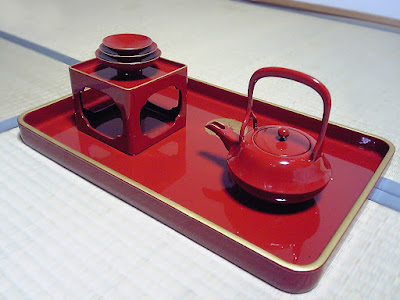
The tradition of drinking toso at the New Year began in the Tang Dynasty in China and was adopted by Japanese aristocrats during the Heian period. In the Edo-period this custom became common among the wider population and pharmacies would give out bags of tososan as year-end gifts. Toso is drunk from a special set of three lacquered vermilion flat sakazuki cups, which are used in order of size from small to large. The herbal sake is poured from a sort of tea pot which is equally made from vermilion lacquer.


[Sakazuki set]

Drinking otoso is said to ward off ailments like colds for the year and bring a long and healthy life. For generations it has been said that "if one person drinks this his family will not fall ill; if the whole family does no-one in the village will fall ill."

It is easy to make a simple kind of toso at home by buying tososan (packaged in a sort of teabag) and then steep that for about 7 hours in 300 ml of sake. Sake breweries also offer ready-made otoso, of which the above pictured "Shichifuku Otoso" by Daishichi is the most luxurious - this has been made the authentic way by producing all ingredients including the mirin and shochu in-house, and blending them with top-class sake, a process that including aging took several years. The tososan was obtained from the famous Shingon-Buddhist temple mountain Koyasan.


Photos own work / Wikimedia Commons

Japanese Food Dictionary

30 december 2021

Koji-kin, Aspergillus oryzae

Koji-kin, koji mold, Aspergillus oryzae こうじ、麹

A fungus (mold, kabi) used in East Asia to saccharify rice, sweet potato, and barley in the making of alcoholic beverages such as sake and shochu, rice vinegar and also to ferment soybeans for making soy sauce and miso. Because of its importance in Japanese food and beverage production, koji-kin has been called a "national fungus", and the Japanese kitchen a "koji kitchen." Note that while koji-kin refers to the spores of the fungus, the word "koji" is used for the rice, barley etc. after the koji has grown on it. The spores are also called "tane-koji," "seed koji."


[Aspergillus oryzae growing on rice]

Aspergillus oryzae is a type of mold that is native only to the warm and humid Southeast and East Asian regions. Koji is made by sprinkling tane koji over steamed rice and cultivating the fungus under temperature conditions suitable for its growth. As the fungus propagates, enzymes break down the grains' starch and proteins into sugars and amino acids. The enzymes produced are thus also responsible for the taste of the final product.

Different koji are employed for different fermented foods, such as sake, soy sauce, miso, vinegar, shochu, mirin, natto, and pickles.

Seed koji are distributed by seed koji dealers, centuries old family companies which possess the special skills for producing and storing seed koji. That knowledge has been kept strictly secret by each dealer, and consequently only a dozen or so dealers exist in all of Japan.

Making koji is the beginning of the brewing process. It takes place in a koji-mura, a separate room in the brewery, which is warm with high humidity. Koji for high-quality sake is always made by hand. For standard sake it can also be made by machine.

Note: koji is sometimes translated as "malted rice," but as the process of making koji is completely different from malting (which relies on germination), this is misleading.

Photos from Wikimedia Commons

Japanese Food Dictionary

21 december 2021

Amazake, sweet rice drink

Amazake (あまざけ、甘酒、醴) is not a type of sake, as is often wrongly thought, but rather a hot and sweet rice drink that contains no or very little alcohol. It is the perfect refreshment for a cold day. And nowadays there is even amazake for drinking cold in summer!

The saccharification agent koji (Aspergillus Oryzae, a fungus) is set to work on cooled, steamed rice. In less than 48 hours, it turns part of the starch in the rice grains into natural sugars. As the mixture incubates, sweetness develops naturally. To this, water is added.


[Amazake]


An even easier way to make amazake is to use the lees from the sake brewing process (sakekasu). These contain some small traces of alcohol. Usually sugar is also added.

Amazake is often drunk with a pinch of finely grated ginger. It is usually enjoyed piping hot. Amazake is quite healthy and nutritious.

Amazake is sold in winter at stalls, during temple and shrine festivals (often at New Year) and "ready to drink" in cups and cartons in supermarkets. 
Photo from Wikimedia Commons

Japanese Food Dictionary

27 juni 2017

The Omiwa Shrine and Sake

Mt Miwa, a beautiful conical mountain (467m / 1532ft) north of the city of Sakurai, at the eastern edge of the Yamato basin in Nara Prefecture, is an important sacred mountain, home to one of Japan's earliest Shinto shrines, called Omiwa or "Great Deity." The whole mountain is sacrosanct and entry is in principle forbidden even today.

[The Haiden of Omiwa Jinja]

An alternative name for Mt Miwa is Mimoro (Mimuro), which means "August Hall." Mt Miwa serves as the shintai (object of veneration, or "kami-body") of that shrine. On the western slope is Japan's most ancient road, known as the Yamanobe no Michi, which is already mentioned in the Manyoshu poetry collection of about 759. Several large burial mounds from the early Kofun period (2nd half 3rd c. - 4th c. CE) can be found around the mountain.

[The tip of Mt Miwa seen from Yamanobe no Michi]

The deity enshrined here is Omononushi (or Onamuchi), also identified with the Izumo kami Okuninushi, the leader of the earthly deities. In Kojiki (712) and Nihon shoki (720), the kami of Miwa emerges as the prototypical earthly deity, or as John Breen and Mark Teeuwen write in A New History of Shinto (p. 71): a violent force that the early Yamato kings struggled to control. In one story the Miwa kami transforms himself into a red arrow and impregnates a beautiful maiden while she is defecating in a ditch (before the advent of water closets riversides and ditches often served the purpose of natural toilets). The offspring resulting from this union with the arrow deity of Miwa became the wife of Jinmu, the mythical first emperor and fictional ancestor of the Yamato dynasty.

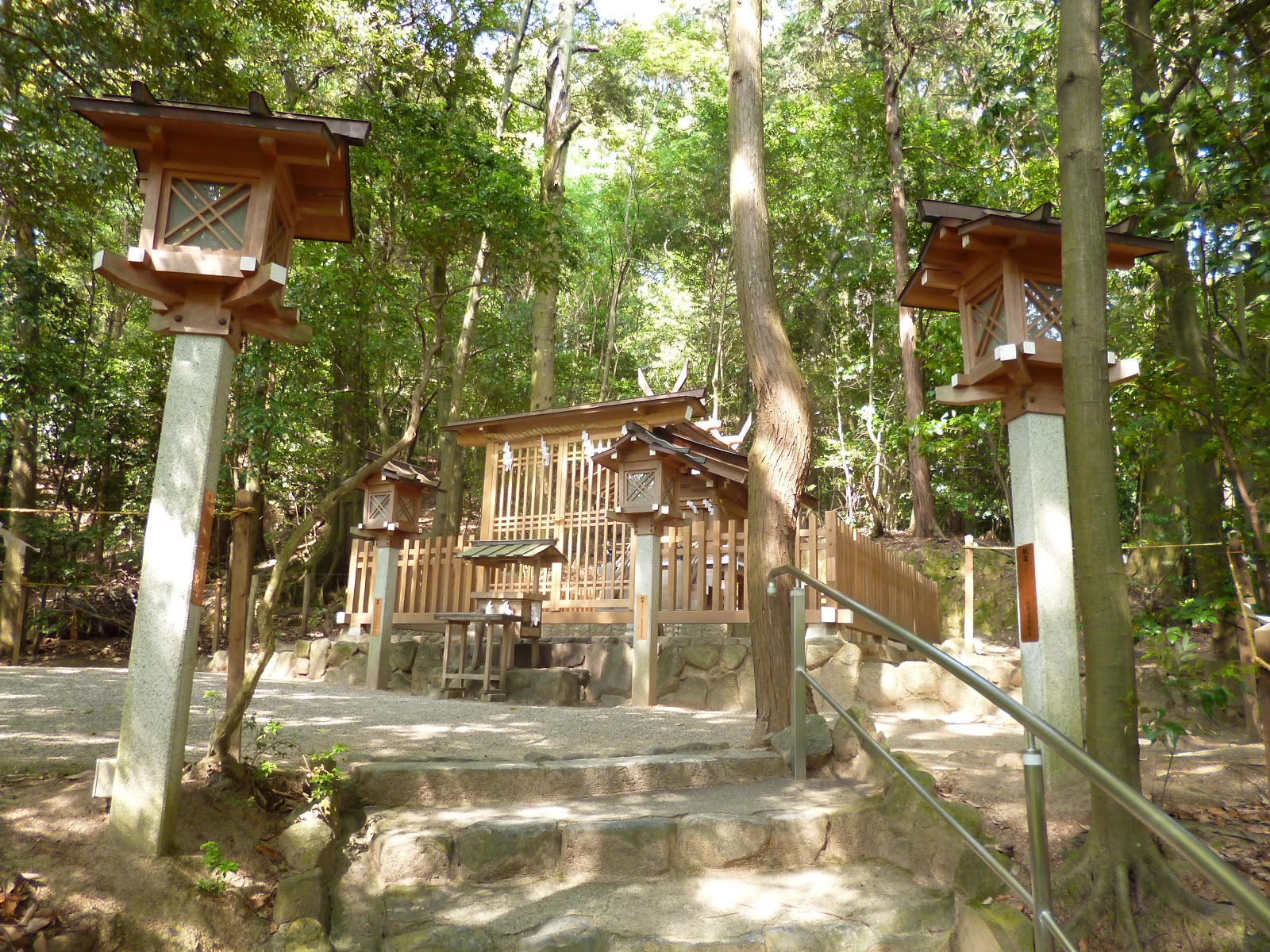
[The shrine stands in a quiet forest and is reached through an ancient type of torii: two posts between which a rope called shimenawa has been slung.]

In another tale, the land of Yamato was harassed by a dangerous epidemic and the kami of Miwa appeared in a dream to the then Emperor, the legendary Sujin. The deity declared that he was responsible for the disease and demanded that his spirit from then on be worshiped by a certain Otataneko. When this man was found and started venerating the Miwa kami, the disease was quelled. In fact, Otataneko was a mythical descendant of the Miwa kami, who - in another snake story - had entered the sleeping quarters of Otataneko's mother (Ikutamayori-hime) by way of the keyhole in the guise of snake.

And in one final story, Emperor Yuryaku dispatched one of his vassals of Korean background to seize the Miwa kami. The deity turned out to be a large snake, which cracked thunder at the emperor, forcing him to flee. So the kami of Miwa was a thunder (and rain) deity, who could appear in both human form and in the guise of a snake or arrow. Even today, the offerings at Miwa include not only sake but also raw eggs, because snakes are in Japanese folklore believed to love eggs.

[Ikuhi Jinja, dedicated to the mythical Takahashi Ikuhi,
the first ever Master Brewer (Toji) of Japan]

Otataneko was the ancestor of the priestly lineages of both Miwa, Kamo (the two Kamo shrines in Kyoto) and Hie (at the foot of Mt Hiei in Shiga). "In other words, they were part of an extensive network of intermarrying priestly lineages who controlled a category of earthly deities that threatened the heavenly rule of the Yamato kings with techniques that were at least in part of continental origin," is the conclusion of Breen/Teeuwen.

There existed already an important cult place at Mt Miwa in the Yayoi period (300 BCE - 250 CE); archaeological surveys have shown that offerings continued here until well into the 7th c. The 7th or 8th c. was probably the time that for the first time physical shrine buildings were set up, as happened around that time at many kami cult places in Japan inspired by Buddhist example. The Omiwa Shrine only has a Haiden (prayer hall) and no Shinden (main hall where the deity dwells), because Mt Miwa, right behind the shrine is regarded as the shintai of Omononushi. Behind the Haiden is a triple torii, this time (in contrast to torii in general) with gates (and a fence) which normally remain closed as the mountain is a so-called kinsokuchi or forbidden place. (There is one entrance at the nearby Sai Shrine where pilgrims identified as such and under strict conditions are allowed to follow a path to a rock formation at the summit of Mt Miwa). The present Haiden at Omiwa dates from 1664.

[Sacred cedars in the shrine grounds. Offerings include sake and eggs,
as a snake is said to live at the foot of the tree]

The above mentioned large keyhole-shaped burial mounds in the neighborhood of the mountain probably belong to the first "great kings" (okimi, the term tenno or emperor was only devised in the late 7th c.) of the Yamato lineage. They probably ruled in the second half of the third and in the fourth centuries CE and Sujin, as we saw credited with initiating the worship of Omononushi at Miwa, may have been the first of the line (his real name was Mimaki-iri-biko-inie no mikoto, "Sujin" is a Sinified name devised - as for all emperors - in the 8th c.; also note that the Nihon shoki adds a fabricated calendar pushing the reign back to the impossible dates of 97-30 BCE).

[Sai Jinja is dedicated to the healing aspect of the Miwa deity]

Like the Matsuo Shrine in Kyoto, Omiwa has deep connections with sake brewing: the brew was handed down to mankind by Omononushi, the deity of the shrine, and continues to be offered to him as a way of thanksgiving. In the Manyoshu, "umazake," "delicious sake," is employed as an epithet for the Omiwa Shrine, and the term "miwa" itself was used to designate sake in the past. The Omiwa Shrine holds an annual Sake Matsuri on November 14, when brewers come to pray for a successful brewing season. In contrast to Matsuo Taisha and the Umemiya Shrine in Kyoto, the link of Omiwa with sake is documented in written sources and it was also deeper than that of just a patron deity for the craft of brewing. Deity and sacred drink form a unity, the one is a manifestation of the other. One of the sub-shrines of Omiwa, Ikuhi Jinja, is dedicated to the mythical Takahashi Ikuhi, the first ever Master Brewer (Toji) of Japan. Several songs preserved in the Kojiki and Nihon shoki deny human agency but affirm divine responsibility (through the power of Omononushi, or alternatively, Sukunabikona) for successful sake brewing. The process of alcoholic fermentation must have been considered miraculous and sacred in antiquity. The song in the Nihon shoki occurs when Emperor Sujin has Otataneko worship Omononushi and for that event master brewer Ikuhi has to brew the sake. Ikuhi then sings the following song:

This sacred sake
Is not my sacred sake,
He who brought forth Yamato,
Omononushi,
He has brewed this sake,
Everlasting,
Everlasting.

[Sake brewery in Miwa - Imanishi Shuzo. The brand name is Mimurosugi, or "Cedar of Mimuro (Miwa)"]

Sake was seen as having regenerative powers, even healing ones. That is again connected to the Izumo myths in which Okuninushi figures a a creator deity, who creates the earth ("the land"). In this endeavor he is assisted by Sukunabikona, a dwarf or child deity who suddenly appears from over the sea. Sukunabikona is clearly a medicine god, who also is venerated in the Sukunabikona Shrine in the pharmaceutical quarter of Osaka. After his work is done, he again retreats to Tokoyo, the Land of Eternal Youth. In the grounds of the Sai Shrine (another sub-shrine) is a well with water to which medicinal properties are ascribed. There is here a clear link of sake with "the water of life."

Cedar twigs from the shrine forest of Omiwa are traditionally used to make sugidama (also called sakabayashi), globes of cedar twigs and needles hung under the eaves of sake breweries (and also the Haiden of the Omiwa Shrine) when the new brewing season starts. When the twigs turn brown, the new sake is ready for consumption.

[Otataneko Jinja (Wakamiya) - it is clear from the architecture that this hall was originally a Buddhist temple: the jinguji of Omiwa called Daigorinji]

The Omiwa Shrine was the most important cult place for the early Yamato court, but later it was superseded by the Ise Shrines. Also, when fixed capitals were set up in Nara (8th c.) and later Kyoto (from the end of the 8th c.) other powerful shrines came up in those areas and managed to get the attention of the court. A sort of apotheosis happened when in the early 9th c. the Hie Shrine in Sakamoto was sponsored (and brought under control) by Enryakuji, the Tendai temple complex on Mt Hiei; Omononushi, the kami of Miwa, was invited to this shrine, where he was paired with the mountain deity Oyamakui. Like all kami cult places, around that time also Omiwa was brought under the management of Buddhism and incorporated in a Buddhist worldview, where kami were seen as a sort of lesser avatars of Buddhas and Bodhisattvas. Several temples (jinguji) were built at Miwa, and remained in charge for about 1,000 years, until the end of the Edo-period.

The Meiji-government had a strict and entirely new policy of separating Buddhism from the kami cult (called euphemistically "clarification;" in fact, as Breen and Teeuwen stress, this was when "Shinto" was created [invented?] for the first time). The temples at Miwa were destroyed; one, Byodoji, was leveled completely, as it was a shugendo temple (the Meiji government particularly disliked the yamabushi priests); the other, Daigorinji, was turned into a sub-shrine (Otataneko Jinja) and here the Buddhist-style hall still survives. The main statue of Daigorinji was a magnificent Eleven-headed Kannon, which at the time of the separation in 1868-71, when countless Buddhist treasures were destroyed, was simply thrown into a ditch. There it was found by the priest of Shorinji, a small temple south of Sakurai, where it received a new home. The once discarded statue now even has the status of a National Treasure! (The main statue of Byodoji, a Fudo Myo-o, is now kept in a small temple near Hasedera).

Thanks to its ancient links with the imperial house, Omiwa Jinja was designated as a "state-funded great shrine" (kanpei taisha) from the Meiji-period until the end of WWII (meaning it was counted among the about 65 major shrines in Japan and its then colonies). Also today, the shrine stresses its link with the imperial family; a visit by the Showa Emperor unfortunately motivated it in 1986 to build a massive steel torii, which is an eyesore on the landscape. But the forested surroundings in which the shrine itself stands are beautiful and allow visitors to catch a whiff of the early kami cult and its strong connection to sake.

[Sources: Miwa - der heilige Trank, by Klaus Antoni (Stuttgart, 1988); Yamato/Kii Jiin Jinja Daijiten (Heibonsha, 1997); A New History of Shinto, by John Breen and Mark Teeuwen (Wiley-Blackwell, 2010); The Cambridge History of Japan, Volume I (Cambridge U.P., 1993); Kojiki, translated by Donald Philippi (University of Tokyo Press, 1968); Nihongi, translated by W.G. Aston (reprint Tuttle, 1985); Shinto Shrines, by Joseph Cali and John Dougill (Hawaii U.P., 2013)]

Sake by Region Index

7 december 2016

Kanzake - the season of warm sake

Years ago when I started making promotion for sake, the main "enemy" was the wrong image of the brew caused by the piping hot sake served in all too many restaurants, not only abroad, but also in Japan. For this hot sake, the cheapest kind of regular sake was used, the one with additions of sugar and flavorings, which after imbibing may cause a headache the next day - so a beverage not really successful in winning friends for sake. In Japan, I mostly used to meet this beverage at bonenkai (year end parties) when restaurants try to keep prices as low as possible and party goers drink as much as possible to steep the past year in forgetfulness... I have heard this stuff designated as "jet fuel" and that is a very apt evaluation!

[Sake warmer (yukanki) made from Shigaraki ware. Hot water is poured into the large pot, then the tokkuri is placed in it until the sake has the right temperature. In this way, you can warm your sake at the table!]

So in order to position quality sake as something radically different from this fuel-type sake, we mainly promoted sake as a beverage that had to be drunk cold, and that was right as we were often dealing with ginjo-type sake. Serving cool is after all the right way for (most) ginjos and daiginjos, nigori sake, shiboritate, sparkling sake, unpasteurized or half-pasteurized sake, and so on. But there is also sake which is delicious when drunk warm!

These are in the first place junmai sakes (junmai-shu); and also honjozo and regular sake (yes, there is also quite drinkable regular sake (although I prefer junmai-shu), as long as you check the label and stay away from those to which sugar and flavorings have been added!). And as a general rule, sakes made with the kimoto and yamahai methods are particularly suitable for drinking warm (sometimes even the ginjo's).

[Daishichi junmai kimoto "CLASSIC" is an excellent sake to drink warm]

But an important point here is: what is warm? As you can see from the fact that I on purpose use the more neutral term "warm" instead of "hot," many sakes - especially the better junmai sakes - should be drunk lukewarm, something between 40 and 45 degrees Celsius, so a comfortable temperature that lies just above body temperature. At this temperature sake gets a heart-warming roundness and friendliness. Sakes which cold or at room temperature may have seemed a bit "difficult" or "harsh," at this temperature open up and show a most amiable character.

So the term "hot sake" is not really very good and I propose we start using the more fitting Japanese term "kanzake." "Kan" 燗 itself already means "warmed sake" or "warming up sake;" "kan wo suru" means "to warm sake" and "kanzake" is the normal term for "warmed sake."

Another point is how to warm your sake. The best way by far is bain-marie: just put the tokkuri with the sake in a container with hot water (not boiling or on the fire) and use a kitchen thermometer to check the temperature of the sake inside.

Kanzake is also the time to use your tokkuri (earthenware or porcelain sake bottle) and choko (sake cups). These are very nice for kanzake, but not very suitable for cold sake (a ginjo or daiginjo should have more space to breath and develop its aroma, so here a glass like a wine glass is best; and I like to drink my junmai-shu when cold from earthenware or glass cups that are larger than the usual choko). Collecting such tokkuri and choko from different areas of Japan (which all have their own type of earthenware) is great fun, even more so when using them for your winter kanzake!

20 januari 2016

Matsuo Taisha, Kyoto's Sake Brewer's Shrine

Matsuo Taisha (also called Matsuonoo Taisha) is one of the oldest shrines of Kyoto. It now is in the first place the tutelary shrine of sake brewers, but that has not always been the case. It was established in 701 by the immigrant Hata clan. The shrine stands facing the Katsura River, with its back to a hill (Mt Matsuo) on which an iwakura can be found: a grouping of large sacred rocks. Such stones were believed to be places where the kami (deities) would take their abode. This was the original cult place and it is still intact; later, the shrine was built at the foot of the hill.

[Tsuridono Hall in front of the Main Hall,
from where prayers are offered]

The deities honored in Matsuo Taisha are Oyamakui no kami and his consort Nakatsushimahime no mikoto (a third deity, Tsukiyomi no mikoto, the kami of the moon and brother of the Sun Goddess, is housed in a separate shrine a short distance away). Oyamakui was a kami revered by immigrant clans such as the Hata. The Hata probably came to Japan from Korea in the 4th or 5th century. They settled in what is now the Kyoto area and are also connected with the Fushimi Inari Shrine and with Koryuji Temple. They were welcomed in Japan because they brought advanced technologies, such as sericulture, weaving and water control. In the mid-sixth c. the clan comprised more than 7,000 families.

[Kyokusui Garden, by Shigemori Mirei]

The Hata developed this area and later helped the court to establish the capital here in 794. Oyamakui has been called a mountain god, although that term may obscure his real identity: he is rather the deification of the pure and life-giving water that streams down from the mountain. That is evident from the Reiki no taki ("the Falls of the Holy Turtle"), a waterfall in the grounds behind the main hall, and also from the Kame no i ("Well of the Turtle"), a natural well also on the mountainside. The turtle is the messenger of the kami of Matsuo. After the foundation of Heiankyo, together with the kami of the Kamo Shrines, Matsuo-san was promoted to become one of the protectors of the capital.

[Shinyoko, with stacked sake barrels]

The link with sake is much more recent. It only comes from the Muromachi period (when sake brewing became an industry) and was connected again with water, in the form of the belief that sake of which the brewing water contained some water from the Turtle Well in the grounds of the shrine, would never turn sour (sourness due to hiochi bacteria was a big problem for early brewers). So Matsuo-san became a protector of the craft of sake brewing, something which is still his most important function today. Sake breweries often have a small Shinto altar (kamidana) dedicated to Matsuo-san in the brewery, near where the actual brewing takes place, and at certain important times such as the beginning of the brewing year, the brewers will worship there together. Every year new amulets from the shrine are received as well and brewers often visit the Matsuo Shrine for the Jo-u Festival in November, when prayers are said for successful brewing.

But the link of sake is not with the actual founding history of the shrine (the Hata brought several new technologies to Japan, but sake brewing was not among them) - this in contrast to the other major "sake shrine," the Miwa Shrine to the south of Nara (in Sakurai), which has a deeper connection with sake, in the sense that sake figures in its foundation legend, where it is presented as a gift to mankind from the gods.

[The torii gate. At the back the Romon gate.]

The Matsuo Shrine stands immediately next to Matsuo Station on the Hankyu Arashiyama Line (running between Katsura and Arashiyama), and the approach to the shrine is brief. The main hall dates from 1397 (with repairs in 1542). An "important cultural property," it has a roof of shingles from cypress bark and long overhanging eaves in the front and back (called ryonagare-zukuri). A stream, the Ichinoigawa ("First Well River") runs through the grounds and has beautiful Japanese rose bushes (yamabuki) from mid April to early May. Two of the wooden statues of male deities the shrine owns are now "national treasures," and one female deity has been declared an "important cultural property." These kami images date from the 9th c. and are among the earliest statues of Shinto gods. They are well worth seeing.

[Iwakura no niwa, garden with huge rocks like the iwakura
on top of Mt Matsuo, by Shigemori Mirei]

The shrine gardens have been beautifully laid out by one of the most famous 20th c. garden architects and garden historians of Japan, Shigemori Mirei (1896-1975). The first garden lies in front of the small shrine museum housing the kami statues and is called Kyokusui no niwa (Garden of the Winding Stream - in Heian japan such streams were used to float down sake cups and compose poetry) - it features the big upright rocks Shigemori Mirei became famous for, as well as his modern use of concrete; the second garden, Iwakura no niwa ("Garden of the Sacred Rocks"), lies next to the shrine museum and imitates the iwakura on top of Mt Matsuo, the original cult place of the shrine; the third garden (Horai no niwa or "Paradise Garden") lies to the right between the large torii and the Romon gate, behind a restaurant. It is a pond garden with standing stones, perhaps a bit less typical of Shigemori Mirei's work because of the large pond, but nonetheless beautiful; it was finished by the son of the garden architect, as Shigemori Mirei unfortunately died in the period he was working on this garden.

 
[The Turtle Well]

The three gardens plus the shrine museum, the waterfall Reiki no taki and the Turtle Well can all be seen together for a small fee. There is another fee to climb Mt Matsuo to view the iwakura. Thanks to its sake connection, the shrine also has a a small sake museum which in recent years has been nicely refurbished. There are old tools, cups and other implements, old labels and advertisements, etc. Entry here is free. It is to the left of the Romon, in the same building as a Mori tsukemono shop - interestingly, they have some pickles made with sakekasu (sake lees) which are only sold here.

The biggest festival of the shrine is the Shinkosai, which is held the first Sunday after April 20; it includes a mikoshi procession where one mikoshi will be boarded on a boat on the Katsura River (it will return three weeks later in a second festival called Kankosai). Other important festivals are Hatsumode (the first shrine visit at New Year), Setsubun on February 3 or 4, the Kerria (Japanese rose bush) Festival (April 10 to May 5), Oharae (Great Purification) on June 30, Ontasai (Rice Planting Festival) on the 3rd Sunday of July, Hassakusai (Harvest Festival) on the first Sunday of September, and the above-mentioned sake brewing prayers on the Jo-u day (old calendar) in November (thanksgiving for successful brewing is likewise held on the Chu-yu day in April).

Immediately next to Matsuo Station on the Hankyu Arashiyama Line. Or take bus 28 or 73 from Kyoto Station; bus 63 from Sanjo Keihan Station.
Read more about this and other Shinto shrines in: Shinto Shrines, A Guide to the Sacred Sites of Japan's Ancient Religion by Joseph Cali and John Dougill (University of Hawai'i Press).  
Japanese materials: Nihon no Kamigami, Jinja to Seichi edited by Tanikawa Kenichi (13 vols, Hyakusuisha). Shukan Jinja Kiko (50 vols, Gakken). Kyoto Yamashiro Jiin Jinja Daijiten (Heibonsha).

11 mei 2012

"The Book of Sake" by Philip Harper (Book review)

One of the best books on sake in English is Philip Harper's The Book of Sake: A Connoisseurs Guide. Beautifully edited by Kodansha, with lavish illustrations, this book contains all you have to know about sake and is a pleasure to read, also thanks to Harper's lively style. And that all in less than 100 pages.

Philip Harper is the only non-Japanese toji or master brewer, so he knows what he is speaking about. In a more than a 15-year career, he has worked for fine, small breweries as Ume no Yado in Nara, Daimon in Osaka, and now is active at Kinoshita Shuzo in the north of Kyoto Prefecture.

Harper has managed that impossible task, to write a book that is useful for novices and still interesting for those who are on their way to becoming connoisseurs. After all, in contrast to wine, where you can start drinking as long as you select red or white, dry or sweet, sake has a huge vocabulary of specialistic terms, which can be off-putting for novices.

Wisely, Harper does not start out with an avalanche of jargon but first suggests us to open a few bottles and start tasting. In Making the Most of Sake, he discusses the ideal temperature for drinking sake; which sake to combine with which food; describes the official sake tasting process; and gives information on "drinker's parafernalia", cups, bottles, flasks and other equipment.

We learn that certain types of sake can also be enjoyed "on the rocks;" and that drinking sake warm is no sin (as long as it is not a daiginjo) but that you never should overheat it - Harper discusses various ways to gently heat sake. The interesting thing about sake is, that it can be drunk at many different temperatures and changes character and taste accordingly. It is fun to discover the best temperature for your favorite sake.

Next Harper sings the praise of the combination of a Ginjo sake with your sashimi or sushi, while a full-bodied Junmai fits better with sukiyaki or yakitori.

As regards Western foods, a Kimoto or Yamahai with its yoghurty nuances is the perfect companion to a cheese plate, as well as Chinese foods cooked in oil. Harper provides a "taste chart" and suggest alternatives to the omnipresent thimble-sized sake cup, the o-choko, in the form of glasses and other, larger ceramic cups - especially Ginjo and Daiginjo sake needs room to breath in a wider glass.

In the second chapter, Sake for all Seasons: Types and Styles, we get a little bit more technical as Harper explains the differences between the delicious Junmai, Honjozo, Ginjo and Daiginjo, all premium or super-premium sakes.

He teaches us about Namazake (unpasteurized sake, a novelty of the last ten years or so), the traditional Kimoto method of making the yeast in a natural, but time-consuming and labor-intensive way; about Shiboritate or "Sake Nouveau;" and Koshu or Aged sake. He also gives some space to minor genres as sparkling sake (also a modern invention) and Taru-zake, the sake aged in a cask of fragrant cedar wood.

The going would be heavy if this were only a dry enumeration, but Harper "wets" his story by introducing the actual bottles and brands of the types he is discussing.

Chapter Three, On the Road: Breweries and Regions, informs us about regional styles and about brewer's guilds, but dedicates most of its space to introducing famous sake brands for each prefecture. As elsewhere in the book, the taste descriptions are the work of sake journalist and master-taster Haruo Matsuzaki.

In The Brewer's Craft, we are introduced to the mysterious process of sake brewing, from the raw materials of sake-rice and water, to the koji (the mold grown on steamed rice to change the starch of the rice grains into fermentable sugars), the yeast starter and the actual fermentation process (moromi; sake is characteristically brewn by the "multiple parallel fermentation" method, meaning that production of sugars by the koji enzymes takes place in the same vat and at the same time that the yeast converts those sugars into alcohol - this is also what makes brewing sake so difficult: the two elements must be perfectly balanced).

This is of course where Harper is talking about his own craft, which makes it particularly interesting. His explanation of the often difficult to understand brewing process is the most lucid I know. Harper is so much in his element that he runs out of space here and a very important discussion of yeast and yeast types had to be put at the inside backcover of the book - but this has been done very tastefully by the publisher, with silver letters on black paper.

Of course, not everything is covered in this book of only 100 pages, think for example about the history of sake - and I would have liked to hear more about Harper's personal experiences, but that is perhaps something for another book.

What Harper shows in this volume is that today sake is more delicious and variegated than ever in its long history. He also shows that brewing a good sake is a difficult craft, just like making washi paper, lacquerwork, ceramics, textiles, and all those other, great Japanese handmade crafts.

To brew a good handmade sake is not a process in a computer-controlled factory, but still the work of dedicated, even fanatical people who are obsessed with quality. It is good that "handcrafted" sake finally also is becoming popular on dining tables around the world.
The Book of Sake: A Connoisseurs Guide by Philip Harper and Haruo Matsuzaki, Kodansha International, 2006

Another book by Philip Harper is The Insider's Guide to Saké, a small pocket-sized book that contains much of the same practical information as The Book of Sake, but without the illustrations; in addition, it has lists of restaurants and shops both in Japan and the U.S.

Interesting article from the SWET Newsletter about Philip Harper and the process of editing The Book of Sake

24 januari 2012

Sake Files: The enjoyment of warm sake

There are so many types of sake today that should be drunk cold, that we almost end up thinking cold is the only way to drink sake. No: sake is a drink that can be enjoyed at a wide variety of temperatures, from 0 degrees Celsius ("ice sake") to 55 degrees. As such, it is probably unique in the world. Shaoxing wine from China is also delicious when warmed, but I do not know whether that can be drunk very cold. And there are some wines that can be had warm, but that are inferior types like Glühwein. The sake that is also delicious when warm, is high quality junmai sake.

What has made the image of warm sake bad, is the custom to drink cheap sake very hot. This not only happens abroad, but also in Japanese izakaya where piping hot sake ("tobikiri-kan") is served to hide the fact that it is rather tasteless stuff with lots of diluted brewing-alcohol added for volume plus sugar for taste. The result is a sort of jet fuel, of which the alcohol fumes blow in your face. Good sake should never be made really hot - just above body temperature, or lukewarm (40 degrees), is the best. In that case, it gives a very comforting feeling.

Where does the custom to drink sake warm come from? It has been recorded that when Emperor Saga (785-842) went out to hunt on a certain autumn day, the weather suddenly turned cold and the Minister of the Left, Fujiwara no Fuyutsugu (775-826), offered him warm sake. The Emperor was so delighted at this (according to the story) new way of drinking sake that he ordered that from then on in autumn and winter sake should be served warm in the palace. The idea may have come from China, where the custom to drink wine warm goes back to at least the Tang-period .

The best sake to drink warm is junmai, or a sturdy honjozo. Also Kimoto and Yamahai type sakes are delicious when warm. Perhaps not by coincidence, these are also the sakes that normally are better at room temperature than cold.


1 oktober 2008

The Day of Sake and the Sake Year

Today, October 1, is the "Day of Sake." On this day, the new sake year starts for breweries. Japan's premium sake makers, who follow tradition by only brewing in winter, wake up from their long summer slumber. The low temperatures in winter make that there are less harmful microbes around (after all, the fermentation tanks are open!) and they also make it possible to control the brewing process better. Brewing is all about temperature control.

In October the seasonal workers, including the top man, the toji or master brewer, return to the brewery and start cleaning the vats and all the implements. The new sake rice has by now been harvested and rice polishing can begin.

Every brewery has a Shinto altar dedicated to Matsuo-sama, the patron-deity of sake brewing, from the large Matsuo Taisha Shrine in western Kyoto. Here a prayer is said for safety and success in brewing before any real work starts.

[Koji spores being sprinkled on steamed rice at the Daishichi Sake Brewery]

The first job is to steam some rice, make a small batch of koji and then fill the yeast starter (shubo) with that koji, with more steamed rice, water and lactic acid (to create a suitably sour environment in which the yeast can grow without interference from other microbes). When two weeks later a very strong and pure yeast has been cultivated, the first fermentation tank is filled with the yeast starter, more steamed rice, koji and water. This is added in three stages in order not to smother the yeast starter in the large tank.

Usually first some non-premium sake, or the simpler honjozo, is brewed. The most difficult processes, for the ginjo sakes, usually have to wait until the coldest time of the sake year, January and February.

The first sake brewed in December, is ready in January. When that sake is pressed, many breweries hang up a sakabayashi, a ball made from cedar twigs. Traditionally, these balls are provided by the Miwa Shrine in Nara, another Shinto establishment deeply involved in sake matters. The balls used to come from the sacred woods of the shrine, but I doubt that still is the case.

For New Year, breweries sell specially bottled New Year sake, sometimes with a few gold flakes added to the brew. Nigori-sake, "cloudy" sake or sake that has not been finely sieved and therefore still contains some particles of rice, is also popular at this time.

[Yamaoroshi process for making the Kimoto yeast starter at the Daishichi Sake Brewery]

Many months of hard work continue (sake brewing also goes on during the New Year holidays) and then, finally, in March the last rice for the last batch of sake is steamed. This is celebrated in a short ceremony, koshiki-taoshi, where the steaming vat, the koshiki, is turned on its side to be cleaned. All brewery workers are releaved their hard task is almost over and a party is held. The next month, the last brewed sake is pasteurized and with the rest of the sake from this winter, stored as genshu in the storage tanks of the brewery to mature during the summer. This is the time the master brewer and the other seasonal workers leave the brewery.

Not all sake is pasteurized and today it is common to sell part of the genshu in spring as unpasteurized, un-matured sake. This sake is called "hatsushibori" (first pressing); you also come across the term "shinshu" (new sake"). This type of sake has a young brashness and freshness that makes up for the slight rawness of the taste. Unpasteurized, it is of course drunk cold and has to be handled with care.

During the next months, as spring turns into summer, more unpasteurized sake is sold as  "namazake", which means that it is indeed a bit "raw". Drunk cold, this is a popular and refreshing  summer drink.

July is the time for "hatsunomikiri," a day when the toji returns to taste the maturing sake and check on its progress. "Hatsu" means "first" and "nomikiri" means "opening the tap" at the bottom of each tank to do the tasting. Now such tastings are complimented by monthly chemical analysis of the contents of the tank, to check in detail on the state of the precious genshu.

Then autumn comes along and the properly matured sake is now once again pasteurized, bottled and finally sold. Again a small amount of the sake is not pasteurized for this second time, but sold directly from the maturing tanks as "hiya-oroshi," the sake sold when the weather gets colder so that a second pasteurization is not asolutely necessary. At least, that was the case in the Edo-period. The hiya-oroshi season is still in full swing when the sake year ends and a new year comes along. Compared to the Shiboritate sake mentioned above, Hiya-oroshi is milder and rounder, thanks to the maturing process, but still keeps a greater freshness because of skipping the second pasteurization. Kampai!

4 januari 2007

Drinking Your Way Through Japan - Cup Sake

Cup sake was introduced by Ozeki in 1964, as a convenient way to have a swig while watching the Tokyo Olympics (even today, sake is allowed in Japanese stadiums as fans here never get rowdy). The cup is a kind of sturdy glass, with a content of 180 ml., and covered with a metal cap. In the case of Ozeki, you also get a plastic cap on top of that - you can use the plastic cap to re-close the cup. Not that the contents are so huge you would want to keep them for the next day, but Ozeki probably had the kindness of providing this cap for train travelers. When the cup is still almost full, the sake will be shaken out of it, so the possibility to re-close it in between sips is very welcome indeed!

[The classical One Cup Ozeki stands in the middle. Gekkeikan's cup sake, also a large provider, is to the left. To the right is a new development, a Daiginjo.]

I made the acquaintance of sake via cup sake. There was a vending machine close to my first lodgings when I came to Japan in the early 1980s. The machine was wonderful: in summer it sold cold sake and in winter hot sake! In Holland, there were no vending machines selling either refrigerated or warmed products (I believe they still do not exist, although today people will cite environmental concerns for what is in principle a problem of both service and technical levels). I realized why the glass of cup sake was so thick: so that it would not break when falling down inside the vending machine on its way to the bottom where you could pick it up.

[The red one in the middle is a cup sake vending machine]

My local machine was also a gathering place for men from the neighborhood: they would come every afternoon at five and use the plastic crates stacked against the wall of the sake shop as stools. They would sit in a half circle around the sake machine and have a good time, without bothering others.

Of course, cup sake was not premium sake (but anyway, premium sake was still almost unheard of in the early eighties), but it tasted good all the same. When I was a student at Kyoto University and lived in a student home, I usually kept the glass cups of my One Cup Ozeki sake and recycled them as glasses for juice or cold tea. They were almost indestructible.

In the last ten years or so, cup sake has undergone an interesting transformation. In the first place, it has shared in he general quality improvement of sake. Even large makers as Ozeki now provide higher-priced cups with Honjozo or Junmai. Other makers are doing even better: Dewazakura from Yamagata and Maboroshi from Hiroshima are selling their ginjo sake in cups.

[Aluminum sake cans. Kikusui (Niigata), an unpasteurized, undiluted Honjozo, stands in the middle. A classical ginjo by Dewazakura from Yamagata is to the left. To the right is a ginjo by Seikyo (Hiroshima).]

A second thing is the use of steel or aluminum cans - the last two companies are examples. These are quite common now, but I prefer glass - it is more pleasant to drink from. Another development is that instead of cups we now also have mini-bottles, with about the same contents (180-200 ml.). They are no use when you are traveling, but they are a great way to taste many types of sake at home.

A third phenomenon, already going back further but still going strong, is the cup sake sold by makers of local sake (jizake). These cups with their colorful labels are usually only for sale in the areas where the breweries are located. So traveling around Japan and drinking as many different kinds of local cup sake has become a new sport (some people probably collect the cups or labels as well).

[Last but not least, also Daishichi makes an excellent cup sake - only available in Fukushima]

I found two Japanese guide books to cup sake, attesting to its popularity: The Cup Sake Best Selection 900 (yes, 900 different cups of sake from more than 500 breweries) and the even more interesting Local Cup Sake and Train Travel. To travel around Japan by train - buy a local bento at a small station - and a cup with the regional sake - that is indeed the best way to taste the regional sakes of Japan!